
By Wheeler Winston Dixon.
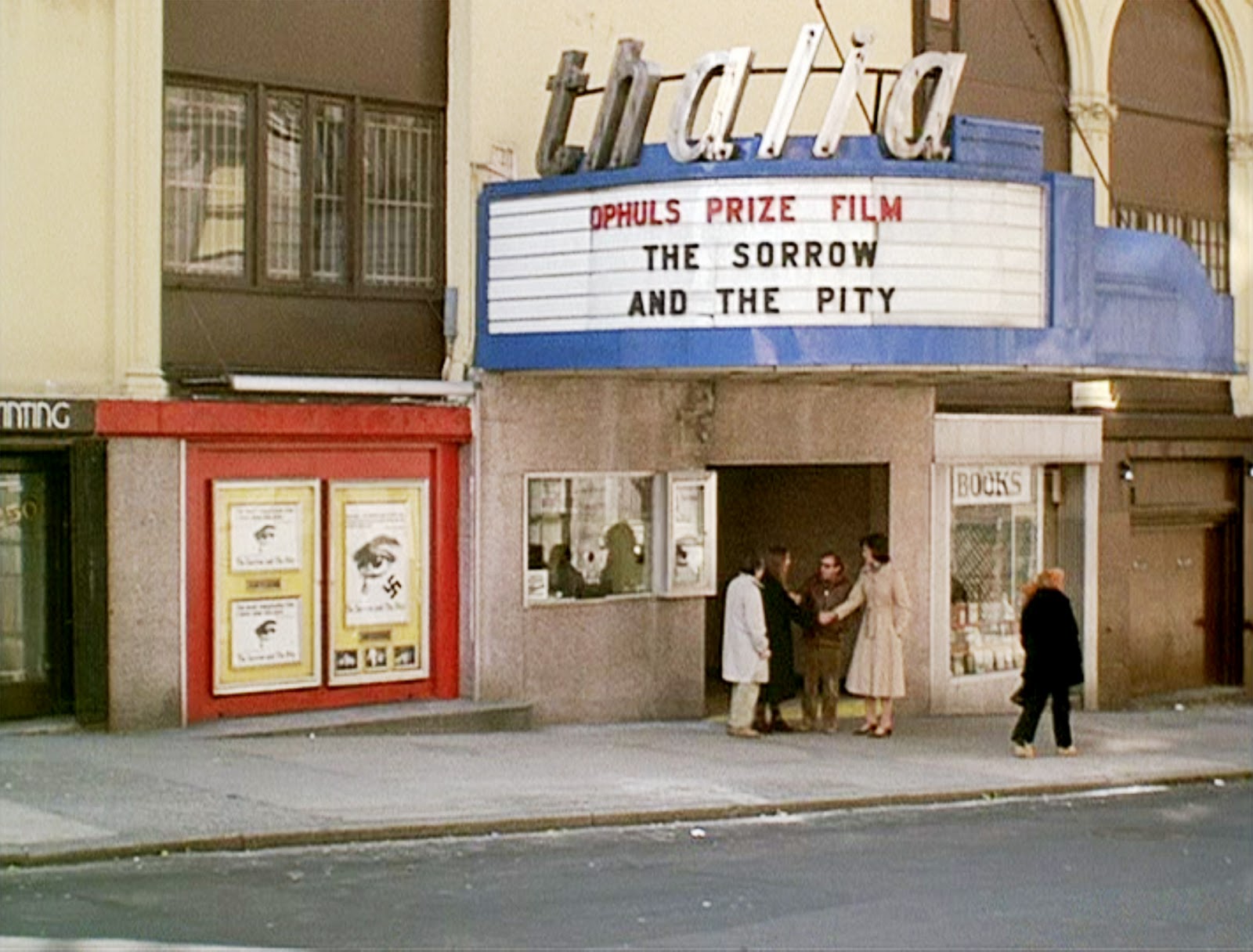
Does anyone remember The Thalia, located at 95th and Broadway, one of Manhattan’s greatest revival houses? I pretty much grew up there. It opened in 1931, and closed in the mid 1980s. The still above is from Woody Allen’s Annie Hall (1977); I’d use another still if it were available, but sadly this is the only one I could find on the web, other than a shot taken just before the theatre’s demise.
From the 1930s through the early 1980s, if you lived in New York City, The Thalia was the place to see foreign films, classic Hollywood films, all night marathons of noir films, the collected works of Tex Avery, Chuck Jones and others; wildly eclectic double and triple bills, projected by one of the best booth crews in the city. In what would prove to be the last days of 35mm projection, the Thalia ran their prints with dazzling brilliance, and the audience was both demanding and appreciative of their efforts.
Woe betide the Thalia projectionist who left the image just one point out of focus; within seconds, the entire house would erupt with fury, pounding on the projection room door, screaming “focus!” or “frame!” or “sound level!” all of which would be instantly corrected. The Thalia was a one-screen theater, of course, and it was kind of a funky place, with a dog that roamed the aisles and occasionally left “deposits” on the floor, much to the chagrin of patrons.
Located right next door to a great deli on the one hand (bring your own sandwiches, if you feel like it), and a secondhand bookstore on the other (you can see it in the image above), it was above all a place where people who loved movies, and were knowledgeable about them, congregated on a daily basis from noon to midnight, seven days a week, to see some of the greatest motion pictures ever made projected with immaculate perfection.
Indeed, one of my most indelible and cherished memories of the Thalia is attending a packed, marathon five-hour screening of Fritz Lang’s complete, two part Die Nibelungen Saga, Siegfried and Kriemhild’s Revenge, augmented by a live piano accompaniment by the gifted Steve Sterner, using long sections of Wagner as the main themes. It had the crowd on its feet ecstatically cheering as the film ended at the stroke of midnight.
I also remember fondly that in the early 1980s, the Thalia ran a year-long “Wednesday film noir” series of triple bills, with everything run in 35mm, of course, and always in the proper aspect ratio; this is where Gwendolyn Audrey Foster and I first saw Irving Pichel’s delirious noir They Won’t Believe Me, on a hot summer afternoon, as part of a triple bill of noirs – all for about $10 admission for all three. The whole thing was just too good to last.
Above all, I remember the intelligence and erudition of the audience, who knew film history and criticism through and through; the Thalia’s programming ran from high to low art, with every possible stop in-between, running a heady mixture of classics and pop filmmaking, but all of it was taken on its own terms by the audience, who were always enthusiastic about the Thalia’s diverse programming.
There was a resolutely communal dynamic to the Thalia’s audience, one we’re unlikely to see again. While it’s convenient to screen a film on your laptop, there’s something to be said for sitting in an auditorium with several hundred other viewers who absolutely understand what they’re seeing, know film history, and have a real devotion to film as an art form.
Often, discussions would break out spontaneously during intermissions, and spill out on to the street in front of the theater, and friendships and alliances were often formed; it also was an unusual audience in that many of the spectators were also filmmakers themselves.
There are a number of repertory movie houses still operating throughout the city, such as Film Forum, which holds dazzling screenings of classic films in their original 35mm format down in the Village – including a just launched retrospective showcasing the films of Barbara Stanwyck running through December 31st – along with Anthology Film Archives, to name just two of the many remaining venues, but there was something about the Thalia that set it apart.
It was sloppy, it was rundown, it barely managed to keep the doors open in its last years, but it was a shrine dedicated to the history of cinema on a living basis, screening anything and everything with ecstatic devotion. It was a place where films were screened to their best possible advantage by skilled technicians for audiences that deeply appreciated their efforts, resulting in a completely immersive experience that served as the backbone of more than one critic’s cinematic education.
Symphony Space now occupies the building that once housed The Thalia, and with the switch to digital DCPs, 35mm prints are just a memory. That’s why we should support the remaining screens that do exist, and continue to showcase the classics, both old and new. The grittiness of the Thalia was unique and egalitarian, and offered something valuable, vital and irreplaceable. Seeing a film on a huge screen with an enthused and informed audience is invaluable; there’s really nothing else like it. It’s really the only way to really experience a film, then or now.
Wheeler Winston Dixon is the James Ryan Professor of Film Studies, Coordinator of the Film Studies Program, Professor of English at the University of Nebraska, Lincoln, and, with Gwendolyn Audrey Foster, editor of the book series New Perspectives on World Cinema for Anthem Press, London.
‘ Este Articulo puede contener información publicada por terceros, algunos detalles de este articulo fueron extraídos de la siguiente fuente: filmint.nu ’