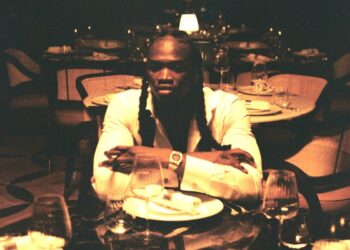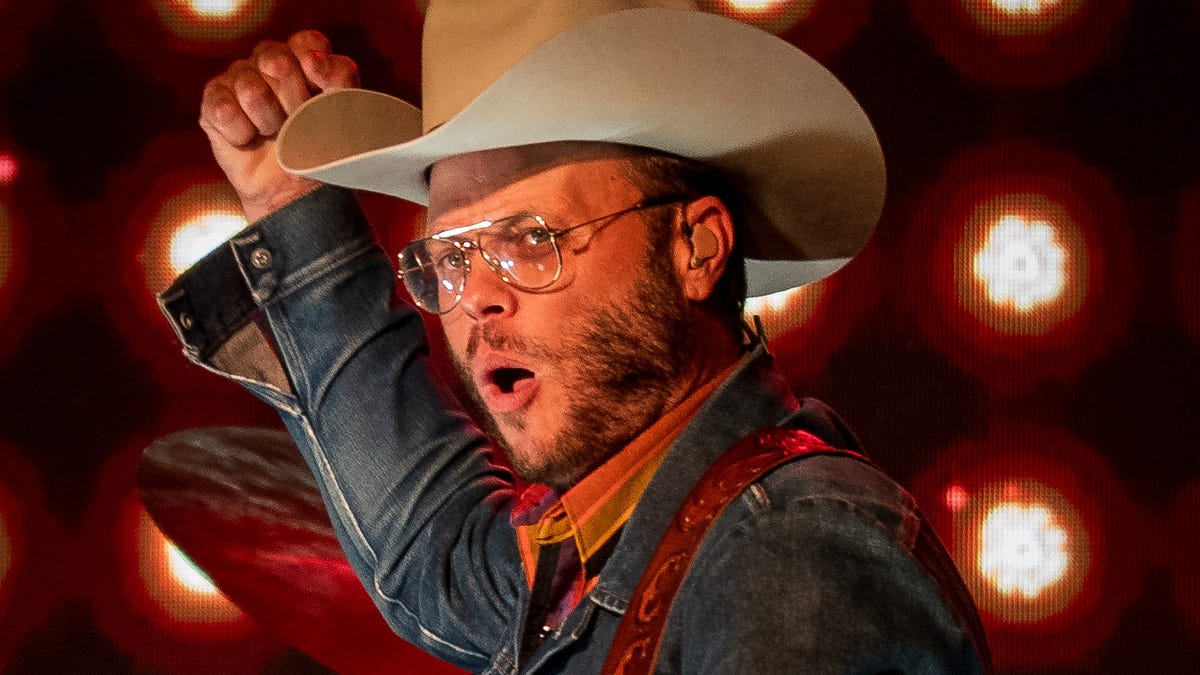
Charley Crockett celebrated the release of new country album ‘A Dollar A Day’ with a marathon two-hour set at the Nashville Palace.
Texasnative Charley Crockett played the equivalent of 30 songs in two hours at a capacity-filled main room at Music City’s Nashville Palace on Aug. 11.
As a world-touring street performer, Crockett once lived in a trailer behind the venue. After a marathon performance, he could easily say his growing legacy could have some ownership not just there, but in Nashville’s evolving future in general.
The event heralded much more than the Aug. 8 release of “A Dollar a Day,” his 16th studio album in 10 years.
The notoriously independent-minded country performer officially signed with Universal Music Group’s New York City-based Island Records in January. Ultimately, the move does not indicate that he has finally sold himself out to the highest bidder.
Instead, the thunderous ovation he received after two hours proved that the hype surrounding the 40-year-old former street busker, which Island had bought into, was not hype at all.
How has Charley Crockett, his band arrived at their latest album?
Over the past three years, Crockett and his backing band, the Blue Drifters, have finally shown the effects of playing roughly 1,000 barnstorming dates worldwide since the COVID-19 pandemic.
Time hasn’t worn down the group and its lead vocalist. Instead, more than ever it has made them confident, exploratory and honest. To keep themselves motivated, they’ve flipping on its head every musical tradition upon which they’ve built their careers.
Navigating blues, country, folk, jazz and soul as not obvious inspirations but rather as a series of musical fun house mirrors would seem difficult.
Album No. 16, however, features Crockett and company working in Los Angeles with second-generation musician and Grammy-winning producer Shooter Jennings. Waylon’s son has a history of helping brilliant artists navigate difficult moments when the air around them turns rarefied.
Performed live, “Lone Star,” a new album track that on Monday night was part of a three-song encore, arrived like ’70s-era countrified funk that could’ve doubled as a film soundtrack’s lead song, heralding Crockett as “Billy Jack,” “Super Fly,” or a combination of both.
Crockett sings: “Lone Star is a man / One not riding for the brand / Greenback dollar in his hand / Lone Star makes a stand.”
How honest has Charley Crockett’s lyricism grown?
Another song, “Tennessee Quick Cash,” is a bold anthem against the Nashville music machine. It compares accepting lucrative album advances and making creative sacrifices to succeed in country’s mainstream to, as he once did during his rise to stardom, receiving a payday loan.
He sings: “Now I know what you’re about to say / About their predatory ways / But brother, at least they let you know it right up front / ‘Cause if you take that ride downtown / Where them rounders hang around / You’ll find anything in the world but a fair deal.”
It pairs well with “Easy Money,” another autobiographical song that speaks of exotic-dancing friends “taking easy money off good-time men,” or of himself eventually arriving in New York City as a desperate, street-hustling, drug-dealing guitarist.
As he did for recent single “Killers of the Flower Moon,” he has also found a way to weave his western heritage into history’s most infamous annals. “Santa Fe Ring” from “A Dollar a Day” analogizes his career’s intersection with the music industry to Mexicans dispossessed of their land by corrupt, powerful and wealthy attorneys and politicians in post–Civil War New Mexico.
“Country music is learning how to stand up for yourself,” Crockett said to the Nashville Palace crowd.
He didn’t bellow it from the stage. Instead, it was offered almost as the most well-worn and hard-learned of cautionary tales. He was offering it as much as a reminder to himself as an attempt to elicit another ovation from the crowd.
What inspires Charley Crockett’s artistry moving forward?
Crockett’s music has evolved from feeling like the soundtrack to a spaghetti western. Now, he’s casting the widest sonic net possible to harness musically wayward souls disinterested in the commercial industry’s offerings.
At present, that’s music that, to make a broader corollary, is still a “gumbo” of unique styles. However, the countrified blues rock and jazz infused soul that Shooter Jennings has unearthed is the unmistakably acquired, yet delicious taste of the grease of pig knuckles now simmering in the mix.
Sometimes that feels like Cream-era Eric Clapton’s sound; other times, it’s something akin to when Eric Burdon and the Animals evolved into a psychedelic blues band at the onset of the Summer of Love. Deeper still, it’s like being tuned to an urban FM radio station able to seamlessly play Jimi Hendrix next to B.B. King and Bill Withers in the early 1970s.
Then, the band can still comfortably slide into 20 minutes of pure, unadulterated Texas dance hall sounds, including “Ain’t That Right,” “Paint It Blue” and “Life of a Country Singer.” Then, to keep themselves on their toes, classic material like “$10 Cowboy” was re-imagined with the Band’s Bob Dylan-esque folk tinges, while “Trinity River” featured bossa nova-inspired, second-line New Orleans jazz.
The event ended, notably, with a delirious crowd singing and two-stepping along to his cover of Tanya Tucker’s “Jamestown Ferry.”
Crockett is right: “There’s no such thing as earning easy money.”
‘ The preceding article may include information circulated by third parties ’
‘ Some details of this article were extracted from the following source www.tennessean.com ’