Troy Sawyer comes from a long line of musical talent.
A trumpet player, composer and producer, Sawyer’s great-grandfather, Louis D. James, played with cornetist Buddy Bolden. And you’ve probably heard of his cousin, six-time Grammy-winning singer-songwriter Leon Bridges.
Growing up uptown, Sawyer began playing music at an early age, picking up the violin in pre-K before switching to the trumpet in fourth grade. He played in school bands, including St. Augustine High School’s Marching 100, before going on to form his own band The Elementz.
Suffice it to say, like so many New Orleans-born musicians, music is both in his blood and in the community he grew up in. Carrying on that tradition was as important to Sawyer as playing was.
So much so, in fact, that in 2010 Sawyer decided to become a teacher through a fellowship with Artist Corps New Orleans, which was helping train and pay to put professional musicians in local classrooms. He hoped it would put him in a position to help bring up the next generation of New Orleans musicians.
It was a time of immense change in the city. The traditional neighborhood public school system that had helped foster generations of musicians had been dismantled in the wake of Hurricane Katrina. In its place, a near complete charter school system was being implemented.
Ostensibly designed to fix a school system that was already performing poorly well before the storm, the switch to charter schools meant students were choosing from schools across the city rather than attending their neighborhood schools. That lengthened travel times for kids and took them out of the communities that helped grow their musical interests for much of the day.
And their focus on test scores and meeting performance standards often meant music education became an afterthought and, in some cases, entirely expendable.
For Sawyer, that’s meant more than a decade of short-term gigs, broken promises and bouncing from school to school.
His 2010 fellowship at the New Orleans College Prep Charter School, which he’d hoped would become permanent, abruptly ended when administrators told him, “Oh, we’re focusing on drama. We’re not going to do music,” Sawyer says.
Undeterred, Sawyer found a new job, this time at Benjamin Mays Prep. But that school closed a year later due to poor academic performance. Next, he went to Arise Academy, only to get more bad news at the end of the year.
“They decided to get rid of music and P.E. How do you do that?” he says.
As it turns out, it happens regularly.
The issue isn’t unique to New Orleans or charter schools in general, but they do face closure if their students don’t score high enough on tests. Many also are operating on tight budgets that will likely only get tighter as officials brace for declining local tax revenues, the end of pandemic relief funds, and federal cuts.
“This isn’t just a problem of New Orleans music education. It’s a nationwide problem that we see,” says Ashley Shabankareh, director of operations and programs for the Trombone Shorty Foundation. “The switch to the charter system definitely exacerbated these issues, but it is a national trend that often art-based programming tends to be cut first.”
Trumpeter Troy Sawyer, right, clasps hands with students and trumpeter Sean Vappie, left, and trombonist Ashley Shabankareh.
Advocating for music in the birthplace of jazz
Musicians and educators, both inside and outside the school system, have been fighting to improve music education in a city known worldwide for its music. But it’s often an uphill battle in an underfunded school system.
Sawyer’s story shows the difficulty of trying to teach music in New Orleans in a nearly all charter school system that almost by design emphasizes standardized testing over the arts.
After his experience at Arise, Sawyer decided to take a few years off and teach part-time. Then in 2017 he returned to the classroom full-time as the music teacher at KIPP Central City Primary in 2017. However, a few years later, he was met with more disappointment.
Once the pandemic hit, he said the principal asked him to be a co-teacher with a science teacher instead of teaching music. He pushed back, and ultimately, he says the principal told him the school would be going in “a different direction with the music program.”
The next school year, Sawyer took a position at Lafayette Academy, needing to support his family while live performances were cancelled. Before he even started, the school was considering getting rid of his position, he says.
“Once again, gotta advocate for my position, advocate for music in this city called the birthplace of jazz,” he says. “This is crazy.”
Sawyer signed on to come back for a third school year. But on the last day of school, he says the administration told him they didn’t have enough money in their budget to pay for a full-time music teacher anymore.
The day after Lafayette Academy told Sawyer they were cutting his position, his fledging nonprofit Girls Play Trumpets Too held its debut performance. Since then, he’s left the school system and focused on growing the program, which has since impacted more than 100 girls in New Orleans.
“A lot of these educators that are qualified, that want to give back and give quality instruction, are burnt out, and they leave the profession,” Sawyer says. “And I’m one of them.”

Assistant Director Seinas Edwards leads the Landry Walker High School choir in 2016.
‘Incremental growth’ since the storm
In the years before Hurricane Katrina, the state had been gearing up to take over low-performing schools and either directly run them or turn them into charter schools, creating a “Recovery School District.”
The storm and the federal levee failures damaged 110 school buildings or 87% of operating schools in New Orleans, according to The Data Center. For many, that meant losing band instruments and uniforms in the floodwaters.
Although some schools who fared better were able to reopen in early 2006, most couldn’t open their doors again until the following school year or after.
While schools were closed, the state legislature fired all 7,500 public school employees in the city. “Thousands, including veteran band directors, were never rehired,” according to A Closer Walk NOLA, which tracks musical history in the city. Ever since, there have been fewer Black teachers and New Orleans-born teachers in the city and more outside recruits.
The state and other decision-makers also replaced the local school district with a charter school system, run by independent charter networks.
“You used to have a public system that reached kids everywhere,” says Jordan Hirsch, a New Orleans music historian. “That system is fractured into these charter operators.”
With the storm decimating schools, music education took time to rebuild, even with donations for instruments pouring in from groups all over the country.
In 2008, less than 20% of elementary schools in the city were offering music programming, according to Artist Corps Co-director and Managing Director Sonya Robinson, a statistic she says was “scary” to the community.
That spurred the creation of Artist Corps and other nonprofits. Since then, Robinson says there’s been gradual improvement in the state of New Orleans music education.
“I think there’s been incremental growth in all areas of music education since we started in the field in 2008, but it was so limited in 2008, it had nowhere to go but up,” she says.
In 2018, the school system became “reunified,” meaning schools are now under the oversight of the Orleans Parish School Board. By 2019, all schools in the district were charters, making New Orleans the first district to have an all-charter system until last school year, when the Leah Chase School opened as a traditional public school directly run by the school board.
Since reunifying, more schools have added music education during the school day, including part-time music educators and those from nonprofits, according to Robinson.
“There was more intention to add music back in,” she says.

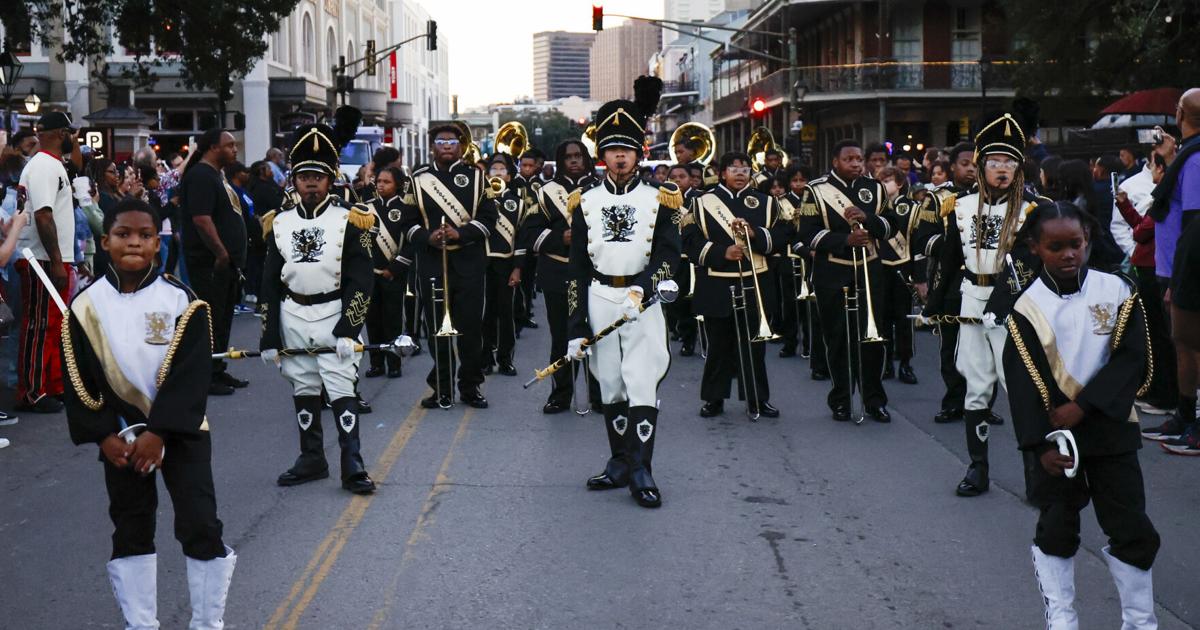
The Edna Karr band performs at a football game in November 2024.
Numbers hard to come by
Anecdotally, people will reminisce about a golden time before the storm where school bands were giant and thriving. But “it isn’t just a pre- and post-Katrina situation,” Robinson says.
A district staffing formula meant that almost every school had music programs, including vocal music and general music, as well as both a band and choir director, one longtime music educator says. There was also a citywide strings program and jazz outreach.
But in the mid-’90s, there were budget cuts, which impacted arts and music programs the most. Many educators left the city in search of teaching the arts in cities where there were more resources and stability.
“We never recovered from that because that message sent was sent out loud and clear,” the same longtime music educator says.
It’s hard to get exact data comparing the state of New Orleans’ music education before and after the storm, including what percent of schools in the city have a full-time music teacher.
Schools are not required to report data about their music education programs to NOLA Public Schools, meaning it’s up to the individual charter networks to keep track on their own accord.
At the request of a school board member, Artist Corps began gathering data on school music programs in 2018 in order to help schools secure a major grant from the Save the Music Foundation and other nonprofits. The information they collect is based on their relationships with the schools, who are voluntarily sharing it with them.
Artist Corps found in 2018 that of the 65% of New Orleans public schools that responded to their survey, 83% reported not having the instruments they needed for their music programs. Less than one in five reported having instruments in “good condition.”
In the last seven years, the situation has improved, with grants helping bring millions of dollars’ worth of instruments to New Orleans schools.
Artist Corps is currently analyzing new data based on reports from 83 of 93 schools, scheduled for a full release in October.
Of the K-8 schools that reported information to Artist Corps, 55% said they had general music programs, 57% said they had marching or brass bands and 21% said they had concert bands during the 2024-2025 school year.
Nearly a third of schools also reported having vocal music or choir programs, and 13 schools had strings or orchestra programs.

First day of school at KIPP Booker T. Washington High School in 2017
Tests, tests and more tests
The move to an almost entirely charter system after Katrina was, and remains, controversial. Metrics show higher performing schools since the change, but many criticize the focus on standardized testing, which doesn’t encourage schools to put money and resources into the arts.
That’s in part because of two significant pressures. First, if charter students don’t score high enough, the schools are at risk of shutting down. And secondly, the schools are trying to make money for their charter management organizations, including in some cases to cover $175,000-$350,000 in compensation for their CEOs.
“It can’t lose money like a school district or break even,” says Matt Sakakeeny, associate professor of music at Tulane University and a volunteer with Roots of Music. “It’s an enterprise of capitalism.”
The ’90s budget cuts and aftermath coincided with a huge national shift in education toward standardized testing. Sakakeeny says it started with President George H. W. Bush’s Points of Light Foundation in 1990 promoting private sector solutions to social issues and culminated with President George W. Bush’s No Child Left Behind Act.
On the state level, that started with the LEAP test, which Louisiana began requiring as an exit exam for 10th and 11th graders in 1991. In 2006, the state created the iLEAP test for third, fifth, seventh and ninth graders in response to No Child Left Behind.
“The country moved toward standardized testing as the kind of end-all, be-all of education,” Sakakeeny says. “It doesn’t seem like it would affect arts education, but it really did.”
Testing has only ramped up since. Locally, that testing pressure could continue to heighten with sweeping new changes to how Louisiana schools are rated. That’s especially true for high schools, where the bulk of a school’s rating will depend on test scores, up from 25% to 75%.
Many school superintendents have been critical of the changes, worrying they won’t prepare children for the world outside of school.
Sawyer says teaching for the test is not what’s best for kids long-term.
“If you’re just going off of this ‘OK, I need to focus on math and focus on this test,’ and you’re teaching the test, the kids will basically be robots,” he says. “They will not have those different skills to survive in this world because you’re teaching them the test and you’re not pouring into their souls, into the individual and bringing everybody together.”

Students step onto the school bus in New Orleans.
Loss of neighborhood schools
Historically, New Orleans has had a strong neighborhood culture, and neighborhood schools were a big part of that.
Hirsch says the typical origin story for a New Orleans musician pre-Katrina would start with hearing a bass drum outside of their house, having a family member who was a Black Masking Indian or singing in the church choir.
And places like the Booker T. Washington High School Auditorium were not just for school shows but also a concert venue where Black touring artists could perform during Jim Crow.
“There was an immediacy and accessibility to live music that was sort of baked into New Orleans neighborhood life, and schools were integral to that,” Hirsch says.
For a glimpse of this phenomenon, look no further than the familiar New Orleans introductory question: “Where’d you go to high school?”
As a veteran teacher puts it, “That tells you what neighborhood you grew up in, that tells you who you run with, that tells them how you cook your red beans slightly different than the neighborhood next to you, and that tells you what band you played in.”
But following the storm, Hirsch says there was a mass displacement of Black residents from their neighborhoods, accelerated by the demolition of public housing and rising housing costs. Some left New Orleans completely: According to the Data Center, there were nearly 120,000 fewer Black residents in the city from 2000 to 2023. Meanwhile, others ended up scattered across the city.
Lots of Black New Orleanians who lived in “neighborhoods that used to be kind of musical meccas, like the Treme, the Lower 9th Ward, 7th Ward, these mostly downtown Black neighborhoods” have “been pushed into neighborhoods that just aren’t set up for that kind of musical community life,” Hirsch says.
And with the charter system, students are no longer going to schools in their neighborhoods and instead being bussed across the city. That’s meant New Orleans schools are spending millions of dollars more on transportation annually. Tulane’s Cowen Institute found that in 2019-2020 New Orleans schools spent an average of $901 per student on transportation, while the state average was $718.
According to a report by the Education Research Alliance, the average distance between a student’s home and school increased by two miles after Katrina. A 2018 study found that students were spending an average of 35 minutes on their bus ride each way, with a quarter of rides lasting 50 minutes or more.
“Once you have kids that are moving out of their neighborhood, going to other schools, you’re de-investing in that particular neighborhood, and that neighborhood is going down,” Sawyer says. “Now you have these schools, they’re abandoned, they’re closed.”

Ashley Shabankareh
Shabankareh says though this phenomenon is harder to measure, they’ve noticed that a surprising number of kids at the Trombone Shorty Foundation’s after-school brass band programs haven’t been to a second line or even a concert.
“When you ask young people like ‘How many of you have been to a second line?’ you maybe get like a fourth of the students that say yes,” she says. “Very few students have actually been to see a concert.”
Hirsch says the displacement of Black residents can help explain this.
“Second line routes have been more or less the same for generations, but there used to be tens of thousands more children that lived on them,” he says. “Kids are spread out much further away from the schools they attend, and you don’t have the kind of relationships that used to be fostered at the neighborhood level that would reinforce school-based music education.”

Students play their instruments in May 2024 at Audubon Gentilly School.
No consistent music curriculum
Pre-Katrina, there were powerful middle school and junior high school bands that acted as feeder programs into some of the high school bands, Sawyer says.
These bands had “great music educators that would teach the fundamentals of music,” he says. “So by the time we get to high school, they’re on a whole ’nother level.”
Now, some are starting to learn to play an instrument in high school.
High school band directors “have to basically teach kids that are in high school some of the things they should have been taught when they were in elementary school, middle school, [like] how to read, the fundamentals of music,” Sawyer says.
Sometimes because they need to put on a band show and parade routines, they may not have time to teach the kids how to read music, he says.
“Now these band directors are forced to teach kids by row and play the same songs that they hear on the radio, and they’re not learning the fundamentals, which decreases the quality of music education in New Orleans,” Sawyer says.
Sakakeeny agrees. “Overall quality has lowered because the comprehensive, sequential music education system is over,” he says.
And if people can’t read music, it’s harder for them to play a gig, especially one that requires certain songs be played.
“That has affected the quality of music that they can play and reading music and tapping into that,” Sawyer says, “Because when you have a gig where you gotta read music, majority of the musicians now in New Orleans, especially the kids, cannot really read music.”
That matters because music is its own language, as the veteran teacher puts it. “If you don’t have that foundation, it’s going to be difficult to grow it later,” he says.
The situation has improved in the last several years. According to data collected by Artist Corps, there are more schools with choir and vocal programs and strings and orchestra programs, including at the elementary and middle school level, than there were in 2018, the last time they collected data.
That’s largely because of a grant, which drove $2 million worth of instruments to New Orleans schools, with a focus on middle school concert band programs.
And programs like Sawyer’s Girls Play Trumpets Too and trombonist Corey Henry’s Treme School of Music, Arts and Production teach foundational music skills. These children are then the ones who go back to their school band and help teach the other students in music class.

Corey Henry of the Tremè Brass Band performs in 2018.
“We try to work on the fundamentals of music with them from the beginning, showing them about the music theory and the fundamentals of music, and making sure that we start them there and then moving them to the actual instruments,” Henry says.
Still, having a decentralized school system means there’s no consistent music curriculum across the city.
“All the things we’ve gained from having autonomy at the school level are so important, but rigorous, sequential music instruction is something that we have lost,” Robinson says, adding “If you change schools … you may go to a school that has absolutely zero music at it.”
Without communication between the charters, “There’s no sharing of what works, and more importantly, there’s no sharing of what doesn’t work,” the veteran teacher says.
Teacher turnover a ‘red flag’
Robinson says that what Sawyer experienced with schools cutting their music teacher is common in the New Orleans school system.
“Those folks just want to teach, and they’re like, ‘I can’t teach when I’m just seen as coverage,’” she says.
Usually, when a position is cut, it’s replaced within two or three years, but she says she sees a lot of instances where a position will be eliminated, brought back and then cut again.
She also says she sees a lot of placements for music teachers that last between six months and two years before there is similar turnover with the next teacher.
“That’s a red flag to me, and all those questions come up for me of what is our thinking about what music means at the school, how are we hiring, how are we matching, and what are we thinking this person means within the context of the culture of our community,” she says.
Sawyer says school leaders need to prioritize music educators and realize the value they bring to students. That includes funding music programs and listening to what music teachers have to say.
“I think we need to have that investment and to make people feel important and heard and understand that what we’re teaching is very important,” he says. “It’s not anything that’s secondary. It’s not anything that just could be put on the side.”
Music educators and music education have a broader impact on a school.
“Many times the music and arts educators are the leaders from the community that have deep community roots and deep community leadership,” Robinson says.
Robinson points to music educators Nikia Russell at Success at Thurgood Marshall, Andy Bower at Homer Plessy Treme, Allen Dejan at Audubon Gentilly, Keith Hart at Willow Middle and Kelvin Harrison at KIPP Morial as providing great music instruction in the city, among many others.
Sawyer says a strong music program fosters a sense of school pride, something he feels is lacking in some schools today.

Troy Sawyer with Girls Play Trumpet Too students
Nonprofits stepping up
After Katrina, many local nonprofits formed to help bring back music education in New Orleans, along with groups that existed long before the storm.
As traditional school programs have shrunk or collapsed altogether, nonprofits have become an essential part of the music education landscape in the city, providing after-school instruction, summer camps, instruments and other needed resources.
That includes groups like Sawyer’s Girls Play Trumpets Too, the Trombone Shorty Foundation, Roots of Music, the Jazz and Heritage Foundation, the Louisiana Philharmonic Orchestra, the Ellis Marsalis Center for Music, the Louis Armstrong Summer Jazz Camp, Make Music NOLA, Second Line Arts Collective and so many others.
Many are members of the New Orleans Music Education Collaborative, which the Jazz and Heritage Foundation recently reconvened for regular meetings with NOLA Public Schools representatives. They used to meet monthly but are now meeting quarterly.
At the meetings, attendees discuss trends they’re noticing in music education in the city and issues they want to address. For example, a major issue they’ve identified is that many of the nonprofit programs end up serving the same group of kids.
“The same kids will go to this camp and this after-school program and this weekend program, because their parents are really motivated to get them there and get them the services,” Robinson says.
At these meetings, they’ve talked about ways they can serve more students in the community, including potentially having a common application form, she says.
Sawyer says the nonprofits are on the ground working with students, so they know the problems and are able to come up with solutions to them.
“Sometimes you have to step out of the system to really be effective and impactful and, as I say, have an autonomy over your vision to make that impact,” he says.
Shabankareh agrees that nonprofit music education is important but says it isn’t meant to replace music education in schools.
“Nonprofit environments aren’t necessarily designed to be like the catch-all, be-all or substitute, but to add in and supplement additional learning that young people might want to engage in that they don’t get during the school day,” they say.
For example, Shabankareh says the Trombone Shorty Foundation focuses on traditional and contemporary brass band instruction, including improvisational techniques and styles of music that aren’t taught during the school day.
“I think about nonprofit spaces more as an opportunity to deepen and extend that learning beyond the classroom and apply it into spaces that they might use in their everyday career,” she says.
School programs are able to reach a variety of kids, including those who may not have thought about playing music before.
“Maybe you just don’t even know if you like music until you’re sitting in a classroom forced to go to a music class,” Sakakeeny says. “The light bulb goes off, and you fall in love.”

The Leah Chase School opened in 2024.
Small steps
For its part, NOLA Public Schools does appear to be trying out a few initiatives aimed at expanding its music and arts education offerings.
Last year, the district created the Leah Chase School, the only district-run school in the city. The district had run some schools temporarily since Katrina, but the Leah Chase School is intended to be permanently run by the district.
Then-superintendent Avis Williams said at the time she wanted the school to focus on the arts, including cooking as a nod to the iconic chef it’s named for.
In a press release, the district touted it as “a new direct-run traditional public school that promises academic excellence and a nurturing, arts-inclusive environment.” They’ve also indicated they could be open to more direct-run schools in the future.
In April 2024, the district announced it would be creating a new position of director of fine arts to lead the fine arts program for direct-run schools “encompassing instrumental, vocal, and general music, theater, visual arts, and dance.” So far, that’s just the Leah Chase School.
For the role, they hired Asia Muhaimin, who has more than two decades worth of education experience, including as band director at Warren Easton Charter High School.
“I am so excited to work with the team and everyone in the city to expand the arts around the city,” she said at the school board meeting after the announcement.
NOLA Public Schools did not make Muhaimin available for an interview with Gambit.

A second line through the Treme neighborhood in 2023.
Looking ahead
New Orleans schools face a number of challenges, coming from all angles.
The New Orleans area lost more than 39,000 people between 2020 and 2024, and a declining population means declining school enrollment and therefore less money for schools.
There’s also been major uncertainty with the system’s budget after an accounting error that left the district with a $36 million hole in its budget. Though members of the school board, city council and Mayor LaToya Cantrell’s administration negotiated a deal to give the board $90 million over the next decade, the mayor abruptly pulled out of it earlier this year.
That left schools with sometimes multi-million-dollar budget gaps to close, which some did by laying off teachers.
At the federal level, President Donald Trump is gutting the Department of Education and also withheld nearly $7 billion worth of education grants scheduled for July 1, though that money has since been released. Louisiana’s portion of the money represented 14% of its total federal K-12 education funding.
Though some of these problems may be new, budget struggles are not. Shabankareh notes that training for music educators involves lessons on fundraising.
“To be frank, budgets for music education programs have always been a challenge,” she says.
But New Orleans musicians have a “natural soul” that “you cannot take … away from us,” as Sawyer puts it.
“Anywhere we go around the world, people can feel that you’re from New Orleans, that you’re just playing with this soul,” he says. “If you say, ‘I’m from New Orleans,’ they just immediately understand the energy and the passion and the soul that you provide.”
Ultimately, it’s up to us to write our history, cure our ills, right our wrongs, and most of all lean on and raise up one another.
‘ The preceding article may include information circulated by third parties ’
‘ Some details of this article were extracted from the following source www.nola.com ’