Key Points
Downton Abbey: The Grand Finale, in theaters Friday, brings the 15-year saga of the Crawley family to a close.
Creator Julian Fellowes says he felt it was time to end the story after six TV seasons and two previous films.
Fellowes was partly eager to give the characters a firm conclusion now to avoid getting further into the historical timeline and WWII.
Julian Fellowes would rather not write a story set during World War II.
That’s why the creator of Downton Abbey decided it was time to end the story of the Crawley family after 15 years (for this generation at least).
“I didn’t really want to get into the Nazis and Germany and the lead up to the Second World War,” Fellowes tells Entertainment Weekly. “I wanted to leave at a time when that had not yet become apparent as a threat.”
Rory Mulvey/FOCUS FEATURES LLC
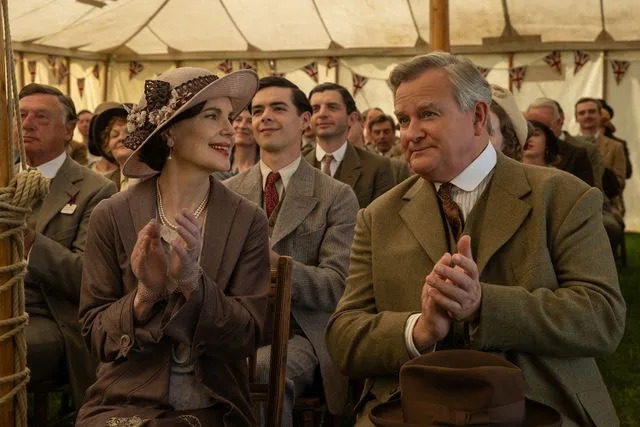
Elizabeth McGovern and Hugh Bonneville in ‘Downton Abbey: The Grand Finale’
Given that, Fellowes confirms that Downton Abbey: The Grand Finale, in theaters Friday, is well and truly the conclusion of this story (at least, it is for this generation of characters anyway).
The film takes place in 1930, which Fellowes says he views as the beginning of the “modern age” and a world quite different from the one in which Downton has existed. (Interestingly, Fellowes and director Robert Altman decided to set Gosford Park in November 1932 for the same reasons.)
Downton has said goodbye several times before, most notably with its series finale after its six-season run on television. Then, potentially over the course of two previous films, each of which could have been a viable conclusion for the storytelling.
But Fellowes wanted to put a definitive end to things for both his cast and the audience to have a sense of closure. “The actors and everyone else had come to the end of this job, and it was time to set them free,” he adds.

Rory Mulvey/FOCUS FEATURES
Laura Carmichael, Harry Hadden-Paton, Elizabeth McGovern, Hugh Bonneville, and Michelle Dockery in ‘Downton Abbey: The Grand Finale’
“We’d have a very big goodbye to Maggie [Smith] in the second film,” Fellowes explains. “We gave her a sort of state funeral, and then, of course, very sadly, she actually died in real life. That was quite a big thing for all of us because we’d worked very closely together for quite a long time. But I just felt that we had said goodbye to Maggie, but we haven’t quite said goodbye to everyone else.”
For many viewers, Lord Grantham (Hugh Bonneville), his American wife Cora (Elizabeth McGovern), their daughters Mary (Michelle Dockery) and Edith (Laura Carmichael), and their tight-knit group of servants have become almost a second family. Fellowes feels he owes that audience and their loyalty some reassurance of the characters’ general well-being.
Want more movie news? Sign up for Entertainment Weekly‘s free newsletter to get the latest trailers, celebrity interviews, film reviews, and more.
“I wanted to be sure that the public who’d followed their fortunes felt happy and satisfied to say goodbye to these people,” he says. “In other words, I felt they needed to have an indication of where they were all going and how they were all going to deal with the changing world. It’s no longer going to be a world of white tie and footmen; that was on its way out. So, we needed to be sure that they would be okay.”
Read the original article on Entertainment Weekly
‘ The preceding article may include information circulated by third parties ’
‘ Some details of this article were extracted from the following source www.yahoo.com ’