So far, Noah Hawley’s Alien: Earth has proven to be a monster hit with audiences, and the show effortlessly weaves serious scares and mysterious lore into a tapestry of modern horror. One aspect of the show that shocked fans, though, was that it blatantly retconned franchise history, ignoring some of the major events of both Prometheus and Alien: Covenant. Those movies were directed by the man who brought this fictional universe to life, but the blunt truth is that Alien: Earth was right to reject Ridley Scott’s alien origin story because it was baffling and convoluted.
Part of what made the xenomorphs so scary in the original Alien and its sequels was that nobody really knew what the xenomorphs were or where they came from. But Ridley Scott decided to partially answer the question with the prequel film Prometheus, which featured Peter Weyland and an erstwhile crew traveling to a distant planet to visit the Engineers, an alien race that created humanity. Meeting his maker doesn’t go well for Weyland, but things go swimmingly for David, an android who escapes on an alien spaceship and later begins conducting grotesque experiments, eventually creating the xenomorph.
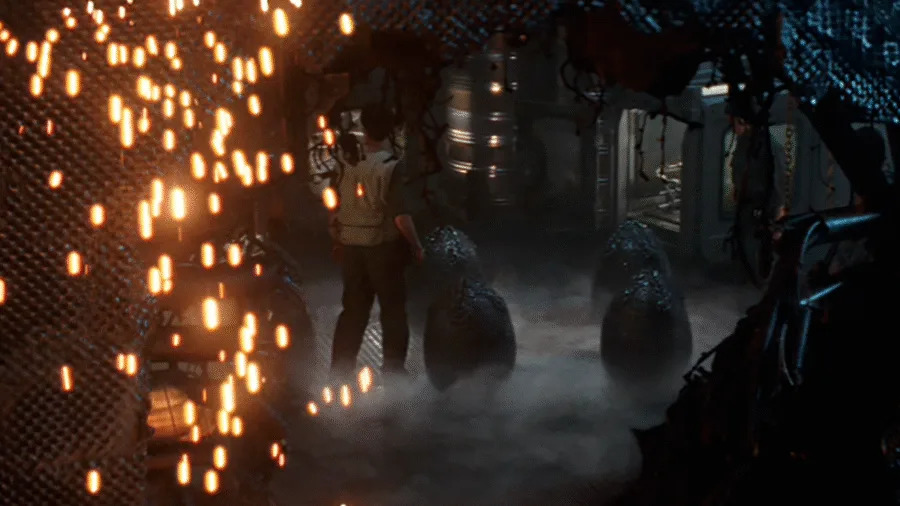
Xenomorph eggs aboard the Maginot in Alien: Earth.
Alien: Earth basically ignores this by revealing that the USCSS Maginot discovered xenomorphs five years before David began the experiments that would eventually create the perfect lifeform. It’s possible that some clever writing might be able to still weave David’s tale into the overall Alien narrative, but right now, it looks like the show has retconned this android being the one who created these iconic aliens. While some fans feel the show should have hewed closer to Ridley Scott’s vision, Alien: Earth is a much better show for ditching the convoluted xenomorph origin he cooked up in Prometheus and Covenant.
While it was beautiful, Prometheus was a frustrating mystery box of a movie that challenged audiences to figure out (in a move sure to trigger X-Files fans) what the mysterious black goo is that kept infecting people. It turned out to be an Engineer bioweapon, one David would later use to wipe humanity’s creators out while using their technology to conduct experiments. Eventually, these experiments (which involve black goo, alien wasps, and a hapless human) lead to the creation of the xenomorph.

David discovers the Engineer bioweapon in Prometheus.
Even when Alien: Covenant came out, I thought all of this was over-the-top and unnecessary. Honestly, the xenomorphs were much scarier when we didn’t know exactly what they were or exactly where they came from. And if we absolutely had to have an origin story for horror’s creepiest critter, why did it have to involve other aliens, an evil android, an offscreen genocide, and half a decade of mad science research courtesy of someone we never even heard about in the earlier movies?
Alien: Earth wisely cuts all of this out and presents the Facehugger eggs as just another bit of alien life that Weyland-Yutani scooped up in hopes of making money. They have no way of knowing (until it’s too late, of course) that the eggs contain creatures that will plant alien life in unsuspecting victims. And thanks to the Weyland-Yutani ship containing these specimens crashing to the planet, this amoral company ends up bringing a major galactic threat directly to Earth.

The xenomorph threat on Earth in Alien: Earth.
Just like that, Alien: Earth delivers backstory that reinforces what we know (like Weyland-Yutani’s relentless search for alien life) while keeping the xenomorphs’ origin appropriately mysterious (if Prometheus is fully retconned, we’re back to having no idea exactly where they came from). Everything in the show feels true to the spirit of the first two Alien films, which (mostly) makes the fandom happy. And Alien: Earth not getting bogged down in xenomorph back story means the show is free to introduce its own weird lore about humanity’s search for immortality.
There’s no doubt that Ridley Scott is a visionary creator, and we owe the ongoing success of this franchise to the success of his masterful 1979 Alien. But as Gladiator II proved, there is such a thing as taking too many trips to the same well, and Scott arguably should never have returned to the Alien franchise. Now, with both Prometheus and Covenant seemingly retconned, Alien: Earth can do something the franchise has struggled to do for decades: tell something other than a half-baked origin story answering a question nobody was really asking.
‘ The preceding article may include information circulated by third parties ’
‘ Some details of this article were extracted from the following source www.yahoo.com ’