Truly, Donald Trump’s selflessness and magnanimity know no bounds. The US president has taken Hollywood’s side this week – or at least, it seems he thinks that’s what he did – even as the industry’s punchiest riposte to Trumpism yet was topping box-office charts around the world.
While the opening weekend numbers for the Leonardo DiCaprio-led satirical thriller One Battle After Another were filtering through yesterday – a favourable if not seismic $50m (£37m), £2.4m of which was from the UK – Trump has posted on his Truth Social platform that his regime would be “imposing a 100 per cent tariff on any and all movies that are made outside of the United States”, with the stated aim of protecting the domestic film industry from foreign usurpers.
Several wags on X asked if the president was prompted to post after seeing DiCaprio’s film, which has been variously described by Republican pundits as “a reckless ode to radical terrorism” and “an ill-timed apologia for Left-wing violence”. Yet One Battle After Another poses a further problem for Trump: it’s one of the few Hollywood blockbusters in recent years actually to be made anywhere near Hollywood, and would have been untouched by his tariffs.
The prospect of tariffs on films made overseas was first raised by Trump in May, in a social media post that prompted widespread international confusion. Did “made outside the United States” refer to filming locations, or all aspects of production – and if the latter, wouldn’t it be more cost-effective for studios to leave the US entirely? Would the tariffs apply to streaming platforms too, or just theatrical releases?
Given that films are digital goods, and therefore exempt from tariffs in line with a 1998 World Trade Organisation ruling, how would they be levied in the first place? Wouldn’t it be easier to offer competitive tax incentives, like Britain, Australia and many other countries do, in order to lure businesses back voluntarily? And as with all other tariffs, wouldn’t the cost ultimately be passed on to the (in this case American) consumer anyway?
And what does “made outside the United States” actually mean? It angers Trump that many Hollywood productions – from Wicked and Barbie to the new Avengers and Spider-Man films – are made in the UK. But some scenes will be shot on location in the US, along with special effects and post-production. And how could could a globe-trotting caper like Mission: Impossible possibly be filmed in, say, Malibu?

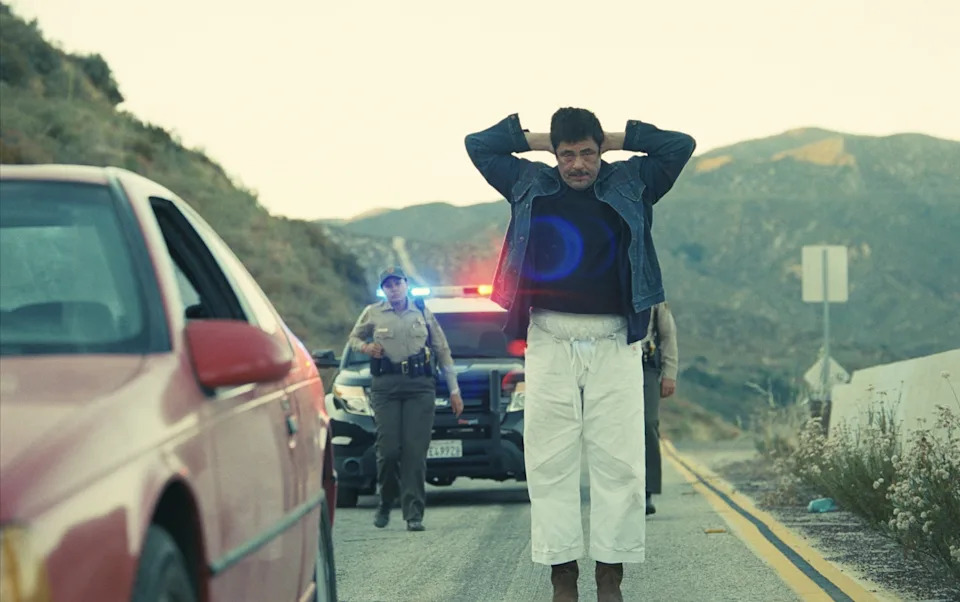
Largely shot in California, One Battle After Another, starring Benicio del Toro, would theoretically be unaffected by tariffs
More than four months have passed since those questions were raised. Despite the presumably Herculean efforts of Trump’s special envoys to Hollywood – Jon Voight, Sylvester Stallone and Mel Gibson – to grapple with the economic nuance in the interim, no further details, nor even a vague timeline for implementation, have since cohered. Another creatively punctuated internet post, though, we did get.
“Our movie making business has been stolen from the United States of America, by other countries, just like stealing ‘candy from a baby,’” Trump wrote on his Truth Social platform on Monday, before blaming the downturn on California’s “weak and incompetent” governor, Gavin Newsom. (In response, in a social media post of his own, Newsom described Trump’s 100 per cent tariff proposal as “100 per cent stupid”.)
Ironically, One Battle After Another is exactly the sort of production Trump appears to believe he’s championing. A Dr Strangelove-esque send-up of contemporary US politics, it was shot largely in California, where DiCaprio’s Bob Ferguson, a crusty ex-Antifa type, is trying to save his teenage daughter from a military hit squad. This outfit is led by Sean Penn’s Colonel Steven J Lockjaw, who hopes that exacting revenge on this old foe and his offspring will help land him a position in the state’s most prestigious white supremacist cabal.
While not a blunt transliteration of America’s current political plight (everything’s adjacent or askew, and there’s no Trump stand-in), the film certainly touches on various live issues – some more acutely than writer-director Paul Thomas Anderson could have imagined. It opens, for instance, with an armed raid on an immigration detention centre – which, after the recent shooting at an Immigration and Customs Enforcement (ICE) facility in Texas, takes on a deeply uneasy resonance. Still, I think Anderson wants his audience to feel deeply uneasy, regardless of their own political sympathies.
One Fox News commentator likened the film to “a movie about World War Two in which you are meant to be cheering for lovable Nazis”. But to claim that One Battle After Another uncritically champions DiCaprio’s Weather Underground-type revolutionary outfit would itself be a reactionary reach.
The French 75, as they call themselves, are variously portrayed as egotistical crackpots and incompetent jobsworths, while the only noble impulses on show anywhere are DiCaprio’s love for his daughter and protective paternal instincts. It’s all rather sweetly pro-family.
Will Trump watch the film and reconsider? It feels unlikely, given that it’s almost three hours long. But from Hollywood’s own perspective, its title may serve as a tidy summary of the remainder of Trump’s second term nonetheless.
The movie business might have no love for the president, but its splashy glamour and back-slappy acclaim are Trumpian values through and through – which makes bringing it under control, or at least partially on side, a burning presidential concern. The sabre-rattling and bluster will not stop any time soon. One battle after another sounds about right.
‘ The preceding article may include information circulated by third parties ’
‘ Some details of this article were extracted from the following source www.yahoo.com ’