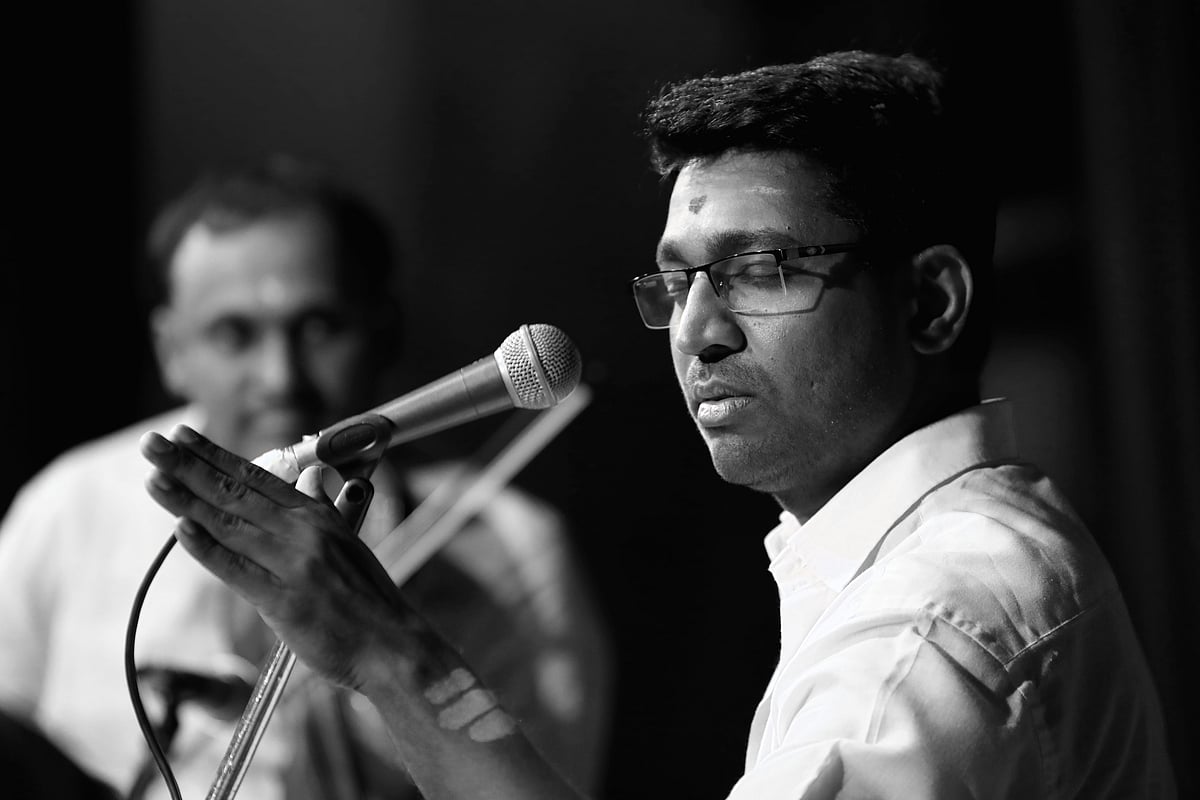
“Yeah. Always been asked in several interviews, like why only four or five artists came out and called out the hypocrisy,” he begins. “The counter question I ask is: yes, there were only a few people who came out and asked, but was there even one other artist, then or now, who comes and supports or gives evidence that there is no hypocrisy?”
The controversies he references involve heated debates around secularism, inclusivity, and the very essence of the art form. Ramprasad argues that the narrative of an exclusionary Carnatic music scene is evidence-less. He points to the genre’s history of revered artists from diverse backgrounds, from the Dalit saint-composer Purandara Dasa, whose works he is meticulously setting to tune, to masters like Mandolin U Srinivas and KJ Yesudas.
“It will be foolish of an artist to say that my hall should be filled only with a certain kind of people. As a person who makes money, I want a larger number of tickets to be sold,” he states. He believes the accusations are often theatrics, advanced by those who “will never have solutions” and are backed by an ecosystem eager to fuel controversy.
He illustrates his point with a sharp analogy. “Why should lawyers wear a black coat to argue in a court? After all, their job is to argue. Why can’t they go in shorts? And the same people who question the dress code in Carnatic music, when they go to a synagogue and perform, they wear a topi and make the co-artists also wear topi. Where did your secularism go?”
In this regard, he mentions how the entire ecosystem deliberately uses diversionary tactics when hypocrisy is called out by changing the narrative to why some people are always opposed to the idea of inclusivity. He contends that inherently almost all artists are inclusive — but most of them do not thump their chest while doing it and market it to their business advantage.
For Ramprasad, the most profound contradiction lies in attempts to inject explicitly non-theistic content into a tradition fundamentally built on devotion. “The main ingredient in a tomato soup is tomato. In Carnatic music, the main ingredient is divinity. If you take divinity out of Carnatic music, it is just music. So don’t call it a Carnatic music concert, just call it a concert,” although he admits that in the past or present or future, there are no restrictions for even non-believers to practice this art form and there are several successful examples too.
He cites the example of singing tributes to social reformer Periyar, who rejected divinity and famously criticised the Tamil language. “You are singing a song in praise of him in the same language, which he called barbaric. So aren’t you insulting him, or are you actually respecting him? So you are not true to that side either, nor true to this side.”
‘ The preceding article may include information circulated by third parties ’
‘ Some details of this article were extracted from the following source www.newindianexpress.com ’