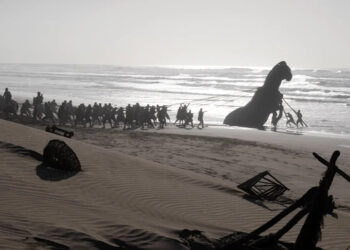
As many Trekkies might be able to tell you, Gene Roddenberry created “Star Trek: The Next Generation” out of spite. When “Star Trek: The Motion Picture” came out in 1979, it was a big swing, taking a rinky-dink science fiction series and blowing it into a massive, psychedelic, $44 million space opera. It was about a gigantic, dangerous space cloud that appeared out of the cosmos and began bearing down on Earth, its mission unknown. The film ended with human beings merging with ineffable machine intelligences beyond our comprehension. It was heady and great, closer in spirit to the previous decade’s “2001: A Space Odyssey” than the contemporary “Star Wars.”
But when “The Motion Picture” didn’t make quite as much money as Paramount wanted, Roddenberry was informally removed from any further involvement in any sequels. A new creative team took over, and made three sequels from 1982 to 1986 that were all much more successful. Roddenberry resented that control of his creation had been wrested from him, and decided to one-up the bigwigs by making a new “Star Trek” series all his own. This time, he would lean even harder into his original show’s utopian themes, and — most importantly — retain total creative control over it. In 1986, he had assembled most of what he needed to make “Star Trek: The Next Generation,” a series set a full century after the original series.
Of course, as detailed in William Shatner’s 2014 documentary “Chaos on the Bridge,” the first two seasons of “Next Generation” were, well, chaos behind the scenes. Roddenberry would regularly re-write scripts without other writers’ knowledge, and there was a lot of arguing as to who should really be in charge. Roddenberry butted heads with just about everyone and would micromanage everything into oblivion. These tense feelings were recalled sharply by Ronald D. Moore, one of the more celebrated writers of “Next Generation” beginning in its third season. On a recent episode of “The Sackhoff Show,” Moore said he came on to “Next Generation” in 1988 amidst a lot of animosity and “bad blood.”
Read more: The 5 Worst Episodes Of Star Trek: Voyager, Ranked
The first two seasons of Star Trek: The Next Generation were chaos behind the scenes
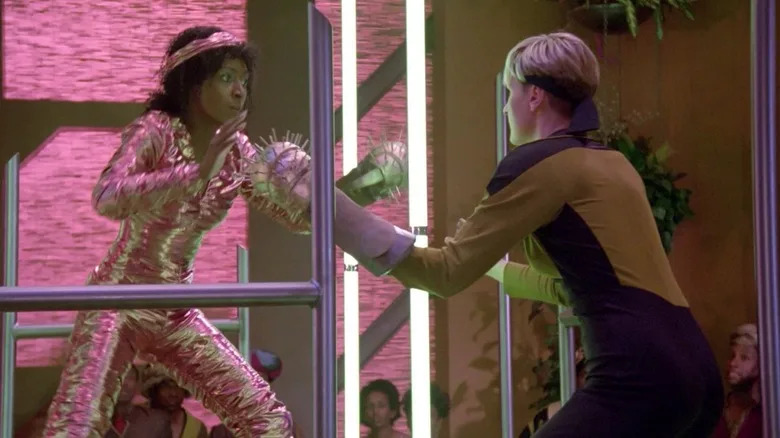
Tasha Yar fighting with Lutan on Star Trek: The Next Generation – Paramount
Most Trekkies will also be able to tell you that the first two seasons of “Next Generation” are a little rough. As the show was finding its path, it churned out some pretty awful episodes backed by some pretty awful ideas. “Code of Honor” (October 12, 1987) is often referred to as “the racist one,” while “Angel One” (January 25, 1988) is “the sexist one.” In previous interviews, Moore talked about how he got his start on “Star Trek” while touring the set during the second season. He turned in an unsolicited script to a friend who was working on the show, and that eventually led to him getting an agent and getting hired.
But he essentially entered bedlam. He recalled the constant shifting of staff members, and the control Roddenberry so assertively exerted over the series. It was a bad atmosphere, and a lot of people hated each other. He doesn’t call out anyone by name, but non-Trekkies might want to look up figures like Maurice Hurley and Leonard Maizlish, who seemingly contributed to the chaos. As Moore put it:
“The show was in turmoil. The early seasons of that show were epically in turmoil. […] The first two seasons in particular, before I got there, there was so much bad blood behind the scenes. […] Gene was still alive. Gene would throw out scripts and fire writers and hire other ones. And writers would backbite each other. A lot of inner turmoil and division about what the show is, what the show’s not. Just a lot of angst and anger. And people coming and going.”
A lot changed when the third season began. Michael Piller took over as the showrunner, and several new writers were hired, including Moore. The direction of the show changed, as it began to focus on singular characters in each episode, rather than the whole ensemble each time.
The show’s veterans had all become cynics

Two Picards standing in a turbolift on Star Trek: The Next Generation – Paramount
Moore said that expediency and desperation were the central workplace tenets in the “Star Trek” offices when he came aboard, and that the show’s previous writers had all become jaded. He described the tone of his new workplace like this:
“I joined in the third season, and a couple of [writers] were veterans from the previous year. And they were cynics. ‘Yeah, it’s all good until it all blows up, kid. Okay, here we go.’ But we were also in this hand-to-mouth thing. […] We were never more than one script ahead. We were prepping outlines and prepping beat sheets. […] In the writers’ room, writing, you just had to move fast, trying desperately to get pages out the door.”
Moore said he had to learn on his feet, and that the tone of the workplace was always one of panic. The entire show seemed to be perpetually behind schedule, and the speed didn’t allow for mush polish or careful story considerations. Moore understood that he was only appreciated at first because everyone was desperate for more help. As he put it:
“Part of their welcome to me was of necessity. ‘We need a body! Could you write? Go write this scene!’ And you would just write, turn it in, do it again. You built this muscle memory of being able to write fast and do it today. It has to be here tomorrow. Something’s shooting. It had to be done. You can’t have writer’s block. You can’t have fear. You just put something on that page and turn it in. And that was the atmosphere of that first season. It was a crucible … but I loved it.”
Moore ended up staying with the series through its seventh and final season, and even co-wrote the films “Star Trek: Generations” and “Star Trek: First Contact.” He also worked heavily on “Star Trek: Deep Space Nine” and the final two seasons of “Star Trek: Voyager.” Clearly, the chaos eventually cleared up.
If you’re looking for the easiest way to keep up with all the major movie and TV news, why not sign up to our free newsletter?
Read the original article on SlashFilm.
‘ The preceding article may include information circulated by third parties ’
‘ Some details of this article were extracted from the following source www.yahoo.com ’