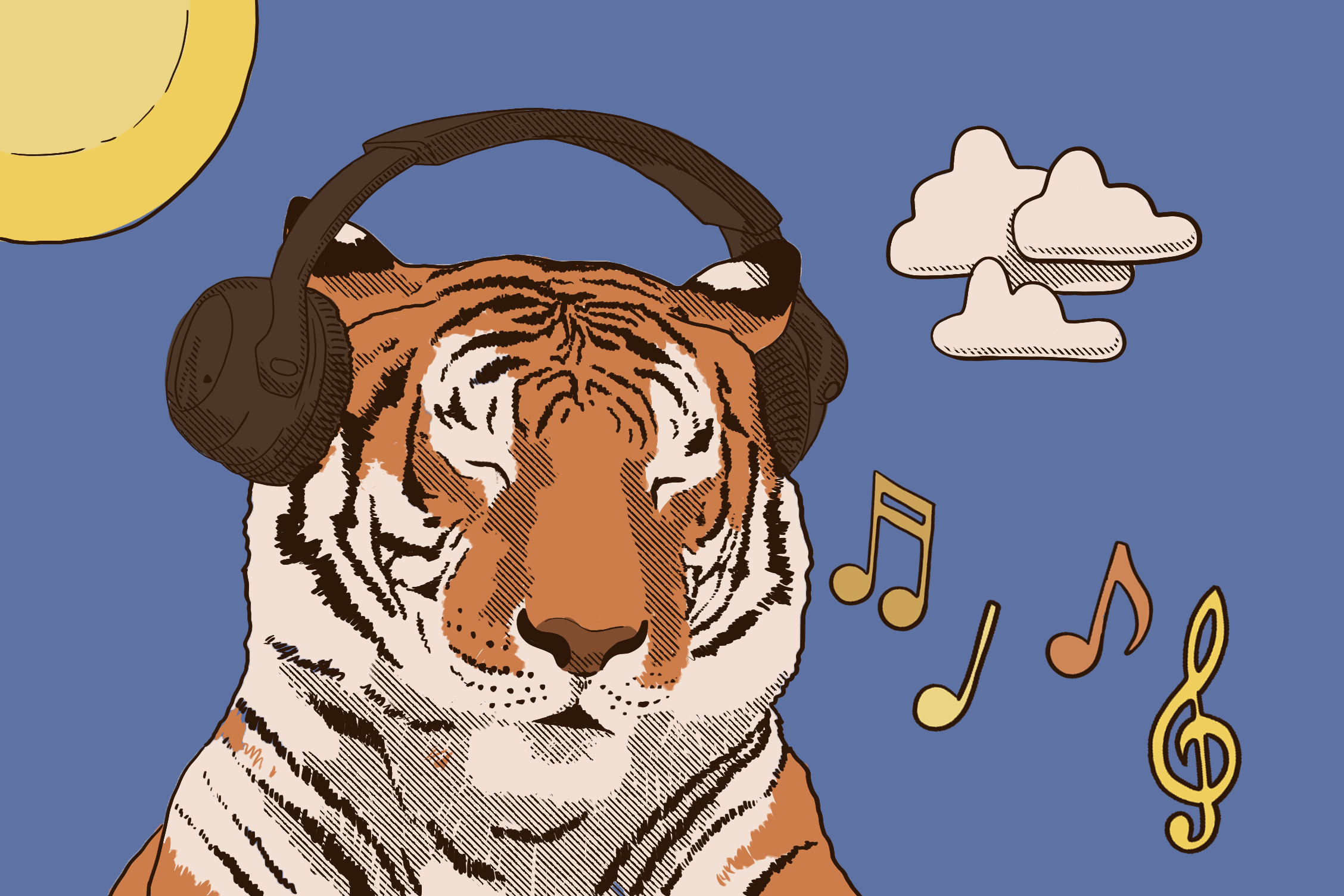
Cinema for the Ears pushes the boundaries of what music can be by immersing audiences in their own imaginations using experimental sound.
The annual Cinema for the Ears concert was held on Monday, Oct. 13 by the LSU School of Music’s Experimental Music & Digital Media program. The showcase featured eight electroacoustic experimental pieces by LSU students, faculty and world-renowned composers with the intention of introducing audiences to a unique form of storytelling.
“We want to immerse the audience in sound and create kind of a different concert setup than normal,” said Fiona Ju, a third-year Ph.D. student in the EMDM program and the sound technician for the event.
Unlike a traditional concert with live musicians on stage, Cinema for the Ears was entirely computerized, with all of the music coming from speakers rather than performers. With no visual subject to focus on, audience members were meant to focus solely on the music and how it made them feel.
The concert was held in the Digital Media Center Theatre, which boasts an impressive sound system of 92 speakers and 71 audio channels. Ju was able to use this sound system to map out the audio of each piece onto different speakers across the room, creating a layered, multi-channel musical environment that literally surrounded the audience in sound.
At any given moment, one could hear the creaking of a door to their left, the clanging of metal-against-metal to their right or the whistling of wind travel from one side of the room to the other. During one piece, the sound of rainfall coming from speakers above and around the audience made it feel as if rain drops were really falling from the ceiling itself.
“It’s like raining from the ceiling,” Ju said. “But actually, it’s just because we have all the speakers in the ceiling. I’m just mapping those sounds to the channel of the rain to the ceiling of the theater, so you feel like it’s raining from above your head.”
The term “cinema for the ears” was first coined by French composer Francois Dhomont to describe how sound, like a movie, can take one’s imagination on an immersive, cinematic journey without the use of visual aids. Dhomont was a pioneer in electroacoustic and experimental sound.
According to Ju, experimental music is not a single genre but rather a broad concept that encapsulates any kind of music pushing against the status quo.
“It’s doing something that’s unconventional,” she said. “Outside of what people usually think music is.”
Electroacoustic music, in particular, combines elements from both acoustic and electronic styles of music. For example, a composer might use audio samples of real-world sounds and then manipulate them electronically, adding reverb, delay or overlaying purely electronic sounds onto the acoustics.
Because it can be manipulated to create unique sounds and produce interesting effects, electroacoustic music lends itself to experimentation. Structure and melody are often pushed aside in favor of chaos and spontaneity. The point of this style is not to be beautiful or pleasing to the ear, but rather to make audiences feel something and to prompt listeners to reconsider how they define music.
This specific style of music is certainly not for everyone. Ju recalled a concert she attended where much of the audience left after just one or two pieces, but she maintained that it is important to challenge audiences in order to make any strides in the music industry. Afterall, many standard practices in the music industry today were once radical ideas when first proposed.
“That’s why we’re still doing this,” Ju said. “We keep doing experimental things. We keep pushing the boundary and see what we are going to have in the future.”
EMDM will host its next event, Laptop Orchestra, on Nov. 14 at 7:30 p.m. in the Digital Media Center Theatre. Admission is free.
‘ The preceding article may include information circulated by third parties ’
‘ Some details of this article were extracted from the following source lsureveille.com ’