IT IS PERHAPS A NOT VERY SURPRISING TRUTH that the artists who tend to be most critical of television—and of the culture it has shaped and will continue to shape—are those very few truly great artists who have spent the majority of their creative lives working within the medium. Think of Rod Serling or Paddy Chayefsky in America. England seems to have an endless supply of such people, most prominent (and most beloved by me) among them being Dennis Potter. And as little known as Dennis Potter still is in America, even less well-known than him is Nigel Kneale, whose 1968 teleplay The Year of the Sex Olympics, written for the BBC2 anthology show Theatre 625, was so remarkably prescient about how grotesque TV would become that we’ll probably hit the exact spot mapped out in his story no later than April 2026.
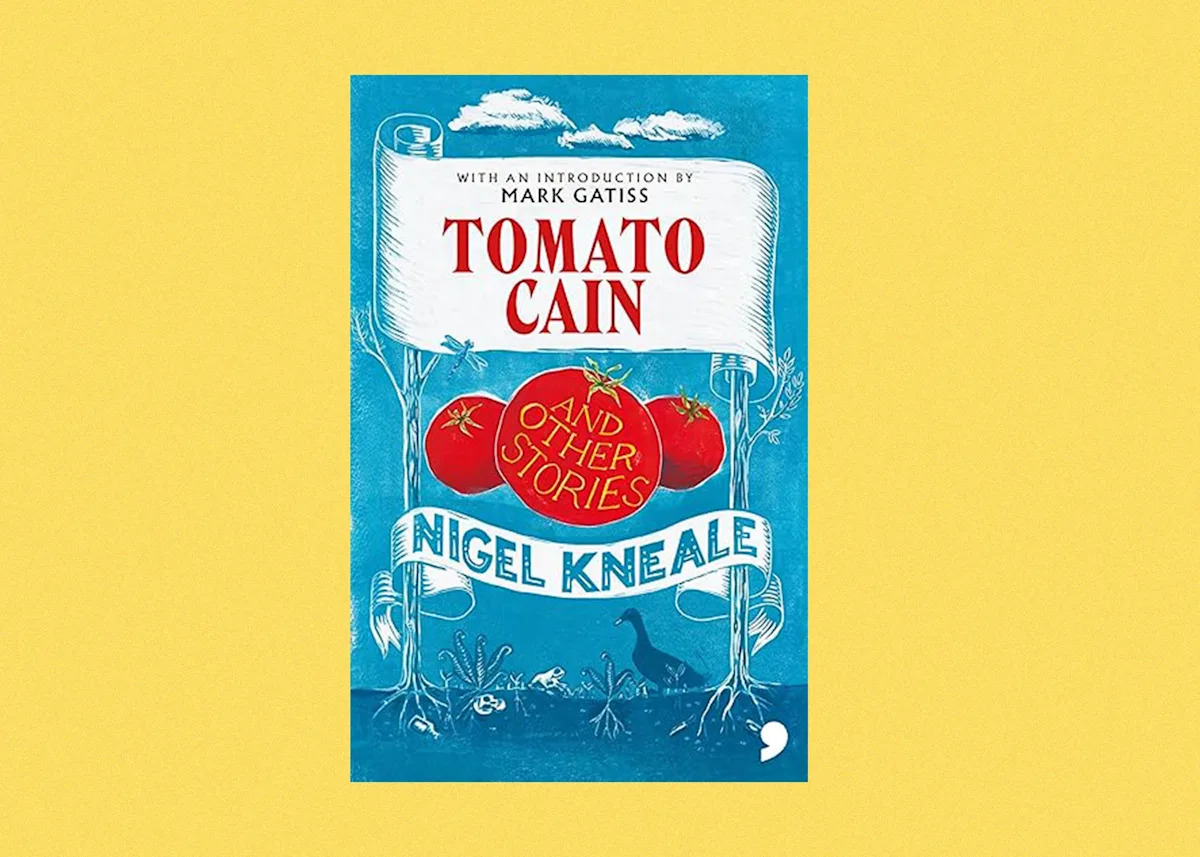
Like many writers of his generation and nationality, Kneale wrote in many genres: The Year of the Sex Olympics is science fiction; The Stone Tape (1972), another of his classic teleplays, is horror; and the iconic Hammer film for which he wrote the screenplay, Quatermass and the Pit (1967), is one of the most successful hybrids of those two genres ever filmed (or written, for that matter). Yet for all his success, and for all the skill, innovation, imagination, and sheer talent he put into his scripts, Kneale’s interest in writing prose seemed minimal. Kneale published just two works of prose: Quatermass (1979), a novelization of the TV serial from the same year (part of a longer series of Quatermass stories, of which Quatermass and the Pit was an earlier installment); and, in 1949, two years before his first script was produced for television, his only short story collection, Tomato Cain and Other Stories.
And it was through that book—or, really, the title—rather than his famous scripts that I first learned of Kneale. I found the title, Tomato Cain and Other Stories, tucked away in the Recommended Reading List in the back of Stephen Jones and Kim Newman’s indispensable reference book Horror: 100 Best Books. I was struck by the title, because what kind of horror could Tomato Cain possibly pertain to? I’m a sucker for an unusual title. However, for most of my life, used copies of this collection were completely unaffordable. The closest I could get was finding a horror anthology that included another reprint of Kneale’s ghost story “The Patter of Tiny Feet,” with its scalpel-sharp line, “This was not a house with a woman in it,” which encompasses one character’s grief and loneliness with grim succinctness. This is surely the most famous story from Tomato Cain, in part, I imagine, because of the way Kneale has that same lonely character reveal an unpleasant side, to himself and to his marriage, as he speaks of his late wife and how she was “unworldly” and “unnecessarily emotional.” Then later, as this man, Mr. Hutchinson, explains to the journalists questioning him about the paranormal phenomena plaguing his home, he describes his late wife as “in some ways . . . so to speak . . . retarded.” This causes one of the journalists, our narrator, to observe, “He looked as pleased as if he’d just been heavily tipped. If that was pure intellectual triumph, it was not good to see.” You were lucky to find “The Patter of Tiny Feet” in an anthology, and even luckier to find “Minuke,” a conceptually unique haunted-house story, which contains the immortal line, hinting at something about Kneale that I’ll get to: “I buried what was left of the dog myself.”
Before you go any further (I know, I know), take a moment to sign up for a free or paid subscription. Your inbox will appreciate it.
Luckily, Tomato Cain and Other Stories came back into print three years ago in an expanded edition from Comma Press, boasting blurbs from Ramsey Campbell and Garth Marenghi himself, Matthew Holness. Across the collection’s 31 stories, Kneale experiments with different forms, approaches, focuses, and genres (ironically, the title story, “Tomato Cain,” cannot be described as a horror story, even by the most expansive definition of the term).
Something Kneale does in “Minuke,” as in several other stories, is employ a first-person narrator as one side of a conversation. For example, this, from his story “The Terrible Thing I Have Done”:
I want you to promise me that when I’m dead—oh, never mind reassuring me!—when they take me down river to the embalming place, promise me you’ll see that my copy of the Book of the Dead is a good one, with all the instructions. I know the embalmers often slip a dud scroll into the burial equipment, with mistakes in it, and pieces left out.
“The Terrible Thing I Have Done” is told from the unique point of view of an ancient pharaoh’s food taster. With him being the “I,” who can “you” be but the reader? Not literally, of course—the “you” is named, and his name isn’t Bill Ryan—but if one’s inclined to feel this way, one might feel implicated in the terrible thing that’s been done (if one thinks that in this case the thing is all that terrible). Worse, for you, is you can’t quite enjoy the catharsis of brutal revenge delivered to “you” in “Chains,” partly because of who’s “you,” and partly because the comeuppance is so richly deserved.
Kneale had a gift for disquieting imagery as well. Take this from the book’s eeriest story, “Jeremy in the Wind”: “As we went along, he talked to me—a funny sort of voice he’s got—until a pebble fell out of his mouth.” This story is either about an insane boy, or it’s about an insane boy and his giant, gangly puppet monster friend.
Or this from the quite odd folk horror story “Enderby and the Sleeping Beauty.” Our hero is walking through a dark tunnel when he encounters a row of figures by torchlight:
The figures were of both men and women. Some were painted, in dull colours: blue and green stones sparkled in their dress: more than once Enderby saw gold in the carved folds of a woman’s hair. And every face repelled him. . . .
Each seemed to have a double meaning. A twisting of the brows and a wrinkling round the empty eyes, and madness showed through the face’s laugh. Where they were heavy and stupid, there was vicious cunning also. In eagerness was slavering depravity: in innocence cruelty.
It may sound strange to say this about a horror writer, but Nigel Kneale had a surprisingly dark streak in him. Remember before, the line about “what was left of the dog”? In her introduction to the original 1949 edition of Tomato Cain, Elizabeth Bowen wrote: “It would be fair to say that his children and animal stories, with their focus on suffering . . . most dangerously approach the unbearable.” His story “Oh, Mirror Mirror,” which is a sort of inverse version of Richard Matheson’s classic “Born of Man and Woman,” is not about escaping cruel abuse; it’s not even about abuse beginning. It’s about abuse expanding. The obliviously evil narrator (speaking, again, to you) blathers on:
And after that we must simply be patient, and auntie loving, because we haven’t so very long in the world, have we? And if we’re not ordinary . . .
But it’s the cruelty that Kneale can evoke so powerfully. There’s a story in here that is, in its way, almost unspeakable. It’s called “The Stocking.” It’s very short and, without ever saying precisely what is going on, centers around a very young child, an infant (who, it is also implied, is disabled) being left alone by the adults who wish to go out. And then what happens to that child, which I’m not going to describe or hint at. I will say that Kneale is not graphic, but he does a bit more than imply what happens. He hits a seam between the two options that practically demands, and ensures, one response, which is to first comprehend what must be happening, and from there imagining the details that Kneale is not giving you.
I have read many other stories that do this, by many different kinds of writers, but I was brought up particularly short by this one. I think this was because what it made me imagine was so abominable that I sort of wish I hadn’t read it. But, of course, it’s a good story, because, well, look at its goal, and look how right dead-square on the bull’s eye his shot was. It is effectively unpleasant. The following will sound moralistic, but I don’t mean it that way: I have watched and read descriptions of graphic violence in movies and novels and been entertained by them, if you can imagine such a thing. Yet there is a particular difference, an almost sociological difference, in the way Kneale withholds the ghastly details. Sitting down to do this, to think, “I am going to do this to the reader,” seems unstable, but Kneale, consciously or not, is trying to buttress the reader against desensitization, which is often the grounds on which violent media is criticized. But I believe desensitization is joined at the hip with passivity, and once Kneale’s use of a particular word at the end of “The Stocking” sparks an image in the reader’s mind, and it can’t not, any pretense towards passivity is obliterated, because now you, Kneale’s “you” to his “I,” are doing it.
That is implicating the audience. That’s why horror’s extended foray (once front and center, now a little bit on the fringe, except in films) into extreme graphic violence can become so dull. Graphically violent horror novels that initially provoke disgust will quickly induce boredom. That is desensitization. Or such is the danger if you don’t have the guts to let stories like “The Stocking” work their evil magic on you. The minute stories like that stop bothering you, then uh-oh. Look out.
Send this story to someone you think could perhaps use a bit of re-sensitization.
‘ The preceding article may include information circulated by third parties ’
‘ Some details of this article were extracted from the following source www.yahoo.com ’