MANHATTAN — From my perch on the second level of the futuristic glass castle convention center where New York Comic Con is underway, all I see is Superman.
There’s one, hoisting up an enormous styrofoam planet. Another is making chit-chat with the Riddler, and a third is adjusting his red cape as a bride would the train of her gown. They’re milling about, waiting to take photos with other cosplayers dressed up like characters from other fictional universes. All are smiling — good-natured and kind in their interactions, like any fan knows the ultra-powerful alien superhero would behave. But while they share the ethos of the Man of Steel, there’s a distinguishing characteristic that sets them apart from their fictional counterpart. Not every Superman at the convention is white.
Superheroes and villains from all backgrounds, franchises and planetary origins swarm the Javits Center for the annual gathering of science fiction and pop culture fans, who come together to build community, attend panels and buy the latest merchandise. Everywhere I looked, attendees represented different iterations of characters, age groups, gender identities and races. Some look exactly like their source material, and others don’t.
Now that there’s a new comic-based blockbuster movie released every few months — Captain America: Brave New World, Thunderbolts*, Superman and The Fantastic Four: First Steps all came out in 2025 — there seems to be a superhero for every demographic. That’s evident at NYCC. But that wasn’t always the case.
During my time at the convention, I spoke with fans who told me that it’s not just superhero intellectual property that’s expanding, but their representation in the real world too.
“We’ve been seeing people who look like all of us — not just one type of person or just one race,” Cin’ von Quinzel, a longtime DC universe fan, tells me. The 31-year-old content creator from Brooklyn, N.Y., who is dressed as Padme Amidala from Star Wars, says she’s relieved she no longer sees the same “cookie-cutter, this is the only way a superhero should look kind of character” across comics and movies. Finally.
Miles Morales, the hero of the Spider-Man: Into the Spider-Verse movies, was a game-changer, Cin’ says. He’s Black, Latino and a New Yorker like her, and means so much to other Spanish-speaking fans. It just took a little too long for him to enter the mainstream for her liking.
Still, Morales was a sign that “there’s more people who look like us [creating] the comics,” she says. “For a really long time, it was just white men [writing and illustrating]. For decades. Now we have everybody.”
Who do superheroes belong to?
That diversity and inclusion in storytelling is so important for fans like Cin’, but not everyone is open to seeing the source material they’re familiar with get tweaked.
“Comic book characters are the closest thing our modern culture has to mythology,” filmmaker and longtime superhero fan Jon Hill tells me. “Fans take those stories … and think about them … They get tattoos and collect things and join online forums to talk to each other and discuss the details … they inhabit these stories, so they no longer just tell them, they consider that they belong to them.”
When these heroes and their stories that mean so much are tampered with — especially the superheroes fans spent their childhoods with — they get upset. It feels like a personal loss and reminds them that they’re getting older. But superhero stories are changing and evolving all the time, just like the myths of Zeus and Hercules.
What makes comic adaptations different from so many other franchises is the existence of the “multiverse,” or multiple parallel realities. It’s also a handy tool writers use to “fix problems,” Hill says, giving heroes alternate powers and even bringing them back to life. If Iron Man is dead in the Avengers cinematic universe that we know, he’s alive in another one. He may just look or act differently from his original self.
With the multiverse concept, there can be something for everyone — but that means that the fans who originally loved the earlier versions of the comics feel like they’re losing a bit of their own identity.
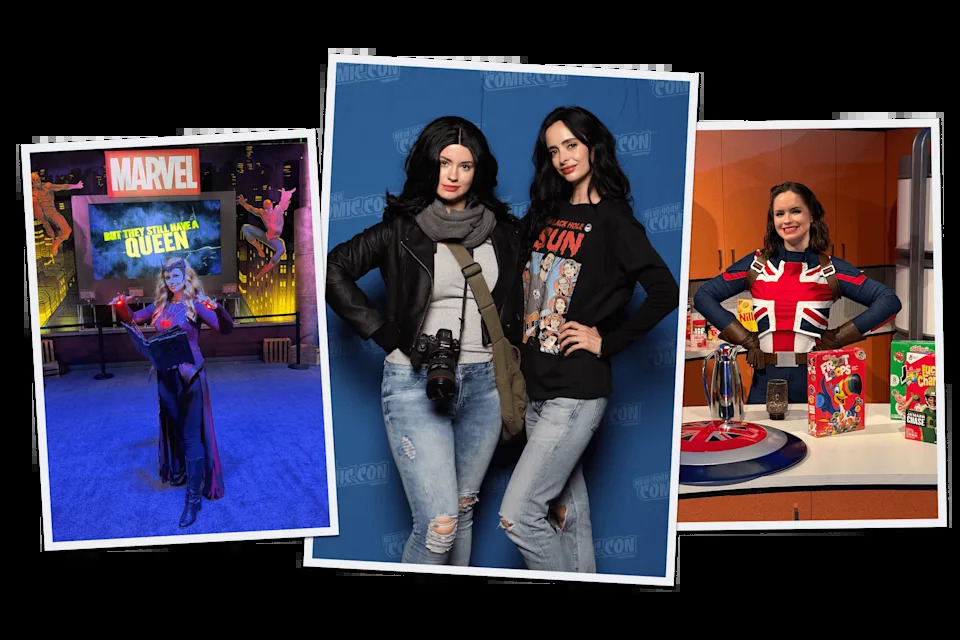
From left: Pettit dresses as Scarlet Witch, as Jessica Jones with Jessica Jones star Krysten Ritter and Captain Carter. (Courtesy of Taylor Pettit)
As characters across multiverses diversify, so does its fan base. I meet Taylor Pettit, a 25-year-old cosplayer from North Carolina, who is dressed as Scarlet Witch, one of the first female heroes to lead her own live-action TV series. Pettit tells me she has only ever felt delighted that the blockbuster adaptations of comic book series target different demographics and loves how the popularity of superheroes makes them “less of a freaky, weird thing to love.”
She hopes fans across the board can see the multiverse as a good thing — something that allows them to celebrate the past, present and future of all the characters they care about.
“Little girls, or children of any race or gender identity, get to watch people that look like them, act like them and have similar experiences to them. They get to be the main characters, save the day and have superpowers,” Pettit says. “I’ve never understood … why people are so adamant about not experiencing other cultures. I think that’s one of the coolest parts about living.”
Superhero fandom is an emotional thing. Even the people who are resistant to change feel so much for their characters. But those welcoming change have a much sunnier outlook, especially at NYCC, where their online fandoms briefly enter real life.
Kiera Elizabeth, left, and her boyfriend dressed as Black Widow and Bucky Barnes. (Courtesy of Kiera Elizabeth)
Kiera Elizabeth, a 26-year-old content creator from Brooklyn dressed as Black Widow, bounds up to me outside the Starbucks where we planned to meet. She came to NYCC with her boyfriend, who dressed as Bucky Barnes, and she proudly tells me she handcrafted his bionic arm herself out of foam.
At conventions, she recommends latching onto a favorite character and dressing up like them.
“[Black Widow] is iconic because she’s the only female original Avenger in the movies, and I’m a huge feminist,” Kiera tells me, explaining her costume. “She’s always been one of my favorite characters because I always root for the women in superhero movies.”
For Kiera, cosplay is a way to feel connected to that material and to other fans. It’s helped her build community. She considers herself to be socially anxious, but at these events, that all “melts away,” she says. Especially in costume.
“It’s like I am Black Widow. I just gotta try to mirror [her] until that’s true,” she says. “I’m way more confident in cosplay.”
‘A symbol of hope’
As I talked to more fans about the jubilation of representation in the superhero fandom, I couldn’t stop thinking about all the Supermen I saw. This extremely handsome white guy who’s been around forever was somehow still dominant, despite all the new takes on characters. But there’s something special about his most recent iteration onscreen.
James Gunn’s 2025 reboot of the franchise earned widespread acclaim from critics and hard-to-please fanboys who were thrilled with David Corenswet’s upbeat, sweet take on the Man of Steel. In the movie, he stays true to his comic roots as a do-gooder, and declares that “kindness is the new punk rock.”
The alien who crash-landed on Earth as a baby is actually, technically, an immigrant — a plot point that ignited a culture war spat around the film’s release. But above all, he serves as a symbol for how all longtime fans should act. He’s just nice.
Jake Fogg dressed as Superman. (Courtesy of Jake Fogg)
So are many of the people who cosplay as him. Jake Fogg, a 36-year-old sales and marketing director from North Carolina, tells me he has been dressing up as Superman since 2020. It doesn’t hurt that he looks like Superman either. He was once scouted by a Warner Bros. employee to promote the franchise at a random, non-superhero-related event, simply because his suit and glasses evoked Clark Kent.
Fogg dons the supersuit all the time — mostly for charity events at children’s hospitals, and the response he gets from kids and adults alike is infectious.
“[Superman] could be the most powerful being on the planet, but all he wants to do is the right thing,” Fogg says. “He’s a symbol of hope … that’s what he brings to people when I’m wearing the suit. People smile. It’s just different.”
He’s also cosplayed as Batman and the Mandalorian, but Superman “brings out a light in people that’s hard to explain.”
“The world needs Superman,” Fogg adds. “Showing kindness and seeing the impact that only he can bring … it’s awesome.”
Fandom can be toxic, but it can also be empowering. It can make people feel represented, give them community and introduce them to new perspectives. The people who refuse to adapt to changing times and open their hearts to a multiverse of possibilities will be left behind by their own all-powerful hero if they don’t learn to be kind. They can look to Superman as an example — he’s pretty much everywhere these days.
‘ The preceding article may include information circulated by third parties ’
‘ Some details of this article were extracted from the following source www.yahoo.com ’