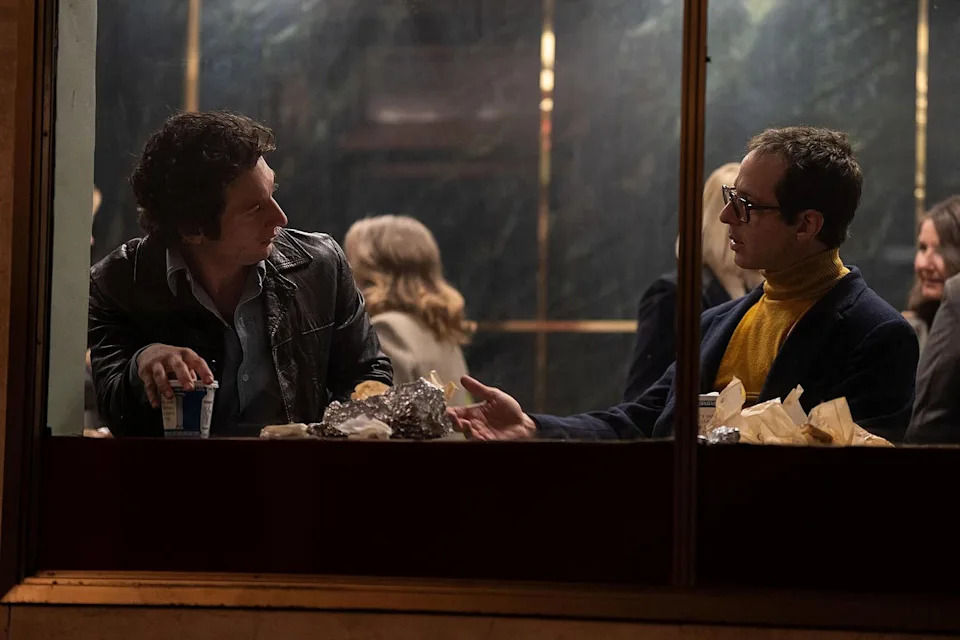
AFTER LISTENING TO HIS CLIENT’S NEW SONGS, Jon Landau (Jeremy Strong) seems rattled, unsure of himself. Stewing over what he’s listened to—an unexpectedly warbly and echoey mass of acoustic guitars and lyrics about serial killers and execution lines and robberies gone wrong; about murder and mayhem and bankruptcy—he says to his wife, with no small measure of concern, that these are songs written by a man who feels “condemned.”
The man, of course, is Bruce Springsteen (Jeremy Allen White), and the album Landau has just experienced is Nebraska. And once you hear that line, a lot of Nebraska really snaps into place. On the one hand, songs about desperate men committing ugly crimes—about the “meanness in this world,” as the unnamed narrator of the title track puts it—are, perhaps, a logical extension of the beaten-down, recession-era heroes of Born to Run and Darkness on the Edge of Town. It’s not a huge leap from “Racing in the Street” or “Meeting Across the River” to “Johnny 99.” On the other, though, there is an ugliness and a desperation in Nebraska that is simply absent from those earlier works.
Writer-director Scott Cooper’s film, based on the book of the same name by Warren Zanes, is not unlike Nebraska itself in certain regards. One can imagine audiences reacting to it the same way Al Teller (David Krumholtz) does when he hears the album for the first time, telling Landau to turn it off midway through a track and saying that, while undoubtedly interesting, it’s not for him. He was expecting something a little more palatable, a little more marketable. Those of you expecting Ray or Walk the Line or A Complete Unknown will likely react similarly, with a look on your face that asks what is this, what am I being subjected to?
Yes, we hit some of the familiar biopic beats. Springsteen’s home life, with his drunk, abusive father Douglas (Stephen Graham) and desperate, unhappy mom Adele (Gaby Hoffmann) sets the stage and undergirds most of what follows. There’s a girl, Faye (Odessa Young), whom Bruce meets, woos, and inevitably abandons. There is heartbreak and struggle and, ultimately, triumph.
Keep up with all our movie and book reviews, our journalism, and our commentary—sign up for Bulwark+ today:
But Cooper is after something a little different here. This isn’t a movie about a rise and fall and rebirth, as so many musically inclined biopics are. It’s a snapshot of an artist in flux, one reaching for new avenues of artistic inspiration. One doesn’t imagine Bruce Springsteen, American bard, prone on a floor, absorbing the band Suicide’s debut self-titled album, to the consternation of his in-home musical engineer. It is, in a way, a movie about movies, though not in the self-congratulatory sense we often think of such pictures. No, Deliver Me From Nowhere is not, strictly speaking, “about” the movies Badlands or The Night of the Hunter. But it is, at least in part, about how Terrence Malick’s and Charles Laughton’s films helped Springsteen channel his own emotions, helped him grapple with the darkness on the edge of his own soul.
And it is, ultimately, about how successfully channeling those influences isn’t enough to stave off that darkness. We tend to think of artists as biomechanical machines that input adversity and excrete salvation, but Cooper’s film builds toward a revelation that, frankly, I didn’t see coming, even knowing a fair amount of Springsteen’s story and a little about the making of this album. Again, I can envision certain audiences sitting there and stoically saying, “Okay, that’s it? Well, that’s not for me.” I, on the other hand, found it to be a tremendously moving portrait of fathers and sons and the search for self-worth even in the face of tremendous success.

Look, you probably don’t care about any of this; you just want to know if White looks and sounds like Springsteen. And he does, as much as anyone can channel that early-’80s, beginning-to-crack Springsteen yowl. He’s got the stringy, sweat-soaked hair and the pinched face while he’s ripping off an early version of “Born in the U.S.A.” that would be shelved while the Boss tried to exorcize Nebraska from his soul. Strong is fantastic as Landau, embodying manager and producer as faithful guard dog. Not quite Springsteen’s muse; more jealous protector. And there’s a delightful cast of character actors surrounding the production of the album: Paul Walter Hauser, Marc Maron, Krumholtz, Graham, Hoffmann, etc. Great cast, all turning in fine work.
And the movie looks fantastic; kudos to Cooper and his cinematographer, Masanobu Takayanagi. Lingering shots of White on a pier, looking out at the water, contemplating life, closeups of White and Young riding a merry-go-round, the black-and-white shots from Springsteen’s youth and the smoke-filled bar in which his father was hanging out. It’s just a pleasure to watch and feel the textures of.
‘ The preceding article may include information circulated by third parties ’
‘ Some details of this article were extracted from the following source www.yahoo.com ’