Digital entertainment will always have a place in our media-focused world. However, amid all the scrolling and streaming, more people are embracing the analog lifestyle, at least part-time.
Although Wi-Fi is a necessity for 21st-century living, homeowners are increasingly outfitting spaces dedicated to screen-free recreation. That could mean curling up with a bestseller, uncorking a cellared bottle of wine, or listening to vintage vinyl.
“More and more people are choosing to leave televisions and tech out of certain rooms in their homes, as a way to reconnect with themselves and with the people they invite in,” says Christie Ward of Ward + Gray, an interior design firm in New York. Ward says there’s a “growing desire to create tech-free zones” in her clients’ residences. “It’s almost become a luxury to have a room without tech and have the chance to unplug.”
MORE: ‘Lord of the Rings’-Inspired ‘Hobbit House’ in Utah With a Private Lake Lists for $43M
Beyond a room’s theme, whether it’s playing billiards or imbibing, people expect style and comfort in these entertainment rooms, too.
“Clients are asking for elevated, multipurpose spaces that feel as considered as the rest of the home,” adds Joan Enger of J. Patryce Design in Hoboken, New Jersey. “These ‘tech-free’ zones often become the most relaxing and sought-after rooms in the house.”
Enger, Ward, and a roster of interior designers with experience curating these unplugged spaces share their thoughts on rooms that cater to various forms of screen-free pursuits.
Centering a Space Around Music
Whether you’re the one playing or the one listening, a musical instrument can be a cultural alternative to surfing the web and bingeing Netflix, and lend an artistic quality to a room without taking over the space.
“While you want the piano to feel like an intentional part of the design, it doesn’t necessarily need to be the focal point,” says Marea Clark of Marea Clark Design in San Francisco. “Striking a balance between connection and separation is key.”
Clark says not to treat the instrument like an afterthought, and ensure there’s seating and enough space for listeners (and singers) to gather. Plus, don’t skip the accoutrements that elevate any room. “Art and decorative pieces around a piano make [it] feel curated and thoughtfully integrated into a space.”
No worries if you have limited square footage for a large musical instrument—even a turntable can spark interaction and connection. One such example is a room in a New York townhouse that Ward and her partner Staver Gray designed around their client’s record player.
MORE: Broken Contracts Are Soaring. How to Keep a Buyer From Backing out of a Home Sale.
“Open shelving was used for record storage, keeping the collection visible and inviting—an ever-present cue to slow down and enjoy some music,” Gray says.
A cache of custom-designed furnishings and details, a vintage game table found on 1stDibs, Turkish movie posters, and a Ward + Gray–imagined “Checkmate” rug—a nod to the client’s passion for chess—complete the look.
Making a Room ‘Game Central’
Billiards, ping pong, and various card and board games can define the space and pack plenty of fun. But amusements aside, a game room can still have panache.
“The pool table will likely be the focal point of the space, but the surrounding furniture should encourage casual conversation in a comfortable setting,” Enger says. She recommends selecting pool-table finishes—both the wood tone and the felt color—that complement the rest of the room’s decor. She says the room should be functional yet feel inviting.
“It is key to strike a balance between form and function, especially for this type of room,” Enger explains. “We often add slim bar tables and stools, comfy vintage lounge chairs, and small drinks tables.” For a game room in a New Jersey home, she incorporated the same level of detail as she would in a formal living room, including the placement of art, collectibles, and window coverings.
“We whitewashed the brick, refinished the existing pine floors, and painted the paneling and tin ceiling to give it a moody glow-up,” she says.
Likewise, Tracy Morris of Tracy Morris Design in McLean, Virginia, says that a space for table tennis can be chic.
“A ping-pong table can absolutely be part of a stylish room—it just takes a thoughtful balance,” Morris says. “It’s about treating the ping-pong table like any other piece of furniture—integrating it into the overall design instead of letting it dominate the room.”
In a game room Morris designed, she chose a sleek, sculptural iteration of the classic ping-pong table as the centerpiece. “Its angular base and matte black finish give it a furniture-like quality, so it feels intentional rather than just functional. We layered in arcade and table games to make the room feel truly interactive and inviting,” she says.
Creating a Cozy Space That’s All About Books
A book collection is only one element in a home’s reading area. To curate a true escape, designer Sara Swabb, founder of Storie Collective, a boutique interior-design firm in Washington, D.C., advises starting with comfort.
“You don’t want a reading room to feel like a study hall. It should feel like a retreat,” Swabb notes. “Deep, upholstered chairs or a window bench with layered pillows can make all the difference.” Swabb also suggests placing a low table adjacent to the seating area, providing a spot to keep your book or a drink. Meanwhile, a textured or patterned area rug can “soften acoustics and ground the furniture.”
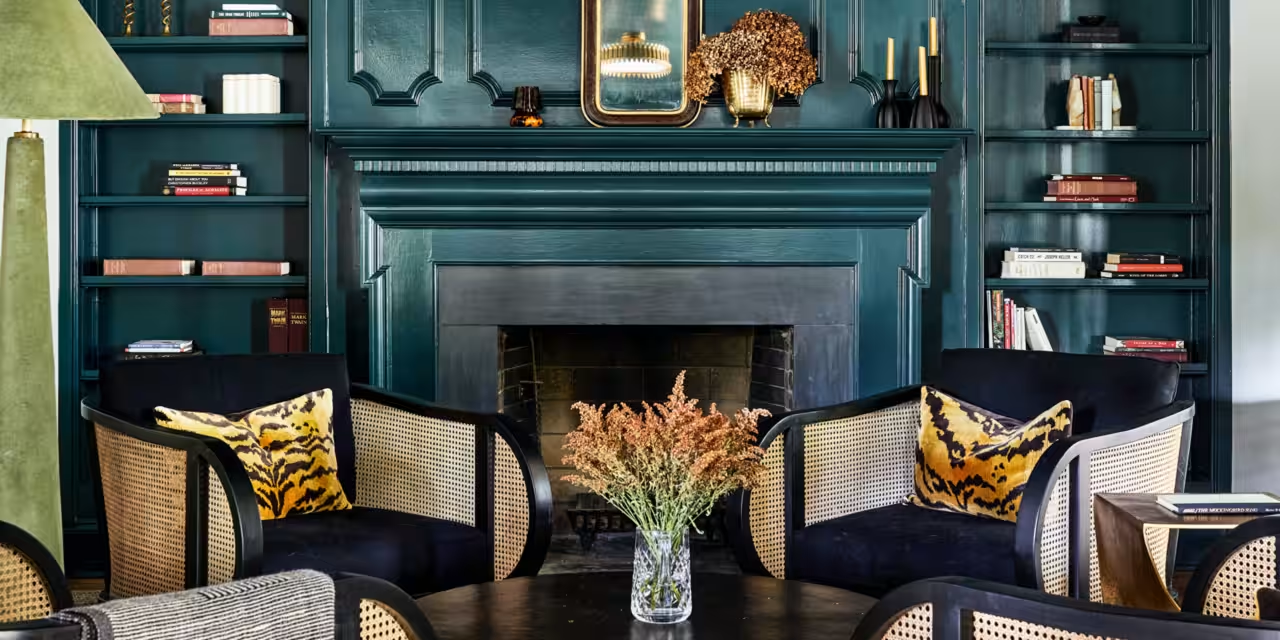
Color is the most straightforward design element to forge that inviting aesthetic. Swabb references a project in which she specified a high-gloss teal for the walls, ceiling and millwork. She says that the “inky” color adds drama but also makes the room feel like a little jewel box—cozy and collected, but not buttoned up. Likewise, she enveloped an elegant yet relaxed reading space in a warm, soothing terracotta. “Neither space takes itself too seriously, even though they’re both quite tailored,” Swabb says.
From Mansion Global Boutique: Outdoor Spaces Should Shine in All Seasons, Says Fernando Wong
Styling is the final piece of the design puzzle. “Bookshelves should hold more than just books. Mix in ceramics, framed art, found objects—things that reflect personality,” she adds. And don’t neglect lighting. She recommends layering table lamps, sconces, and a floor lamp with overhead lights. “It creates warmth and makes the space feel more dynamic.”
Designing an Area for Wine, Cocktails, and Convo
Areas dedicated to drinking and socializing are more popular than ever. The pandemic sparked the realization that we all need connection, and what better way than with a glass of your favorite wine, spirit, or brew in hand?
David Ries of Ries Hayes, an interior design studio in New York, says large home bars are making a comeback—upscaling the bar carts we’ve seen in recent years—as more people are entertaining and mixing cocktails in their residences again. These rooms should provide comfortable seating, warm and flattering lighting, and details such as vintage glassware and art, so the space encourages interaction, he says.
For avid wine collectors, Kristy Nye Nicholas of Ramsay Nye, an interior design studio with offices in Ann Arbor, Michigan, and Athens, Georgia, advises taking stock of your collection to accommodate existing wines and any forthcoming bottles. Also, consider how you’d like your bar room to function and what kind of atmosphere you’d like it to have.
“Is there a memory of a grandfather’s Chesterfield leather sofa and whiskey that they want to serve as the inspiration? Or is it the bar at an incredible boutique hotel where they spent their honeymoon? We love to use [a client’s] personal story as a jumping-off point for the design concept. It never fails to lead us to a space that is wholly unique to them,” Nicholas says.
Likewise, Ries muses about a project his team did on Eastern Long Island.
“Personal touches like a small Persian rug and a hand-carved African sculpture bring warmth and character, reminding our client of their travels and experiences,” he notes. “The goal is to create an environment that invites people to slow down and savor both the drinks and the moment.”
This article originally appeared in the Fall 2025 Issue of Mansion Global Experience Luxury.
‘ The preceding article may include information circulated by third parties ’
‘ Some details of this article were extracted from the following source www.mansionglobal.com ’