Many and perhaps most of today’s popular-music superstars are women: Beyoncé, Adele, Ariana Grande, Lady Gaga, Olivia Rodrigo, Billie Eilish, Chappell Roan, Sabrina Carpenter, and of course Taylor Swift. Beyond the headlines is a vast world of independent and assertive music creation. From the costumed, Black Sabbath–indebted metal stylings of Riley Pinkerton of Castle Rat through the UK jazz of Nubya Garcia and on to Molly Tuttle’s bluegrass-pop and Kathleen Edwards’s Americana, women are often the reason to listen to new music. Three new albums are representative of the spirit and originality women are now bringing to music on their own terms.
Madi Diaz, photo by Allister Ann
Madi Diaz is willing to open the door to her heart and invite strangers to stroll in. What they’ll find there is a churning mix of fear, anger, defiance, self-knowledge, and evolution. Not shy about being incisive, Diaz crafts songs that are by turns haunting and beseeching, then immerses them in the messy guts of love and all its maddening complications.
Fatal Optimist is Diaz’s sixth album and the last in what her latest artist bio calls the “Heartbreak Trilogy.” While its rawness, which often verges on obsession, can be startling, it can also be undeniably honest and powerful. In “Feel Something,” in which her eye for detail shines, she sings “I wanna be someone who doesn’t know your middle name.” Then she pushes her voice in the wishful choruses, “If you want me to make you feel something/If so how, if not why, if I can.”
Fatal Optimist is centered on Diaz and her acoustic guitar, but several other guitarists, including Waylon Rector and Hudson Pollack, plus Jake Weinberg on bass add fullness and texture. The hooks are subtle but very effective, as in the rising chorus of “Heavy Metal,” where, over a beautiful set of changes, Diaz sings about her heart. “It’s not gold, it’s not platinum/It’s not silver.” Despite the distinguished company, Fatal Optimist is Diaz alone with her guitar and voice, raw, emotional, and undeniably musical, bravely vulnerable and crying out for what it all means.
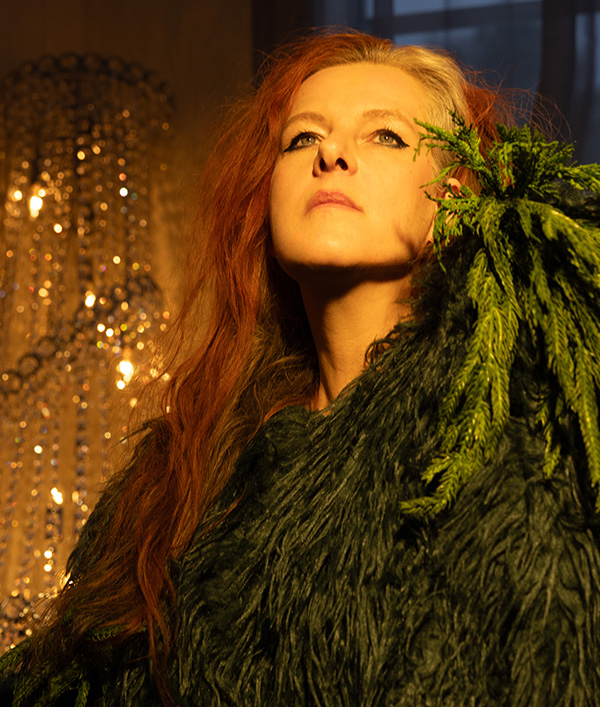
Neko Case, photo by Ebru Yildiz
Ever the unknowable individualist, Neko Case likes to spin out deliberately showy and enigmatic fables whose origins and significance may not be obvious, even to her, until she sings them. On Neon Grey Midnight Green, she once again unfolds the detailed musical swirlings that, delivered with such style and force, have practically become a genre to themselves: Neko World! In “Louise,” she states, “We’ll make the steak knife’s journey/To the center of a hornets’ nest/And emerge through the doorway/Of that impossible blue.” That (or whether) there’s autobiography in these ambitious productions seems both obvious and unclear, which is surely the point. Case loves to live behind and among such elaborate musical disguises.
Musically, Case’s original songs on Neon Grey Midnight Green, most co-written with Paul Rigby, are of a piece with the rest of her catalog. The short, rococo settings for her voice are more focused on flow and feeling than on familiar song structures or building toward hooks. Recorded in Vermont, where she lives, with parts recorded elsewhere and flown in when she and Tucker Martine mixed the album, this many-layered set required a small electric band of guitars, synths, and drums as well as the 15-piece PlainsSong Chamber Orchestra to realize her vision. It’s easy to be swept up in her shifting, complicated passions, whether or not they have a cogent thrust and meaning. Yet there are flashes when you’re allowed to see an unobstructed psychic full-frontal of the artist. In “Rusty Mountain,” she briefly snaps into focus: “Love songs mostly, sound the same /An exercise in futility, for me /But there’s a few who get away with it /They’ve some divergent insight I can’t find.”
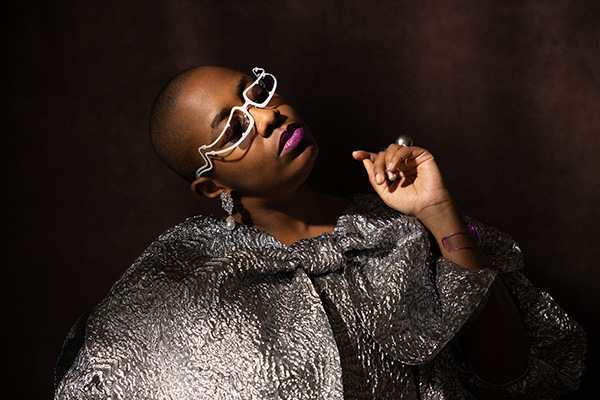
Cécile McLorin Salvant, photo by Ebru Yildiz
There are at least as many definitions of jazz as there are people who create it. It’s that ever-shifting, inclusive definition that continues to make the music such an unpredictable pleasure. Oh Snap, a new album from jazz experimentalist Cécile McLorin Salvant, a singer/songwriter who is one of the most striking creative forces in music today, is the audible result of Salvant plunging her toes into the world of “digital tools and effects that she had never played with before,” so says the press release. GarageBand, Logic, AutoTune, Midi plugins, drum loops, vocal effects, reverb, and filters all play a part in building this playful collection, which, according to Salvant, answers the question “How could I use music as a way of journaling?”
AutoTune, which she compares to “Photoshopping,” in the wrong hands can become audio poison or outright ridiculousness. But here, in “A Little Bit More,” she experiments with the overused effect by, in her words, going “full glam, full drag.” An iPhone voice-memo recording of Salvant singing an a cappella rendition of The Commodores’ “Brick House” (“She’s mighty mighty, just lettin’ it all hang out”) adds humor, a quality often lacking in jazz and anything jazz-related.
The musical equivalent of a sketchbook, this collection illustrates again and again the seemingly endless prismatics of Salvant’s musical interests and personality. Viewed in the context of her singular oeuvre—she won three consecutive Grammy Awards for Best Jazz Vocal Album and was nominated for three more—Oh Snap is a lesser work. Still, it is expressionism and originality carried to a high level, diminishing any judgments with its curious, adventitious seeing and learning.
‘ The preceding article may include information circulated by third parties ’
‘ Some details of this article were extracted from the following source stereophile.com ’