It’s official: “Chartificial intelligence” is here.
Breaking Rust, a new artist on the scene, is topping charts … but he’s not a real person. He’s a computer-generated outlaw blues-country singer.
“Walk My Walk,” a song from Breaking Rust’s October EP “Resilient,” is the No. 1 song on Billboard’s Country Digital Song Sales Chart, a list of the most-downloaded tracks in the U.S.

An AI-generated image of country artist Breaking Rust.
Rust has a husky, soulful voice à la Marcus King or Chris Stapleton. AI images depict him as a manly cowboy-type with a chiseled jawline and stubble. He wears a dark hat with a bandana tied around his neck.
“Walk My Walk” has over 3 million streams on Spotify, and Breaking Rust sports over 2.2 million monthly listeners. His other tracks “Livin’ On Borrowed Time” and “Whiskey Don’t Talk Back” are also top streamers.
“You can kick rocks if you don’t like how I talk / I’ma keep on talking and walk my walk,” he sings in the chart-topper that boasts authenticity. “Ain’t changing my tone, ain’t changing my song / I was born this way, been loud too long.”
The track has a stomp-clap rhythm that blends blues and country. But with compressed-sounding vocals and vague lyrics, “Walk My Walk” contains not-so-subtle hints of its artificial origins.
Following Rust’s song on the chart is Ella Langley’s “Choosin’ Texas,” and coming in third is “Don’t Tread On Me” by Cain Walker, another AI artist.
What we know about Breaking Rust
Breaking Rust came on the scene mid-October on Instagram, where he shares AI-generated lyric videos to his over 37,000 followers.
The Linktree in his Instagram bio says he makes “music for the fighters and the dreamers.”
But who’s the creator behind Breaking Rust?
The songs are credited to Aubierre Rivaldo Taylor, someone with virtually no online fingerprint. Taylor is connected to Breaking Rust and another AI music project, Defbeatsai.
The Tennessean has reached out to Breaking Rust on social media.
Breaking Rust comes at a crux for AI in entertainment
Breaking Rust isn’t the only AI-generated artist climbing the Billboard charts.
Earlier this month, Billboard said that at least six AI, or AI-assisted, artists have debuted with Billboard rankings over recent months.
Cain Walker, who placed on the country chart with Rust, also took the ninth and eleventh spots on the chart. Xania Monet, an AI R&B singer, became the first AI artist to debut on a Billboard radio charts in September.
This summer, AI psychedelic rock band The Velvet Sundown made headlines after reaching over 1 million listeners and topping charts.
As AI use in the music industry continues to increase, country artists have expressed frustration.
This year, Martina McBride testified in front of Congress asking for AI regulations. Garth Brooks, Darius Rucker, Luke Bryan, Lainey Wilson and Chris Janson have been vocal about their concerns around the technology.
Other corners of the entertainment industry have been affected by AI artists.
Tilly Norwood, an AI generated actress, has become the subject of controversy over previous weeks.
Framed as a synthetic talent by the company Particle6, the entertainment industry is up in arms over the threat Norwood could pose to real actresses.
More: AI actor Tilly Norwood looks startlingly real. Hollywood is not amused
Is AI music illegal?
In the case of Breaking Rust, the AI model that created his voice would have needed to pull from a vast database fed by the works of real country and blues artists.
Artists including Billie Eilish, Nicki Minaj and Stevie Wonder are among the many creators to have publicly opposed AI models training with their music.
At this time, there is no fail-safe way for creators to determine if AI companies have used their work to train models, which can violate copyrights of the works of countless artists.
Some U.S. senators have been working to find a solution.
In August, Sens. Marsha Blackburn, R-Tenn., Peter Welch, D-Vt., Josh Hawley, R-Mo., and Adam Schiff, D-Calif., introduced an act that aims to allow musicians, artists, writers and other creators the ability to see whether AI is training with their work.
More: Sens. Blackburn, Welch create TRAIN Act to fight back against AI’s use of songs without pay
The Transparency and Responsibility for Artificial Intelligence Networks, or TRAIN Act, would allow creators to access the courts to protect their copyrighted works.
There are no laws that require companies to disclose training information to creators, and very few companies choose to do so.

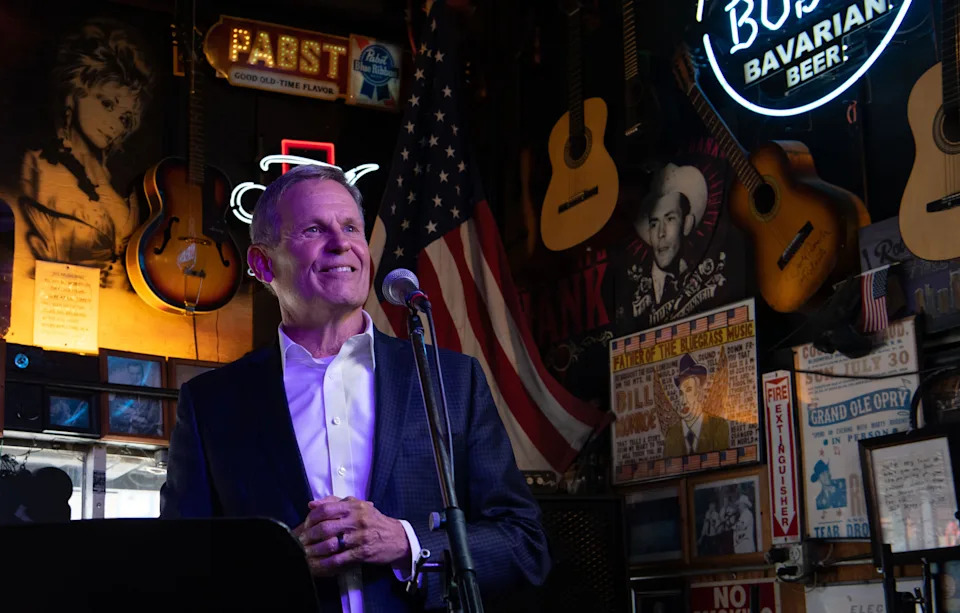
Gov. Bill Lee talks about the importance of the ELVIS Act to prevent unauthorized uses of artists’ voices and likenesses from AI technology at Robert’s Western World in Nashville, Tenn., Thursday, March 21, 2024.
In March 2024, Tennessee became the first state to pass an AI-focused law, the ELVIS Act, which protects individuals’ voice and likeness from misuse of AI.
The act added artists’ voices to the state’s Protection of Personal Rights law and can be criminally enforced by district attorneys as a Class A misdemeanor.
Artists, and anyone else with exclusive licenses, like labels and distribution groups, can sue civilly for damages.
The No Fakes Act, a similar national bill, has been introduced in both the House and Senate.
Audrey Gibbs is a music journalist at The Tennessean. You can reach her at [email protected].
This article originally appeared on Nashville Tennessean: Who is Breaking Rust? AI generated country song tops Billboard chart
‘ The preceding article may include information circulated by third parties ’
‘ Some details of this article were extracted from the following source www.yahoo.com ’