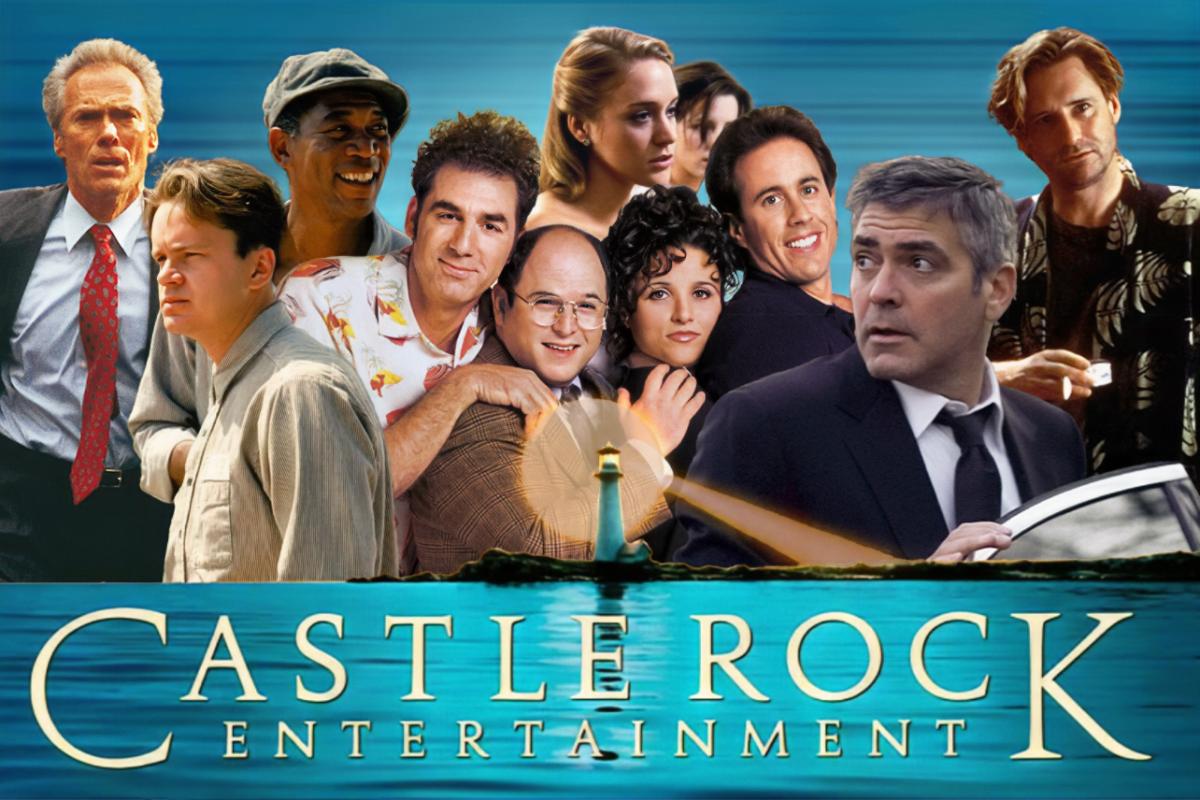
You know the music and the image if you’ve ever let a Seinfeld rerun roll right into the next Seinfeld rerun on cable, or, if you’re old enough, late-night syndication. A shortened swell of music accompanying a lighthouse flashing its beam across the screen, announcing the involvement of Castle Rock Entertainment. Seinfeld was the shingle’s signature TV smash, an easy contender for the greatest sitcom of all time. That show, and dozens and feature films from the ’90s and beyond, might not have existed without the late Rob Reiner, who co-founded Castle Rock in 1987.
Reiner’s name isn’t all over various Castle Rock productions as producer. His producing credits are mostly confined to the movies he directed for his company over the years. But Reiner was invested in the company, named for a fictional Maine town out of Stephen King’s books – an impressive bit of shot-calling, considering that at the time, Reiner had only made Stand By Me. He would go on to direct a film version of King’s Misery, with Castle Rock also producing King adaptations Needful Things, Dolores Claiborne, The Green Mile, Hearts in Atlantis, Dreamcatcher, and most notably The Shawshank Redemption, which Reiner himself had eyed to direct. When screenwriter Frank Darabont refused to relent in his desire to make the movie himself, Castle Rock still produced it, and per this BlueSky thread from critic Drew McWeeny, Reiner considered it their best film to date. (Lucky for Darabont, Reiner’s own Stand By Me, still probably the best non-horror King adaptation and maybe the best one full stop, predates the company’s existence.)
Shawshank had plenty of competition well outside of the King bibliography, too. Castle Rock made movies as varied as their distributors and ownership would eventually become (Columbia put out a lot of their earlier movies; Turner acquired them and paired them with New Line Cinema in the early ’90s; Warner Bros. then bought Turner and its companies, and eventually absorbed Castle Rock in the early ’00s, slowing their output to a few films a year before the company eventually reverted to more or less whatever Reiner was working on). In fact, it seems likely that the company didn’t last longer as a major producer of films because it was so determined to support an eclectic group of films and filmmakers beyond the most commercial (or vanity) projects.

Some of their stuff, like King adaptations, Billy Crystal comedies, and Christopher Guest movies, felt like extensions of Reiner’s work early work. But the company also produced multiple Shakespeare adaptations (Kenneth Branagh’s uncut Hamlet; Othello, co-starring Branagh and Laurence Fisburne); movies from Richard Linklater (Before Sunrise and its sequels; SubUrbia) and Whit Stillman (Barcelona; The Last Days of Disco); a variety of Sandra Bullock vehicles (the Miss Congeniality movies; Murder By Numbers; Two Weeks Notice); a couple of Eastwood movies (In the Line of Fire; Absolute Power) and some great one-offs like Zero Effect and Michael Clayton (though by the time Clayton came out, the company was pretty wound down).
If there’s anything that unites these disparate titles, it’s the sense that mainstream, mass-appeal movies don’t have to be dumbed down or devoid of artistic intent. There’s a faith there, that adult audiences would like to see faithful Shakespeare adaptations, or witty indie comedies like Last Days of Disco, or a thorny western-mystery like Lone Star from John Sayles. In the Line of Fire, with Eastwood as an aging Secret Service guy trying to thwart a presidential assassination planned by madman John Malkovich, is a consummate grown-up summer movie, and became one of the company’s biggest hits. Even Seinfeld, broad and silly and mass-appeal as it became, was a sitcom born from the highly specific, sometimes hilariously prickly sensibilities of its star and his collaborator Larry David. It was not Friends, network-engineered and hot-young-actor-cast for maximum youth appeal. It was singular.
“Castle Rock proved that mainstream, mass-appeal movies don’t have to be dumbed down or devoid of artistic intent.”
That’s not to say every Castle Rocker was a winner; their co-production The Adventures of Pluto Nash is an all-time Eddie Murphy bomb, a laughless and lifeless sci-fi comedy. Also, someone on the Castle Rock team evidently had a real Hugh Grant fixation; they released half a dozen of the man’s movies of the course of 20 years. One of their only non-Reiner movies of the 2010s was a little-seen Grant rom-com with Marisa Tomei called The Rewrite.
But if the company seemed to sometimes show too much faith in their favored stars or King source material, it was thrilling to see them invest time and money in something like Zero Effect, a Sherlock Holmes riff from writer-director Jake Kasdan that predates a number of more popular (and more direct) modern versions of Holmes. In it, Bill Pullman gets perhaps his finest role as a reclusive, socially maladjusted private detective, bouncing off of Ben Stiller as his beleaguered assistant. It’s a terrific movie; Kasdan has made some fun comedies since then, but nothing this smart, funny, or heartfelt, probably because this one bombed at the box office in 1998.

Castle Rock may continue following the tragic deaths of Reiner and his wife Michele, who announced a relaunch of the company in 2021. If so, it’ll face an uphill battle through a consolidation-happy Hollywood that has been crossing favored Castle Rock-favored subgenres (romantic comedy, adult-driven thriller, Shakespearean drama) off its viability list for years. (King, however, remains big business.) But one company continuing to produce movies like In the Line of Fire, Last Days of Disco, Before Sunrise, and Zero Effect would be a wonderful tribute to Reiner’s legacy.
Jesse Hassenger (@rockmarooned) is a writer living in Brooklyn. He’s a regular contributor to The A.V. Club, Polygon, and The Week, among others. He podcasts at www.sportsalcohol.com, too.
‘ The preceding article may include information circulated by third parties ’
‘ Some details of this article were extracted from the following source decider.com ’