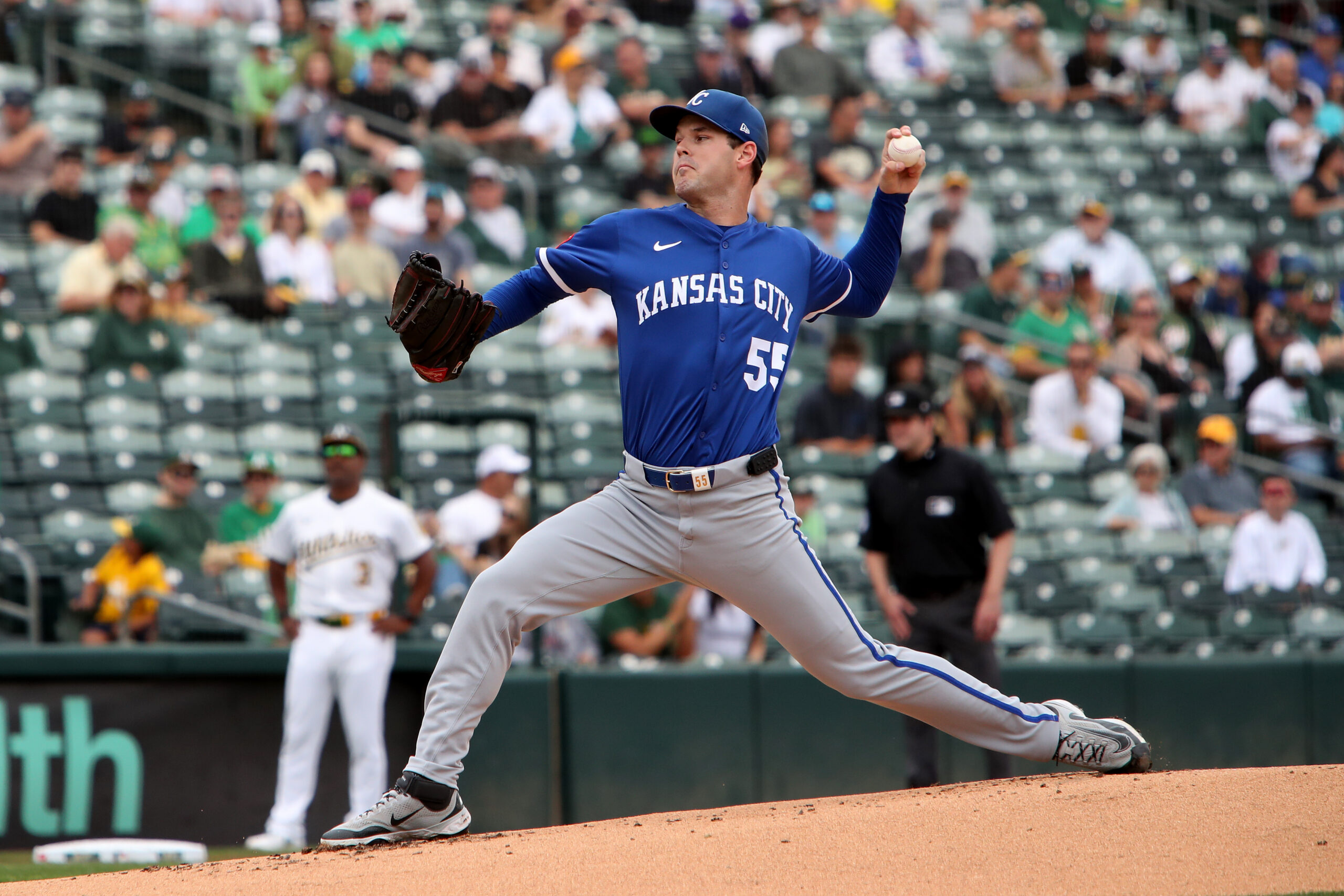
J.J. Picollo’s stance creates clarity for everything that comes next. If Ragans stays, Kansas City’s real job is measurable. Build a staff that delivers 900 to 925 regular-season innings from the rotation, produces at least 18 to 20 pitching WAR overall, and limits Ragans to roughly 150 to 160 controlled innings. Hence, he is still dominant in October. Anything short of those benchmarks is not a plan. It is riding one arm until July and hoping the math works out later.
The Royals do not need drama. They need depth, durability, and a bullpen that can finish.
The Rotation Is Better Than It Looks and More Fragile Than It Should Be
But paper does not throw innings in August.
That means Kansas City cannot build a plan that assumes 165-175 innings from Ragans. They have to develop a plan that survives the games he misses, the shorter starts, and the stretches where the training staff has to be the adult in the room.
Now layer in the rest:
- Wacha gave them 172.2 innings with a mid-3s FIP. That is real value, but he is not a long-term bet to carry a staff on his own. (FanGraphs Baseball)
- Bubic looked like a stabilizer with a 2.55 ERA and a 2.89 FIP across 116.1 innings. That is a legitimate building block if the health holds. (FanGraphs Baseball)
- Cameron’s rookie line was strong on the surface, but his 4.18 FIP raises the question every smart club asks: how repeatable was it? (FanGraphs Baseball)
- Lugo ate innings, but his 5.09 FIP is a warning light, not a trophy. (FanGraphs Baseball)
This is why pitching depth is not a slogan for Kansas City. It is math. Two additional league-average pitchers, worth roughly 2 WAR apiece, add four marginal wins over a full season. Those innings absorb short starts, protect the bullpen, and turn losses in June and July into wins. That is the difference between an 86-win team hovering near the cut line and a 92-win team that controls its path into October.
One Injury Already Changed the Whole Map
That matters because Marsh was supposed to be one of the swing pieces. When he went down, the Royals lost the pitcher designed to absorb short starts. The dominoes showed up in July. A typical example looked like this: a starter exited in the fourth inning, the bullpen covered five-plus innings, six relievers were used, and Kansas City lost a one-run game late because its leverage arms were unavailable. That was not a one-off. It became a pattern. When a team burns its bullpen on Tuesday, it pays for it on Thursday. That is how one missing swing starter quietly turns a competitive July into a losing one.
It forces a chain reaction:
- More bullpen innings early in the season.
- More bullpen innings when the rotation has a short start.
- More pressure on your seventh and eighth inning arms.
Marsh being out pushes Kansas City toward one clear conclusion: they need at least one more starter-quality arm in the organization who can give real innings, not “hope innings.”
The Bullpen Is Good, But The Royals Still Need One More Weapon
Kansas City’s bullpen numbers in 2025 show a respectable unit. Team relief pitching finished with a 3.63 ERA and a 4.01 FIP, placing the group firmly in the league’s competitive middle. That profile reflects a bullpen that limited runs over a full season but still lacked a consistent bat-missing presence in late-inning leverage. It was functional. It was not decisive. (FanGraphs Baseball)
That is not the issue.
The issue is how the bullpen wins in October.
October bullpen arms do two things:
- They miss bats, and
- They can handle leverage without needing perfect matchups.
Strahm Helps, But It Does Not Finish The Job
Now they need the following piece: a true bat-misser in leverage, ideally another lefty, but at minimum a reliever who can take the ball in the eighth with the season on the line.
Bullpen Targets That Fit The Royals: Affordable, Functional, And Built For Leverage
This is not about chasing the biggest name. It is about fit.
Here is how I would frame the target profile for the Royals:
- One left-handed reliever who can miss bats or suppress damage against left-handed power.
- One multi-inning or “bridge” arm who can cover the sixth and seventh when the rotation goes five.
- One depth arm who is optionable or can move between Kansas City and Omaha without breaking the roster.
Events That Can Affect The Rotation And Bullpen, And Why Kansas City Must Plan For Them
The Royals have to plan for predictable stress points, not react to them.
Ragan’s workload management. His 2025 innings total forces Kansas City to be disciplined. Cole is the ace, but he is also a human arm.
Marsh’s absence. You do not replace a swing starter with vibes. You replace him with another starter-quality arm, or you pay for it with bullpen fatigue.
Aging innings from veterans. Wacha and Lugo carried big workloads. That can turn fast in-season if either hits a dead-arm stretch or misses time.
The roster limit. With 13 pitchers, Kansas City’s bullpen must include versatility. If you cannot cover multiple roles, you do not survive a summer of short starts and extra-inning games.
The Standard Must Be A Staff, Not One Star
Keeping Cole Ragans is the right call. Picollo said it plainly: when Ragans is right, he is as good as anybody, and the team is built around pitching.
Now the front office has to finish the assignment.
This is the path. Protect the rotation core. Add one starter-depth arm who can give real innings. Add one leverage reliever who can take the eighth inning without blinking. Pick them now, not in theory. One free-agent arm. One realistic trade target. If those two decisions cannot be made today, the plan will still be unfinished.
The Royals do not need a headline. They need a staff that can take a punch in July and still throw fire in October.
Main Photo Credits: Dennis Lee-Imagn Images
‘ The preceding article may include information circulated by third parties ’
‘ Some details of this article were extracted from the following source lastwordonsports.com ’