Today’s most creative young artists are reshaping recording in their own image. Charlotte Gardner talks to some of the most innovative figures about what the art form means to them
One-of-a-kind timbral magic from a dusky-pure solo soprano in whimsical, new-music communion with clarinet, harp and double bass … The constantly transcribing guitar virtuoso lifting Hildegard von Bingen into electric duet with Chick Corea … The poles-away-from-Elgar English string orchestra uniting William Byrd, Claude Vivier, Richard Strauss and Oliver Leith with knife-edge intensity … The viola player opening up new repertoire horizons for his instrument through the fizzing beauty of his sound … The harpsichordist speaking baroque with such unfettered ownership and soul that his major record label allows him to record the complete works of Louis Couperin across 10 albums (released physically as an 11-disc box-set).
Five sets of artists, with five unique audio thumbprints playing out across five fast-expanding discographies. And all are still so firmly younger-generation in age that whether or not you’ve already identified them as The Hermes Experiment, Sean Shibe, 12 Ensemble, Timothy Ridout and Jean Rondeau, you can perhaps appreciate why – as my eye travels across my desk from the treasured framed Yehudi Menuhin autograph to my laptop streaming a zingingly creative debut album from young period-instrument band the Bellot Ensemble (look it up: ‘Cupid’s Ground Bass’ on First Hand Records) – I believe that it’s now time to stop describing the mid-20th-century period in which Menuhin was in his prime as recorded classical music’s ‘golden age’. That was a golden age. Now we are in another, and it’s young-artist-led. Twenty-somethings we could add to the pile include violinist María Dueñas, pianists Alexandre Kantorow and Yunchan Lim, and conductor Klaus Mäkelä (turning 30 this month). Over in the historically informed performance world, a glittering new baroque community has risen up to explode from our stereos – musicians such as lutenist Thomas Dunford, soprano Lea Desandre, violinist Théotime Langlois de Swarte, keyboardist Justin Taylor and of course the aforementioned Rondeau. For these artists, the baroque language sounds less learnt than simply theirs, burning with contemporary truth and passion. Meanwhile, in opera, where would we be now without soprano Lise Davidsen?
All the above represents only the scantest skimming-off of some of the youngest, highest-profile, most recently established, technically superlative – there has never been a more technically polished generation – and authentically unique cream; and it’s also worth remembering that although pianists Benjamin Grosvenor and Daniil Trifonov have both been releasing albums since 2011, they’re still only 33 and 34 respectively.
Max Ruisi
Consider too that this new generation of committed recording artists coincides with digital streaming having rendered it largely impossible to make any serious money from a classical recording, and less intrinsically prestigious even to release one. It is now easier than ever either to self-release or to pay one of the many small independent labels to put your album out. Yet here we are. And this is perhaps partly because although this overcrowded landscape makes it harder for an album to cut through the noise than it was 30 years ago, these opportunities have offered a greater number of talented young artists the possibility to try. In fact, the recording world’s especially exciting development is precisely the emergence of a new breed of self-starting creator-commissioner-experimenter-collaborator musicians, largely to be found away from the major labels, who are slowly growing highly distinctive discographies that are expanding the classical catalogue in terms not only of expression but also of substance.
The leading specialist classical labels are particularly hot on scooping up and running with this new class of artist. Harmonia Mundi, Pentatone, BIS, Delphian and Chandos all have some. As for the teeming hotbeds, there’s Apple-owned Platoon – actually a multigenre newcomer to classical, but one in whom trailblazers such as pianist George Fu, conductor Dalia Stasevska, 12 Ensemble and the Ruisi Quartet have found a natural partner; and Alpha Classics, whose ever-expanding younger-generation family includes Justin Taylor and his ensemble Le Consort, the Leonkoro Quartet, soprano Julie Roset, mezzo Adèle Charvet, accordionists Ksenija Sidorova and Théo Ould and, making his debut this year, 20-year-old pianist Vsevolod Zavidov, a deep-thinking pupil of Nelson Goerner who looks exceptionally promising.
‘For today’s younger generation, pursuing a career is probably much more complicated than before,’ comments Didier Martin, CEO of Outhere Music (of which Alpha forms a key part). ‘It’s also a generation of unparalleled artistic talent, with a unique level of knowledge. They have embraced all the waves of rediscovery, such as historically informed performance. They mix all this knowledge with what charismatic musicians like Bernstein, Argerich and Gould have contributed. Plus, they are less confined to “their” world – they’re listening to pop, electro … So that makes for an exciting “incubation”. It’s obvious that it should be a label priority to support them. They are the future of music.’

Laura van der Heijden
The reasons why this generation wants to record in the first place, though, are where it gets really interesting. On the one hand, it’s quite simple: a well-received professional recording still has the power to present and validate an early career, fuelling the live concert side where the actual money is made. Hence why it’s a rare week when one or two new debut recordings aren’t landing on my own desk. Yet when it comes to the truly imagination-capturing contingent among these young musicians, there are actually far deeper philosophies at play than mere career progression and earning a crust; and excitingly for the rest of us, these philosophies essentially boil down to one thing: the abiding belief in recording as an art form.
In fact, if you want to talk about what recording means to younger musicians, you could do a lot worse than to begin with how much recordings per se mean to them; because for many, it’s not just knowledge, but utter love and fascination, including love for the truly historical section of the archive. This is eloquently outlined by the pianist Julia Hamos, whose 2025 debut album ‘Ellis Island’ (Naïve, 7/25) caught Gramophone’s attention with the expressive creativity of its journey from Meredith Monk and György Kurtág to Charles Mingus and Béla Bartók. ‘I am an audiophile,’ she enthuses. ‘I think if I didn’t play, I would be a sound engineer. It is an endlessly fascinating art form in itself. From old recordings of Ilona Eibenschütz, Bartók, Dohnányi … to Annie Fischer, Edwin Fischer, the Busch Quartet … to Murray Perahia and Christian Tetzlaff … I have even tried to imitate some of my favourites to see how they played and scratch at the surface of their artistic vision. Then there’s Billie Holiday, Pink Floyd, Radiohead, even Billie Eilish – that list too goes on and on. For all the scary things the internet can be, having access to these musicians’ statements has been most educational.’
To focus squarely on what recording means in this context, we begin with the firm expectation, held by so many of these musicians, that recording professionally will be an essential element of any successful performance career. Take The Hermes Experiment, founded in 2014 by soprano and composer Héloïse Werner, clarinettist Oliver Pashley, harpist Anne Denholm-Blair and double bassist Marianne Schofield, and which is now three brilliantly and daringly different albums into its discography on Delphian. Its debut, ‘Here We Are’ (9/20), was from a critic’s perspective a watershed moment, catapulting to widespread recognition the ensemble’s unique constellation of instruments and the brand new repertoire it had created for it. Yet, while Werner acknowledges that recording success has led directly to more UK concert dates and kickstarted overseas appearances, her response to the question of what recording has brought to the group has a wider angle, coloured by her understanding that their readiness to make recordings said a lot about where the group was in its development. ‘Recording has been a very important step,’ she says. ‘We were quite an odd group, in that we were going to record stuff by living composers that had not been recorded before, or new arrangements of older works but in a new light. So it took us some years to create enough of a body of it to record; even if people don’t see us live, they know about us and they are able to enjoy all this new music that we’ve commissioned and created.’
So for the Hermes Experiment it was a question of ‘when’ not ‘if’ – about sharing something believed to be worthwhile, as well as being uncompromising in the representation of one’s musical personality. This is something Werner says Delphian has given them the freedom to do from the start, and with ever-increasing trust as the years have rolled on. ‘I don’t think I would be interested in recording something that’s been recorded 20 times before,’ she muses. ‘I know people do do that, and I know that can still have value. But what I guess is reflected in the kind of recordings I make, both with The Hermes Experiment and now also with my solo albums, is performing with artists that I really gel with and admire, and putting out something that’s never been done before. And I also love recording! It’s a very different mindset from live performance – one in which relaxing and demanding meet in the middle in a very exciting way for me.’
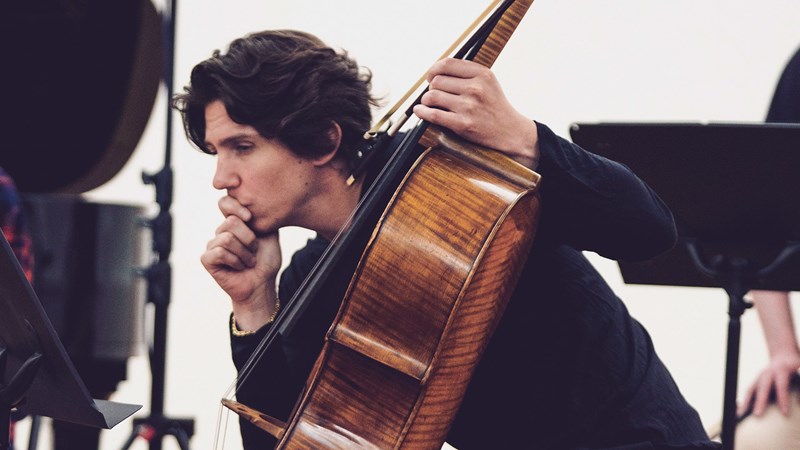
For Max Ruisi, cellist co-founder of 12 Ensemble and the Ruisi Quartet (founded respectively in 2012 and 2013), the recording impetus for both his groups has always been having something they wanted to say – beginning with 12 Ensemble’s powerful debut album, ‘Resurrection’ (Sancho Panza, 11/18), which presented the premiere recordings of Bryce Dessner’s Réponse Lutosławski and Kate Whiteley’s Autumn Songs (their own commission) alongside Lutosławski’s Musique funèbre and John Woolrich’s Ulysses Awakes. Ruisi says, ‘With “Resurrection” there was a tiny bit of wanting to translate on to record that we weren’t just another string ensemble playing English string music. But the real trigger was our thinking, “Oh wow, the ensemble is sounding really good and no one’s putting out records like this or putting on concerts quite like we are – so let’s document that and see if we can bring it to more people.”’ The Ruisi Quartet, meanwhile, waited a whole decade before recording its own powerful debut, ‘Big House’ (Pentatone, 5/23), pairing Haydn with Oliver Leith.
Underlining the fact that none of this has been about profile or money, 12 Ensemble has with all its albums done the opposite of what you’re ‘supposed to do’ commercially – in that it has always recorded a programme only after years of playing it, and never again played the album live afterwards. Perhaps this has even upped the sheer fluent authenticity and do-or-die electricity of the finished products. Either way, it clearly hasn’t held back their concert career. In fact, the group’s success now looks set to spark a new chapter in its recording narrative. ‘The motivations are still the same,’ qualifies Ruisi. ‘We still have to have something to say. But whereas before years of playing might have passed between albums, during which we’d often repeat the repertoire we’d eventually record, we’re now doing quality programmes or projects all the time, and not often getting to repeat them. For instance, at Wigmore Hall recently we programmed some Rautavaara, Stravinsky, Messiaen, an amazing new piece by Isabella Gellis, Many Fruited Dog Tooth, and then Rudolf Barshai’s arrangement of Ravel’s String Quartet. The feedback was unbelievable, it would be rare to put on that programme again, and it’s such a shame that there’s not a document of that event. So I’m becoming more and more excited by the idea of more live releases, so as to document these special moments in time.’
Equally important is the documenting of relationships with composers, and thus of music history. The Ruisi Quartet has for instance just released a recording including Növények (2022), the Hungarian folk-song cycle with piano sextet accompaniment written by Thomas Adès for the quartet plus mezzo Katalin Károlyi, double bassist Graham Mitchell and pianist Joseph Havlat. ‘Although other people are going to play it amazingly well,’ says Ruisi, ‘to leave a record of the playing and the energy of the people who worked with him on it for two years and did the original reading of the first-ever version – of course, we had to do it.’
This sense of responsibility to musical posterity is something that Sean Shibe, as a guitarist, arguably feels even more strongly about. His own discography could be taken for a conscious attempt simply to be different, it being such a story of self-penned arrangements of music originally for other instruments, and premieres. Indeed, his own forthcoming album features an Adès premiere, Forgotten Dances (2023), commissioned for him via the ECHO Rising Stars scheme and already available as an EP release giving a first glimpse of the whole. However, for Shibe this isn’t even simply about musical documentation, but about the guitar itself. ‘Recording has to be putting stuff out there that the world should have,’ he states. ‘The relationship with Tom resulting in Forgotten Dances is really important to me, and the piece is also important on the level of the history of the instrument, which hasn’t had a commission of that length in some time. Also on the album is Harrison Birtwistle’s Construction with Guitar Player (2013), also in its premiere recording, which I think is strange – that Julian Bream commissioned it and then nobody recorded it.’ He continues, ‘In the 20th century, the classical guitarist’s career was doing the famous rep, but commissioning was really, really normal. Now, somehow, with general conservatism related to the decline of the record industry, people’s view of the guitar has become more conservative and sweet – I wouldn’t have wanted to have that sort of career, so there was no point in settling for anything less. I’m lucky in that Pentatone has supported me a lot with these slightly stranger projects – and that Bach transcriptions and the South American repertoire are also important to me, and these stream well!’
Speaking of which, if anyone is wondering whether playlists feature even remotely in any of these artists’ album planning, the answer is an emphatic ‘no’. A topic that feels more relevant is the sense that perfection in recorded performance has gone too far; that there’s a better balance to be found between truth and palatability, or even that the nature of perfection needs to be redefined. Werner enjoys the possibility of tweaking tuning, but doesn’t want ‘to be absolutely perfect in that way that’s a bit clinical’. Shibe comments, unprompted, ‘I’m now so much fonder of strange noises. Listening today to some first edits, I’ve been noticing my breathing is quite heavy, and I’m kind of growing fond of it; whereas I think at the beginning I was really searching for a sanitised idea of a perfect performance.’ Then as I ping emails back and forth about this article with Laura van der Heijden, whose own recent contributions to catalogue expansion include the first recording of Cheryl Frances-Hoad’s cello concerto written for her in 2022, Earth, Sea, Air (Chandos, 7/24), she comments wistfully, ‘I think many musicians miss the days of rougher-edged recordings with more character and more imperfections. Imperfections make us human.’ And sounding human is about to become even more important than ever, as Ruisi points out: ‘AI will do the “perfect”. What it can’t do is the unbelievable, the slightly unconventional and maybe slightly out of tune, but the, “Oh my God, that sounds amazing!”’
The perfection that they all want, though, is of the capturing sort. ‘There always has to be a place for really well-made sonic experiences,’ emphasises Shibe, ‘and that’s always going to fill a place that is impossible to be filled by Instagram or YouTube. Instagram’s metrics want a selfie cam with a terrible microphone. Each album for me – and I think also for Max and Héloïse – is about the creation of an artistic object. If we deviate from that, that’s when the end comes.’
The end, though, is clearly not coming any time soon. And lest we forget, it isn’t simply the specialist classical labels that are boldly following this new generation’s visions. It’s on Decca that violinist Randall Goosby is building a unique, catalogue-expanding discography; and on Warner Classics/Erato that Thomas Dunford and Lea Desandre are breathing new life into period performance, cellist-vocalist-composer Abel Selaocoe is blending African sounds with the baroque, and Rondeau has released his Couperin. Head of Artists and Repertoire at Warner Classics is Bertrand Castellani. ‘I attach great value to the past and its legendary musicians,’ he says, reminding me that his former role at the label was as head of catalogue. ‘But suddenly I think we are in an age where a lot of very singular moments of amazing quality are still happening in classical recording. As for “Why now?” I think we have to be a bit modest and admit that we don’t know; that some things are just how history pans out. But when you see a guy with the energy of Jean Rondeau building on this now 120-year-old catalogue … Frankly, it makes me smile.’ And us at Gramophone too.
‘ The preceding article may include information circulated by third parties ’
‘ Some details of this article were extracted from the following source www.gramophone.co.uk ’