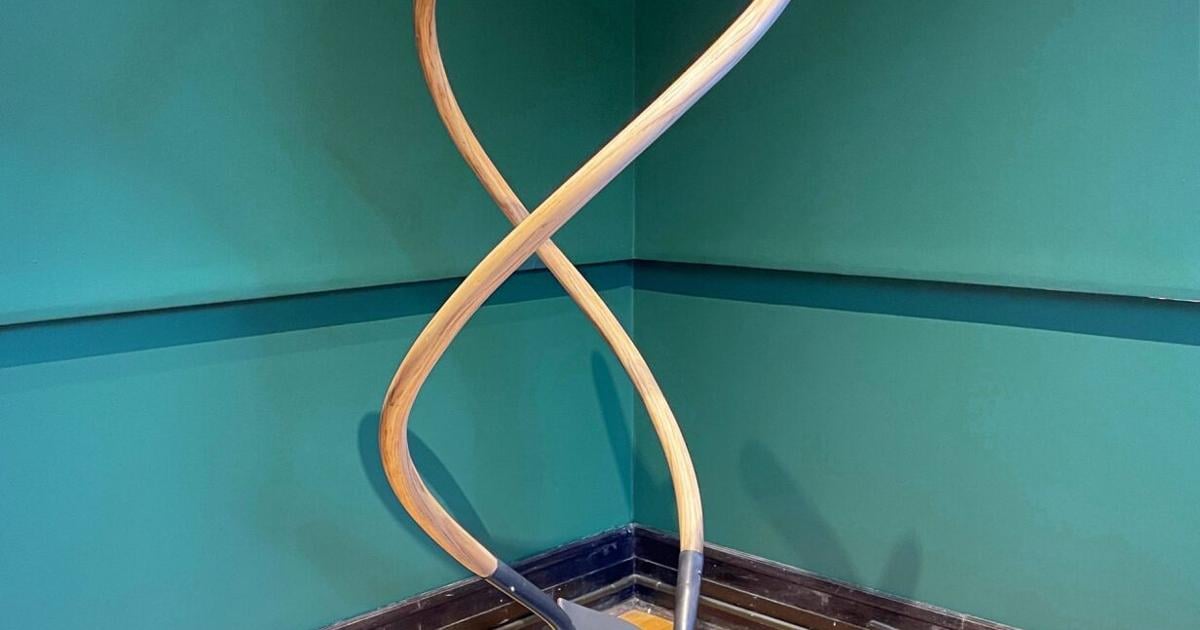
BRATTLEBORO — Two long-handled shovels twist together like strands of DNA. Drawer pulls take the form of a barber’s scissors and combs. In the Brattleboro Museum & Art Center (BMAC) exhibition “The Purpose of Your Trip,” artist Elliott Katz of Burlington transforms familiar tools and heirlooms into sculptural reflections on migration, family history, and the ways personal objects carry memory across generations. Katz’s first solo museum show is on view at BMAC through March 6. Curated by DJ Hellerman, the exhibition is supported in part by BMAC’s Wolf Kahn & Emily Mason Exhibition Endowment Fund.
“The objects in ‘The Purpose of Your Trip’ reflect the complexity of Katz’s grandparents’ lives, shaped by war, displacement, and a deep commitment to human dignity,” Hellerman says in a news release. “At the same time, they speak to the life Katz is actively building today — one rooted in care, creativity, and the ongoing pursuit of a world that values big, open, and independent thinking.”
Katz’s artistic practice bridges traditional craftsmanship and contemporary technology, drawing on his Japanese American family’s history to create charged, human-scaled sculptures from everyday materials, according to the release. The exhibition traces his family’s journey across North America — from immigration in the 1920s, to incarceration during World War II, to the building of a life in Vermont — while reflecting on the ongoing process of self-invention.
Installed in the former ticket office of BMAC’s historic Union Station building, “The Purpose of Your Trip” explores themes of transit, borders, and passage. The site-specific installation allows the 1915 building’s windows and shifting light to evoke movement and impermanence. It includes a large-scale reproduction of a 1942 photograph of Katz’s ancestors, taken by renowned photojournalist Dorothea Lange, as part of her effort to document Japanese American incarceration camps for the War Relocation Authority.
Throughout the exhibition, Katz reimagines tools and heirlooms as sculptural forms. A replica of the suitcase carried by his great-grandfather into the Manzanar incarceration camp is rendered in alternating bands of black walnut, sapele, and ash, transforming its original fabric pattern into precious material. Bronze drawer pulls molded from his grandparents’ barber tools temporarily replace the gallery’s existing hardware, subtly weaving family history into the physical fabric of the space.
Other works reflect Katz’s present-day experience of cross-border family life. The title of the exhibition references the question Katz routinely answers while crossing the U.S.–Canada border to visit his partner and son in Montreal. Sculptural replicas of a passport and a soccer ball, repaired using the Japanese technique of kintsugi, highlight themes of separation, connection, and reparation.
Together, the works in “The Purpose of Your Trip” weave past and present into a meditation on displacement, resilience, and the quiet conviction required to build a meaningful life.
BMAC is open Wednesday through Sunday, 10 a.m. to 4 p.m. Admission is “pay as you wish.” The museum is supported in part by the Vermont Arts Council and the National Endowment for the Arts. Additional support is provided by the Brattleboro Food Co-op, Brattleboro Savings & Loan, Brattleboro Subaru, C&S Wholesale Grocers, and Sam’s Outdoor Outfitters.
For more information, visit brattleboromuseum.org.
‘ The preceding article may include information circulated by third parties ’
‘ Some details of this article were extracted from the following source www.reformer.com ’