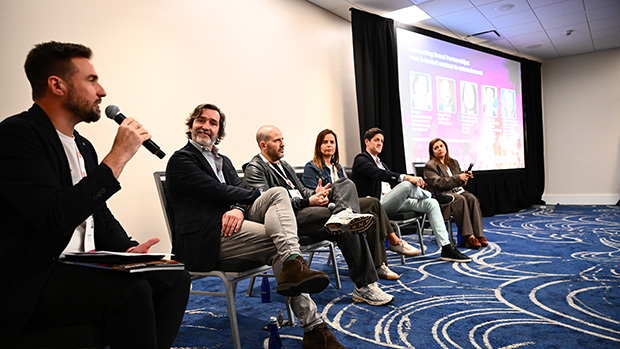
The Reinventing Brand Partnerships: From Branded Content to Entertainment panel at Content Americas
CONTENT AMERICAS: The current state of the industry has created ideal conditions for the growth of branded entertainment, execs at companies including The Lego Group told Content Americas this week.
However, that growth is dependent on producers and advertisers moving away from overly intrusive messaging towards genuine entertainment capable of competing on equal terms with non-brand-funded content, delegates heard here in Miami.
“We’re in the best possible moment,” said Poncho García-Valenzuela, CEO of IPG Mediabrands Entertainment. “Two or three years ago, when a proposal involving a brand arrived, people on the content side would hold their noses and ask the commercial team, ‘How much money is behind it?’ That phase is over. Today, brands are able to make content with real value.”
García-Valenzuela pointed to several projects from IPG Mediabrands as examples of this shift, including A una isla de ti, an LGBTI-focused romantic comedy produced with Morena Films and Canary Islands Tourism.
He also cited Andorra Cycling Masters, developed with Wakai for Andorra Turismo, which later attracted additional partners including Red Bull, as well as brands from the banking and insurance sectors.
“They ended up joining an idea that may initially have seemed crazy to them,” he said. “But it was possible because a brand like Andorra Turismo supported the project from the very beginning.”
The importance of entertainment content to brand engagement was reinforced by Lego’s Felipe Baquero, who said entertainment is now the Danish toy giant’s second most important point of contact with children, surpassed only by parental recommendation.
“Content is Lego’s second gateway to consumers,” said the LA-based exec, who oversees content distribution and partnerships for the Americas for The Lego Group. “Not advertising campaigns or billboards, but experiential and experimental content. Audiences form an affinity with Lego characters, and we extend that experience through entertainment content.”
Baquero highlighted Lego’s recent collaboration with Formula 1, in which drivers raced Lego-built cars made from 400,000 bricks on the day before the Miami Grand Prix. The event generated a 45-minute documentary that the company is now taking to the market.
“For me, traditional branded content is completely obsolete,” Baquero added. “It makes no sense to force people to buy Lego. What’s needed are different kinds of experiences: entertainment that reinforces the brand indirectly, by accompanying the audience – experiences that aren’t fleeting but that consolidate brand image and are felt when it comes time to purchase.”
Other executives on the panel, moderated by Cveintiuno co-editor Gonzalo Larrea, echoed this view, including Rosângela Wicher, executive director of operations and business at Sony-owned Brazilian producer Floresta.
The company this week won a Rose d’Or Latinos Award for best digital-first programme https://www.c21media.net/news/winners-of-the-third-annual-rose-dor-latinos-awards-revealed/ for Shark Tank Creators. However, Wicher cautioned that delivering branded entertainment remains far from straightforward.
“There is very little margin within brands to truly co-create and connect the product with the widest possible audience,” she said. “When it happens it’s wonderful, but it requires a level of maturity in a brand’s vision and communication.”
‘ The preceding article may include information circulated by third parties ’
‘ Some details of this article were extracted from the following source www.c21media.net ’