As far as royal souvenirs and mementoes go, there is very little that could compare to what the crowds at King Charles I’s execution took home. Before he became the first English monarch to be beheaded, Charles I’s downfall and defeat at the hands of Oliver Cromwell and his Puritans in the English Civil War had largely been due to his staunch belief in the Divine Right of Kings and his attempts to dissolve Parliament.
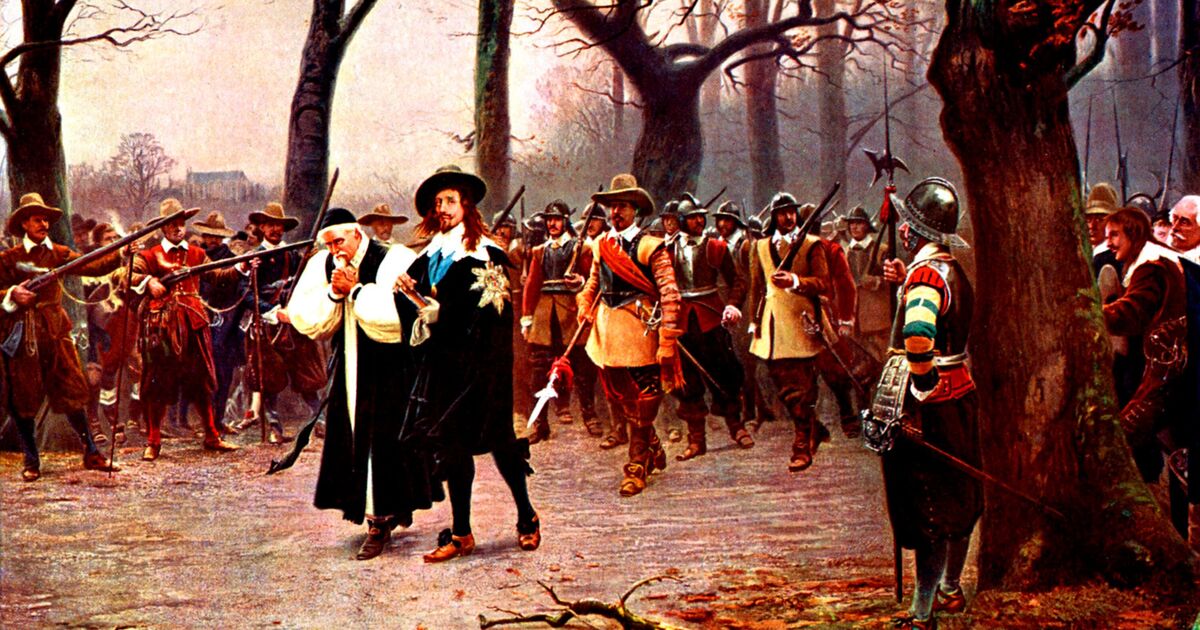
After the King and his Roundheads were defeated in 1645, he was imprisoned by Cromwell, put on trial and later beheaded outside Banqueting House in London 377 years ago today on January 30, 1649.
It was just after the King’s execution that the enormous crowds decided to take a very rare and gruesome souvenir home with them.
After he spent the day before burning his personal papers and saying goodbye to his two youngest children, Henry and Elizabeth, the King spent his final night at St James’s Palace, a stone’s throw from where Buckingham Palace now stands.
On the morning of his execution, Charles I asked for a thicker shirt than normal to reduce the chance of any shivers being mistaken for fear. He was reported to have said: “The season is so sharp as probably may make me shake, which some observers may imagine proceeds from fear. I would have no such imputation.”
The executioner was disguised and did not shout the normal phrase “Behold, the head of a traitor” when he held the King’s severed head up to the crowd so that he could not be identified by his voice.
Shockingly, once the King’s head was removed, the crowd dipped their handkerchiefs in his blood as a memento. His head was then sewn back on, and he was embalmed.
Following Charles I’s execution, the monarchy was abolished, and the country was governed by Oliver Cromwell. Cromwell’s son, Richard, served in the role of Lord Protector and later briefly succeeded his father.
King Charles I’s son, the future King Charles II, had been living in exile in France and the Netherlands for several years, but was invited to return to restore the monarchy following the dissolution of the Long Parliament and fears that the country would fall into anarchy.
While Charles II was welcomed back and proved very popular, his reign was marked by several misfortunes, including the Great Plague of 1665 and the Great Fire of London in 1666. He also failed to produce a legitimate heir to the throne, which meant his unpopular brother, James II, became King after his death.
‘ The preceding article may include information circulated by third parties ’
‘ Some details of this article were extracted from the following source www.express.co.uk ’