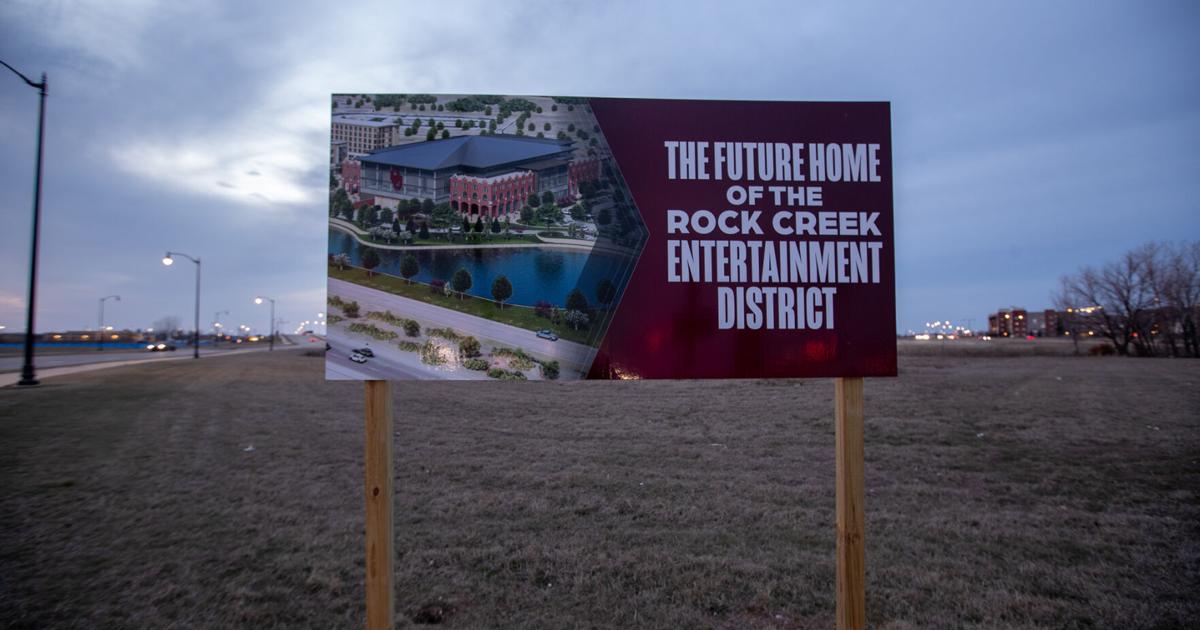
The Oklahoma Supreme Court ruled Tuesday the gist of Oklahomans for Responsible Economic Development’s petition to turn the Rock Creek Entertainment District to a public vote is insufficient.
According to an update on the city of Norman’s website, the entertainment district project will move forward as originally planned.
According to the majority opinion, the gist suggests that the incremental taxes would last for a period of up to 25 years, rather than ending at the first of three occurrences:
• When funds have been provided to allow non-City parties to service debt in an amount of $230,000,000 in principal plus interest
• When a total of $600,000,000 in tax collection is provided
• After the passage of twenty-five years from the creation of the TIF districts
The majority opinion states that the gist does not provide potential signatories with a clear understanding of how long the incremental taxes would last.
The majority opinion states that the gist “does not provide a potential signatory with sufficient information to make an informed decision about the true nature” of the ordinance and the Rock Creek Entertainment District plan
Additionally, the majority opinion states that the gist inaccurately conveys that the ordinance and the Rock Creek Entertainment District plan authorize $600,000,000 in project costs in addition to $230,000,000 in financing, rather than $600,000,000 and $230,000,000 as two of three separate triggers.
Oklahoma Supreme Court majority opinion on petition regarding Rock Creek Entertainment District
The dissenting opinion, written by Chief Justice Dustin P. Rowe, states that the gist is not inaccurate, misleading or fraudulent, but it “synthesizes the technically complex governing documents that — in themselves — are difficult to decipher.”
According to the dissenting opinion, the gist is not required to paraphrase all governing documents but needs to provide enough context to be easily understood by signatories.
Oklahoma Supreme Court dissent from Chief Justice Dustin Rowe on petition regarding Rock Creek Entertainment District
Paul Arcaroli, ORED member, told OU Daily Tuesday, shortly after the decision, he was disappointed by the ruling.
“The process of direct democracy is difficult in the country, it’s in the state, and that’s just proved how impossible direct democracy really is, so I think that’s very sad for Norman and sad for our community,” Arcaroli said.
Read more about the entertainment district:
Arcaroli said ORED would continue to look at other options available but the organization does not have any immediate plans.
“There are some things we can look at and we will keep you in the loop. We are disappointed but as President Bartlett says on ‘The West Wing,’ ‘What’s next?'” Arcaroli said.
The Daily reached out to the university for a statement but did not immediately receive a response by the time of this article’s publication.
The Daily reached out to Dan Quinn, former Ward 8 city council member and a real estate agent, who was one of four Norman residents who filed a protest against the petition for comment on the ruling. Quinn did not immediately respond.
The Daily reached out to Rob Norman, ORED’s attorney, but did not immediately receive a response.
This story will be updated as more information becomes available.
Background
Around 1 a.m. on Sept. 18, 2024, Norman City Council approved the University North Park entertainment district 5-4. During the meeting, over 70 residents voiced support and opposition to the district and its TIF model.
On Sept. 20, 2024, three Norman residents filed a petition to turn the district to a public vote.
Organized by the nonprofit Oklahomans for Responsible Economic Development, petitioners collected 11,602 signatures over 30 days, exceeding the 6,098 required by law. Of the 11,602 submitted, 10,698 signatures were certified by City Clerk Brenda Hall.
On Nov. 19, 2024, Nimmo, Allison, McKown and Quinn filed the legal notice opposing the petition. According to the 119-page notice, the protest challenged the gist of the petition and argued it did not comply with Oklahoma Statutes, which require a referendum petition to summarize the nature of the proposed referendum vote in a manner that can be understood by those who do not practice law.
This story was edited by Natalie Armour and Macey Thaxton.
‘ The preceding article may include information circulated by third parties ’
‘ Some details of this article were extracted from the following source www.oudaily.com ’