It has often been observed that some of the best music depicting Spain has been composed by the French. Bizet’s opera “Carmen” and Ravel’s “Bolero” are probably the most famous examples, but there are loads of others, including “Symphonie espagnole” (by Lalo), “Le Cid” (Massenet’s opera), “El desdichado” (vocal duet by Saint-Saëns), “España” (Chabrier’s rhapsody for orchestra), and “Le pas espagnol” (a miniature by Fauré).
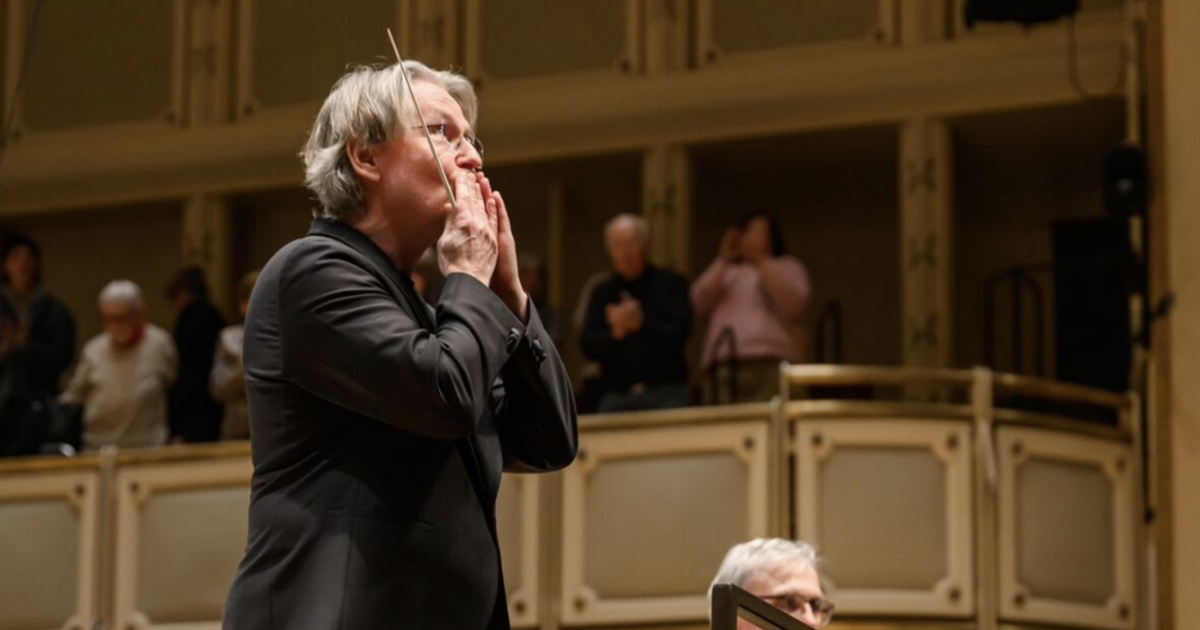
Conductor Esa-Pekka Salonen, who has frequently collaborated with the Chicago Symphony Orchestra over many years, took the reins last week for concerts that opened with a Frenchman offering impressions of Spain.
Debussy’s “Images” for orchestra was the last thing the composer created except for “Jeux.” It is in three parts, with the popular middle section “Iberia” being the music that invokes Spain. In this performance, Salonen moved it from middle to end, with its own three sections each given a beautiful realization. He made sure the pert rhythm of “In the Streets and Byways” was always present, even as the music moved from place to place with the sun lending the music a joyful warmth. “The Fragrance of the Night,” a gorgeous nocturne, was plump in sound and utterly compelling. “Morning of the Festival Day” had effective detail that put you in the midst of carefree festival-goers of all ages.
The opening movement, Gigues, began quietly and was charmingly episodic. The following Rondes de printemps was imbued with both shimmer and bounce.
As engaging as this performance was, the highlight of the evening was Debussy’s “La Mer.” Phillip Huscher’s program notes tell us that Debussy’s parents had once thought to make their son a sailor, so an affinity for the sea is not surprising. This work, one of the most frequently performed of Debussy’s compositions, is subtitled “Three Symphonic Sketches.”
“From Dawn to Noon on the Sea” opens with light banishing the night. The slow emergence of dawn comes along with the ocean’s waves. Salonen was splendid in drawing out the contrasts in the music, which often mimicked lightness and darkness.
The CSO was marvelously fluid in “Play of the Waves,” where you imagine the sun sparkling on the water as the undulating waves blur and the sea creates splashes large and small.
The concluding sketch, “Dialogue of the Wind and Sea,” opened ominously. As the water and wind battled and then danced, the music’s big sound created a vast sense of natural power.
Sandwiched between these two works by Debussy, Salonen placed a new work by American composer Gabriella Smith (b. 1991). “Lost Coast,” Concerto for Cello and Orchestra, featured soloist Gabriel Cabezas. Smith and Cabezas met at the Curtis School of Music in Philadelphia, and the cellist has been associated with “Lost Coast” from its very inception. Originally the piece was for solo cello and electronics, with Cabezas as soloist. There have been many versions of the work, including one with Cabezas joined by the composer, who sings. Smith has said that Cabezas is actually a co-composer of the concerto.
“Lost Coast” was inspired by a five-day solo backpacking trip made by Smith on the Lost Coast Trail on the northern California coastline. The composer describes the terrain as rugged and dangerous, and she notes that she was almost totally alone for the duration of the trip.
This ferocious and jagged landscape has inspired spiky and angular music that features unusual sounds, extended techniques, and the use of non-musical objects as percussion instruments.
The piece also represents the composer’s devotion to fighting climate change. She appeared on stage just before the orchestra performed the work, speaking briefly about her composition. While her music celebrated the feral northern California coast, her dress was pure Hollywood: she was beautiful in a black, full-skirted evening gown that would not be out of place in the celebrity jungle of the Oscars.
Smith told the audience that climate change action has been thus far “criminally inadequate,” which was met by applause. I understand she lives in Seattle and I wondered if she had found a way to travel from there to Chicago in a manner that had a negligible carbon footprint.
“Lost Coast” is packed with originality, including detailed instructions from the composer on how to create the many new and specific sounds she requires. The score even invites one of the percussionists to ask to use Smith’s favorite water bottle because percussing it creates one of the sounds the work requires.
The music is more moody than memorable, with lots of dissonance. Unsurprisingly, Cabezas, so familiar with the work, was magnificent in his performance, from offering hushed tremolos to poignant whale song, squeaky glissandos to microtonal splashes. Salonen drew a strong performance from the orchestra, and Cynthia Yeh was her usual fantastic self when, in the third movement, she had a prominent percussion section that was stylish and potent.
The orchestra clearly leaned into the music and Salonen got a very enthusiastic performance from the musicians, which is not always the case with new music at Symphony Center.
The audience loved the results and when the concert concluded and the final Debussy notes had washed away, patrons were on their feet applauding a fine evening of music.
‘ The preceding article may include information circulated by third parties ’
‘ Some details of this article were extracted from the following source www.hpherald.com ’