Opera review
Desire unfolds under watchful eyes in “Fellow Travelers.”
Set during the McCarthy-era Lavender Scare of the 1950s, the opera by composer Gregory Spears and librettist Greg Pierce opened Saturday at McCaw Hall, marking the first time a production centered on openly gay subject matter has appeared on Seattle Opera’s mainstage. The run — the start of a national tour — continues through Sunday.
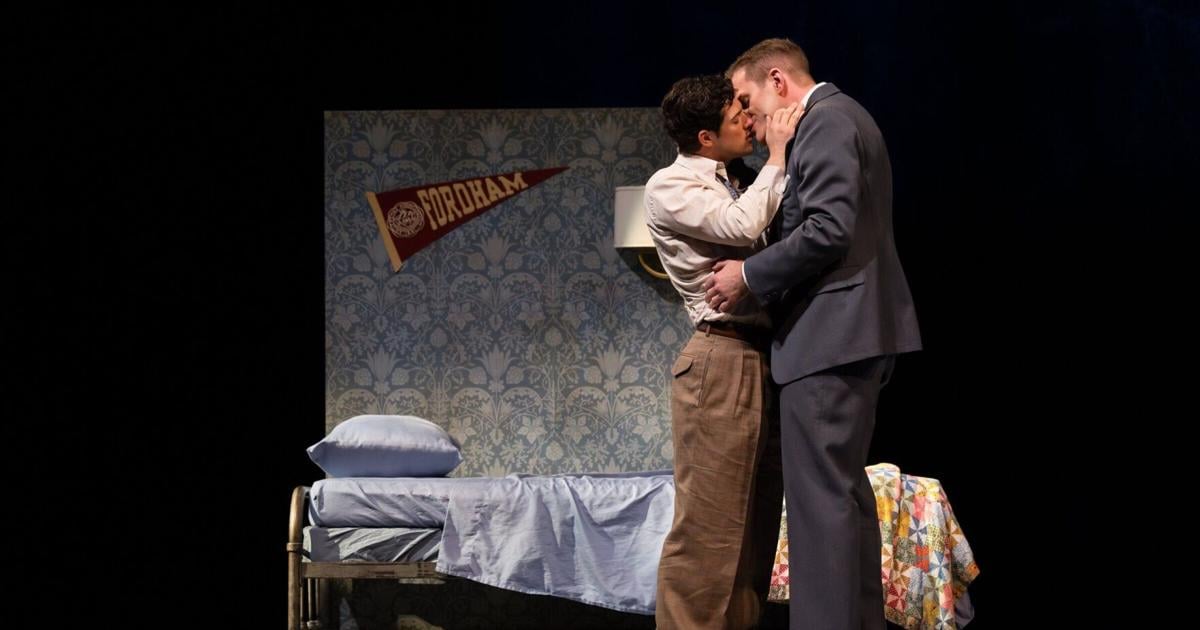
The opera traces the relationship between Timothy Laughlin, newly arrived in Washington, D.C., and Hawkins Fuller, a rising State Department bureaucrat, as Sen. Joseph McCarthy’s investigations heighten scrutiny of LGBTQ+ federal employees.
In this environment, same-sex attraction is treated as a national security threat akin to Communist affiliation. The two men’s bond develops under constant risk, amplifying an incompatibility that neither can overcome, ultimately driving them apart.
Though rooted in fear from seven decades ago, the story feels unsettlingly present. In a politically fraught era again marked by the policing of identity, its depiction of careers undone hardly reads as distant history. The opening-night audience responded with palpable emotion, underscoring why the opera has endured since its 2016 premiere and become one of the most widely staged contemporary American works.
Based on Thomas Mallon’s 2007 novel, the protagonists are fictional but set against a backdrop of historical events. The material reached a broader audience through the 2023 Showtime miniseries, but the opera keeps its focus tightly on the emotional fault lines between Hawk and Tim. With an ensemble of nine singers, it sketches the surrounding machinery of power with economy: McCarthy appears only briefly, and Roy Cohn, McCarthy’s chief counsel, remains offstage. The system looms; the drama stays personal.
Director Kevin Newbury, who has shepherded the opera since its inception, responds as keenly to the architecture of Spears’ score as to Pierce’s tightly crafted libretto. Compact scenes shift with the logic of film editing — from the Dupont Circle park bench framing the opera to Capitol Hill offices and Tim’s cramped apartment. The transitions can feel abrupt, yet Newbury allows emotional resonance to carry across scenes, so private exchanges echo amid the external apparatus of power.
Vita Tzykun’s scenic design and Thomas C. Hase’s lighting support that economy on an open stage where rolling elements swiftly reconfigure the space. Filing cabinets and desks conjure the sterile bureaucracy of the “Man in the Gray Flannel Suit” era — reinforced by Devario D. Simmons’ disciplined midcentury suits, their grays and navy blues punctuated by strategic flashes of color. At moments, tailored propriety gives way to underwear and brief nudity, underscoring the vulnerable intimacy — and real passion — at the story’s core.
Spears’ music combines the driving pulsations of American minimalism with elaborate ornamental phrases and dance-inflected rhythms that evoke the Renaissance and Baroque and lend a poetic, faintly ceremonial air, as if the lovers were enacting a courtly ritual within the drab machinery of midcentury Washington.
Spears proves a natural opera composer and writes gratefully for the voice, balancing speech-inflected rhythms with stylized ornament and differentiating his characters through vocal line.
As Tim, tenor Colin Aikins brought passion and ringing tone to a punishing role spanning naiveté, spiritual conflict and hard-won disillusionment. His confessional “Last Night” aria was a searing high point, underscored by newfound ecstasy.
Baritone Jarrett Ott made Hawk magnetic and imposing, his dark tone projecting confidence that bordered on arrogance. His cool composure in “passing” the polygraph meant to detect “deviance” contrasted with an aria sung in his lowest register, where the weight of his decision to end the relationship registered starkly.
(Seattle Opera has double cast the roles of Timothy and Hawkins for this production, which are being sung by Andy Acosta and Joseph Lattanzi in alternate performances.)
As Mary Johnson, Hawk’s assistant, Amber R. Monroe emerged as the opera’s moral center. Though given less stage time, she invested the role with warmth, intelligence and expressive depth; her duet with Tim offered rare compassion in a world of calculation.
Vanessa Becerra gave the homophobic secretary Miss Lightfoot a brittle edge, her gossip edged with malice, while Elisa Sunshine made a vivid impression as Lucy, the woman Hawk marries.
Kyle Pfortmiller lent authority to Sen. Charles Potter, Tim’s boss, while flashes of humor surfaced in Randell McGee’s Machiavellian Tommy McIntyre, a shrewd operator and aide to the senator who dubs him “Citizen Canes.” Marcus DeLoach shifted deftly among multiple roles — including a sardonic, trombone-accompanied turn as McCarthy himself.
Written for chamber orchestra, Spears’ score gained remarkable depth from the Seattle Symphony musicians in the pit, who, under Steven Osgood, shaped its spare textures into a sound world at once intimate and unexpectedly expansive, its modest forces carrying emotional weight well beyond their scale — much like the opera itself.
‘ The preceding article may include information circulated by third parties ’
‘ Some details of this article were extracted from the following source www.yakimaherald.com ’