As the skirl of a bagpipe filled Mandel Hall Saturday evening, the audience swiveled in their seats toward the back of the auditorium. Piper Scott McCawley strode down the aisle and onto the stage, opening the University of Chicago Folk Festival concert the same way it has opened for more than six decades.
Bagpipers have kicked off the festival’s concerts since 1961, when the event was founded by the U. of C. Folklore Society. Now in its 66th year, the student-run gathering — the oldest university-based folk music festival in the United States — remains a distinctive campus tradition, even if somewhat slimmed down.
Saturday evening’s concert featured performers from across the country, including Gap Civil, an old-time band from Sparta, North Carolina; country blues singer Jontavius Willis of Greenville, Georgia; traditional Tennessee bluegrass band High Fidelity; Cajun musician Luke Huval and his Louisiana band; and Chicago’s Flor de Primavera mariachi ensemble.
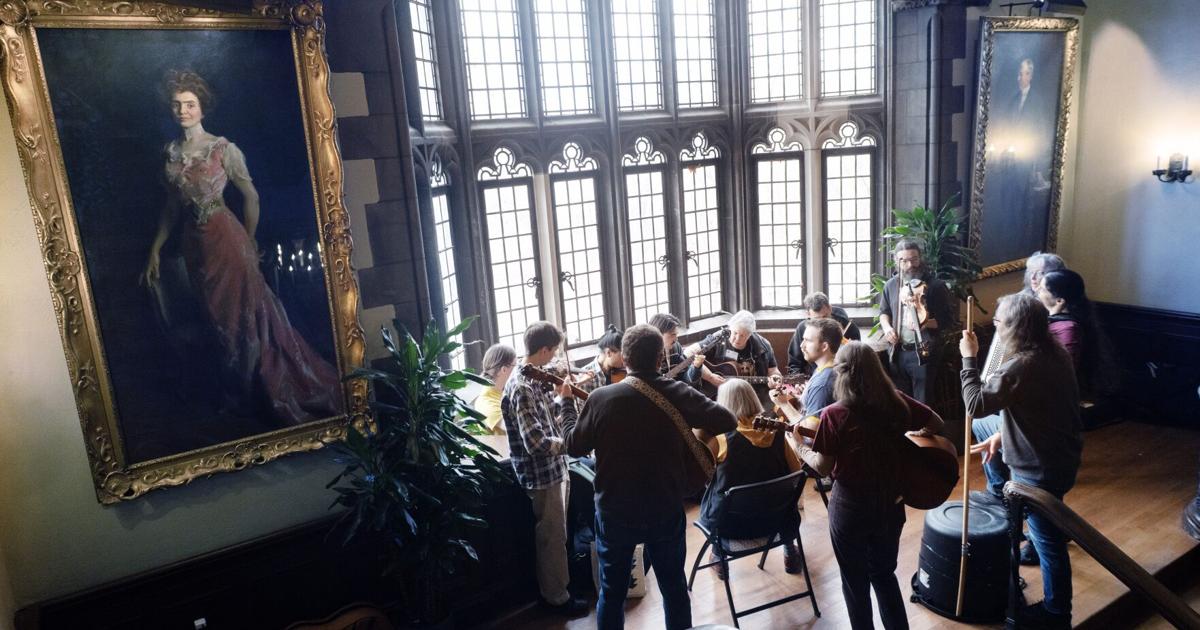
But for many attendees, the festival’s heart lies beyond the main stage. Just a few blocks away in Ida Noyes Hall, musicians and folk enthusiasts spent the afternoon in workshops learning Bulgarian dance, shape-note singing and a dozen other skills, as well as in jam sessions on stair landings and in lounges.
Volunteering at the festival is an active tradition for many Hyde Parkers, including octogenarian Nina Helstein, who helped answer questions and direct attendees Saturday evening. Helstein has attended every festival since 1961 and has been volunteering since her undergraduate years. She described this year’s festival as “very personal” and “one of the best.”
Bob Kass, a former president of the Folklore Society, beamed as he entered the concert hall and recognized old friends. In the summer of 1962, Kass scoured the southern countryside in his father’s car looking for traditional musicians to invite to the 1963 festival. In particular, he was trying to find Almeda Riddle, whose a cappella style he hoped to bring to the event. Kass found her, and Riddle performed alongside legends Bill Monroe and the New Lost City Ramblers.

The festival is a mainstay for young people, too. Twelve-year-old Vienna Whitlock and her 9-year-old brother, Raymond, have attended it for the past five years with their parents and grandmother.
“It’s a tradition,” Vienna said as she and her brother took a break from making quilt panels during the Lakeside Quilting Guild’s workshop. “It’s really fun to be around music all the time.”
Their father, Matthew, has been attending the festival since he was a young boy.
“It’s a magical castle to a little kid,” said Jeannie Whitlock, the children’s mother, as she looked around the wood-paneled library. It’s a place where people “who don’t necessarily know each other are dancing together and making music together.”
Vienna and Raymond both said they particularly enjoyed the workshop on the hurdy-gurdy, a medieval stringed instrument. Shaped like a violin, notes are played with a hand-cranked wheel in place of a bow.
“It was really fun,” Raymond said.

The hurdy-gurdy workshop was taught by a trio of hurdy-gurdyists, including Elmhurst College faculty member Mary Vanhoozer. Among the several hurdy-gurdies Vanhoozer brought was an exact reproduction by luthier Jacques Granchamp of a French vielle à roue (violin with wheel) designed and built by Parisian Jean-Nicolas Lambert in the mid-18th century.
As Vanhoozer cranked the wheel of the hurdy-gurdy, producing a buzzing melody, Vienna and Raymond watched, captivated.
The siblings attended the concert Saturday evening, even though it kept them up much later than usual. Vienna was especially fond of the performance of traditional New England folk and Celtic music by violinist Lissa Schneckenburger and vibraphonist Garrett Cameron.
As the concert came to a close, she turned to her father with a big smile on her face.

‘ The preceding article may include information circulated by third parties ’
‘ Some details of this article were extracted from the following source www.hpherald.com ’