Cocktail bars. Loyalty programs. Motion-enabled chairs that shake and spray scents. Even pickleball and bowling.
Amid a national drop in moviegoing, these are just some ways movie theaters have tried to bring audiences back.
But turns out what’s working is the old-school movie experience.
Amid increasing consolidation of the entertainment industry and the resulting homogenization of franchise-hungry Hollywood, people are looking for the imperfection of analog film, the niche movie they can’t find online, surefire classics they’ve never seen on the big screen and the kind of intimate, communal, neighborhood-centric (and often less expensive) experience that smaller theaters can bring.
Tiny arthouse cinemas in Seattle and around the country are faring well in what online publication IndieWire recently declared the “golden age of microcinemas.” In the era of streaming and scrolling, nostalgia seems to be winning people back. Even the larger independent theaters are drawing audiences with this somewhat counterintuitive approach to programming.
“Movie theaters as we’ve known them for the past century will not continue in the way they have been,” said Shawna Kidman, an associate professor of communication at UC San Diego.
‘Show me something different’
First, a disclaimer. Don’t let the tiny bright spots fool you: Things are looking quite bleak for most movie theaters. Theater chains around the country have shuttered locations. On Tuesday, dine-in movie chain IPIC Theaters notified state officials it would close its Redmond location and lay off 64 workers after filing for bankruptcy last month.
Independently owned theaters haven’t been spared either: Nonprofits like SIFF and the Pacific Science Center have recently closed or sold theaters.
The closure of the Varsity Theater earlier this year drew the curtain on the University District’s era as a cinema hub. And with just 13 operating today, Seattle’s tally of independently owned cinemas stands at its lowest in at least 25 years, down from its peak of 21 in 2012, according to a Seattle Times count.
A handful of those could be considered “microtheaters,” but most are larger, three- or four-screen cinemas owned and operated as local businesses or nonprofits.
This mirrors a nationwide trend: Loosely defined as tiny arthouse cinemas, microcinemas are just a tiny subset of the estimated 3,000 independent theaters scattered across North America.
Most independent theaters have a business model that relies at least in part on mainstream, “first-run” movies, like “Zootopia 2” or “Wicked.”
Which means these theaters, much like multiplexes, are stuck with the blockbuster-or-bust cycle of Hollywood — and an audience that is kind of over it.
Microcinemas literally offer an alternative. And that’s precisely why they’re having a moment.
On a recent Wednesday night, three dozen people gathered in front of an unassuming, two-story building on Rainier Avenue South. Rows of string lights and a neon beer sign in the window cast them in a warm, cinematic glow.
Among those waiting to enter The Beacon Cinema, a small, independent theater, were four friends who had no clue what they were about to see.
All they knew was that a) tickets were free and b) it would likely be something pretty weird. Among the things they’d seen here before: an ’80s movie made in Hong Kong about an evil vase and a 4K rerelease of the landmark anime movie “Angel’s Egg.”
Most didn’t regularly go to the movies, they said, but added that because The Beacon’s programming was unique, it was worth seeing in person.
“I would prefer to watch it from my couch if it’s a big-budget movie,” Gawain French-Byrne said. “There’s just not a reason to go to the theater if it’s going to come to my TV in six months.”
The doors opened. Beacon co-owner and founder Tommy Swenson stood at the entrance with a tally counter. Twenty minutes before showtime, the theater was more than three-quarters full.
The Beacon has found success with indie movies, deep cuts, hard-to-stream films and other fun programming, as well as a recently launched membership program, Swenson said. (While Secret Cinema events offer free entrance, most of those nights’ revenue comes from concessions.)
The theater is cozy and small; with only 48 seats, 20 attendees can make a screening financially viable (as long as other shows continue to sell out).
“We’ve thought at various points about looking for a larger space, and we’ve always just pumped the brakes on it because it would have to fundamentally change how we’re calculating things,” Swenson said. “Like: If we get 20 people in here, that’s OK, that works. But if we have a 500-seat venue, that’s a disaster.”
Swenson is not the only one making these calculations. Across the country, tiny alt movie houses have opened up in recent years, like the volunteer-run, 60-seat Hyperreal Film Club in Austin, Texas; the 30-seat Spectacle in Brooklyn; and 40-seat Babylon Kino in Columbia, S.C.
The Grand Illusion, the small University District theater that lost its lease last year, saw its best years ever in the two years prior to its closure, Executive Director Brian Alter said, thanks to 35mm screenings and distinctive programming. The theater is looking for a new location and is operating as a pop-up at SIFF and Capitol Hill’s Northwest Film Forum.
The Film Forum, which has two screens and seats a total of 156, has also been “doing well,” said newly minted Executive Director Jill Louise Busby.
While the organization faced layoffs in 2024, the Forum has maintained financial stability by operating with a leaner structure and increased grant funding, Busby said. Attendance at the Forum grew 62% from 2024 to 2025, and 2026 attendance is already tracking about 22% higher than the same period last year.
She attributes the jump to a few things, including the Forum’s director of exhibition, Cole Wilder, who implemented a new balance of programming that includes largely mission-aligned social justice films with lighter entertainment like “The SpongeBob SquarePants Movie” (2004), documentaries and cult classics — many of which can’t be easily streamed — as well as increased partnerships with organizations and its surrounding neighborhood.
“People are ready to come back, but you have to give them a reason to be there,” Busby said. “As opposed to just saying, ‘Hey, do you want to see what’s on trend? Do you want to see just what is making mainstream news? Do you want to see just what’s in your algorithm?’”
Micro boom, macro reasons
Sure, the pandemic was a system shock, and people got out of the habit of in-person theater attendance as streaming gained popularity. Yes, costs have been rising.
But many theater owners and industry experts, including Kidman — who’s studied the movie sector extensively — say the reasons for today’s movie theater struggles are structural and predate the pandemic. They trace many problems back to the fickle, studio-controlled nature of the business.
Over the years, studios have instituted terms that make it increasingly difficult for theaters to run a profit.
Most theaters showing first-run movies face similar problems, whether they’re publicly owned multiplexes with 12-plus screens or small, independent theaters.
But the smaller theaters are having a harder time weathering the challenges.
Film rental costs are at an all-time high, with revenue splits for studios in some cases exceeding 60% of ticket revenue, said Jeff Brein, the managing partner of Far Away Entertainment, a small regional chain of local theaters that includes the Admiral Theater in West Seattle and others in Anacortes, Lynnwood, Stanwood and Bainbridge.
Distributors often require multiweek “clean screens,” meaning no other movie is shown during a certain run, giving theaters with few screens little flexibility to draw in visitors with another movie if a release is performing poorly.
Studios have also pushed films to video-on-demand and streaming increasingly quickly, which impacts attendance.
Beth Barrett, artistic director of SIFF, the nonprofit that runs the Seattle International Film Festival and operates three theaters year-round, pointed to recent movies with longer theatrical windows like “Marty Supreme” and the Korean satire “No Other Choice” that drew big crowds at SIFF.
“People are coming to the cinemas because they cannot stream it for a long time,” she said.
Another issue, said Patrick Corcoran, a movie theater business consultant and a former vice president at the National Association of Theatre Owners (now Cinema United): studios are releasing fewer movies, putting their chips on safe bets with higher margins rather than more midbudget productions.
This blockbuster-or-bust strategy directly impacts theaters because “going to the movie theater is a habit in a lot of ways,” he said. Theaters can’t tell audiences, “Sorry, we don’t have anything you’re interested in this week. But wait six weeks, and there’s that big movie that everybody’s talking about.”
Corcoran and other industry veterans predict that further studio consolidation through the pending merger of giants Warner Bros. and Paramount could exacerbate this trend and pose an existential threat to smaller cinemas. (Both companies have claimed they will not decrease production.)
“One of the real scary points for independent theaters is that studios are consolidating all of their resources to not take some of those artistic swings,” SIFF’s Barrett said. “The homogenization of titles coming out of the studio system is the reason that people don’t go to the movies, and so it actually ends up shooting everyone in the foot.”
“Mega” scale appeared to be the answer about 60 years ago with the advent of the multiplex. Today — with the rest of the indie theaters stuck in the middle — scaling down theater size, and perhaps even loosening a reliance on first-run studio movies, seems one of the few viable ways forward.
Case in point: Tasveer, the South Asian art organization that purchased the building formerly home to the Ark Lodge Cinemas, transformed one of the building’s four theaters into a lounge.
Luring people back
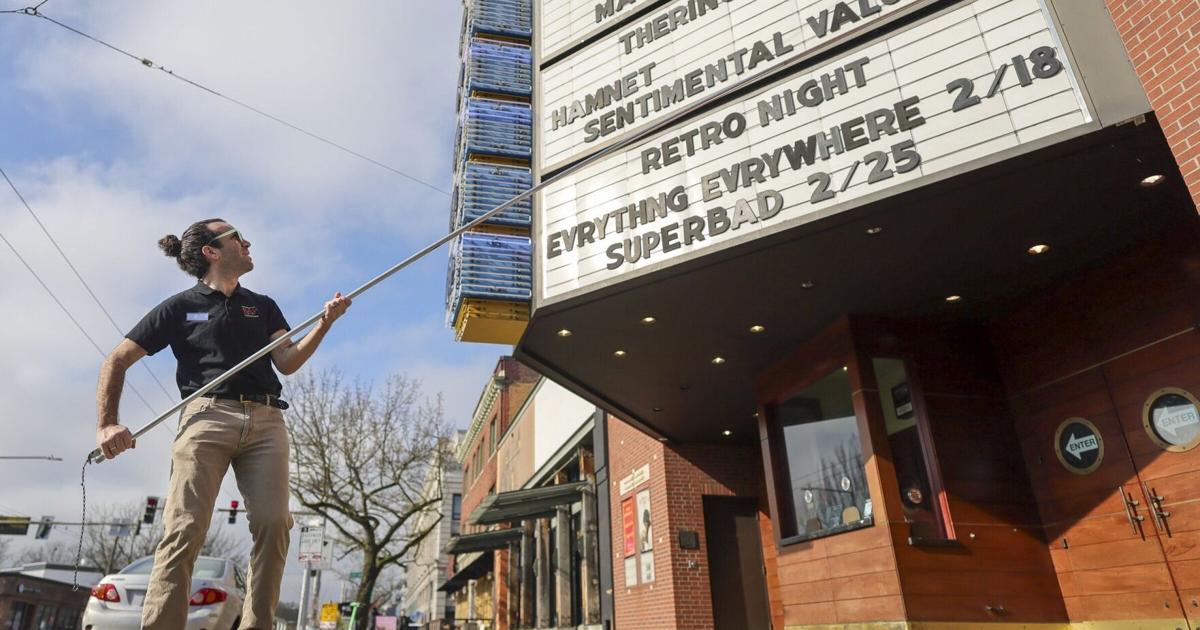
When Jesse Mercury Plack, the general manager of Ballard’s Majestic Bay, first pitched Wednesday Retro Night to his boss, he was met with hesitation. He wanted to screen movies that were already available to stream? And people would show up?
“My feeling was ‘absolutely,’” Plack said. “People like me will flock to a theater to see something that they love. People like me who love movies, we want that communal experience.”
He was right. Retro Night — screening everything from “2001: A Space Odyssey,” to “The Twilight Saga” to “Rear Window” and “Sleepless in Seattle” has been a success, transforming the theater’s slowest night into a busy affair — average attendance increased from 20 to 200. On social media, people vote on which movie they want to see, and the event frequently starts with a quiz or other interactive activity.
The profits are modest, said owner Kenny Alhadeff, but it has successfully lured people back to the theater.
It’s often enough to show someone the appeal of Majestic Bay. Then, when they want to see a first-run movie, even if there are other theaters closer or other showtimes that work better, “they come to our place because it was their home,” he said.
First-run titles remain essential to the business model, Alhadeff stressed. It’s not an easy line of work — a labor of love — but the fact that the family owns the theater outright helps buffer them from major audience swings, he noted.
SIFF, too, has had success with recent screenings of vintage movies, Barrett said, with audiences for those skewing younger.
“People really are looking for those kinds of ways to engage with other people around art that they have by and large heard about,” Barrett said.
In February, “we showed Peter Greenaway’s ‘The Cook, the Thief, His Wife & Her Lover,’ which is one of my favorite films,” Barrett said. “And I really thought it would just be me and a few super nerds, but there were 250 people there.”
“It was a real sign that experiencing art on the big screen is still valuable.”
It’s also a sign that a strategy shift at SIFF Cinema Downtown, the former Cinerama, is working. Barrett said screening more vintage movies, along with a mix of Oscar-nominated and select first-run movies, has been successful so far.
SIFF initially assumed the Cinerama would show largely first-run studio films, but found that some major franchise films underperformed. Downtown ticket sales increased by 4% from 2024 to 2025, while ticket sales for the Uptown theater — where more original, alternative movies get played — increased by 27%. While representing much smaller absolute numbers, sales at SIFF’s 90-seat jewel box Film Center, which skews the most “alt” of its movie houses, increased by 37% during that same time.
Multiple factors are at play here, but this data could tell us something about what audiences want (and don’t want) right now.
Jackie Brenneman, the president and CEO of the Independent Film & Television Alliance, says things may feel painful now for theaters, but she’s optimistic for the industry. She’s especially buoyed by a recent report showing that moviegoing frequency by Gen Z audiences was up in 2025, the highest increase among age groups.
Now, she said, is the time for innovation.
“The industry is over a hundred years old,” she said. “New ways to go back to the way things were, that’s not looking like it’s the future. Those who adapt — they are going to be the new model.”
____________________________
This coverage is partially underwritten by the M.J. Murdock Charitable Trust. The funder plays no role in editorial decision-making, and The Seattle Times maintains editorial control over this and all its coverage.
‘ The preceding article may include information circulated by third parties ’
‘ Some details of this article were extracted from the following source www.yakimaherald.com ’