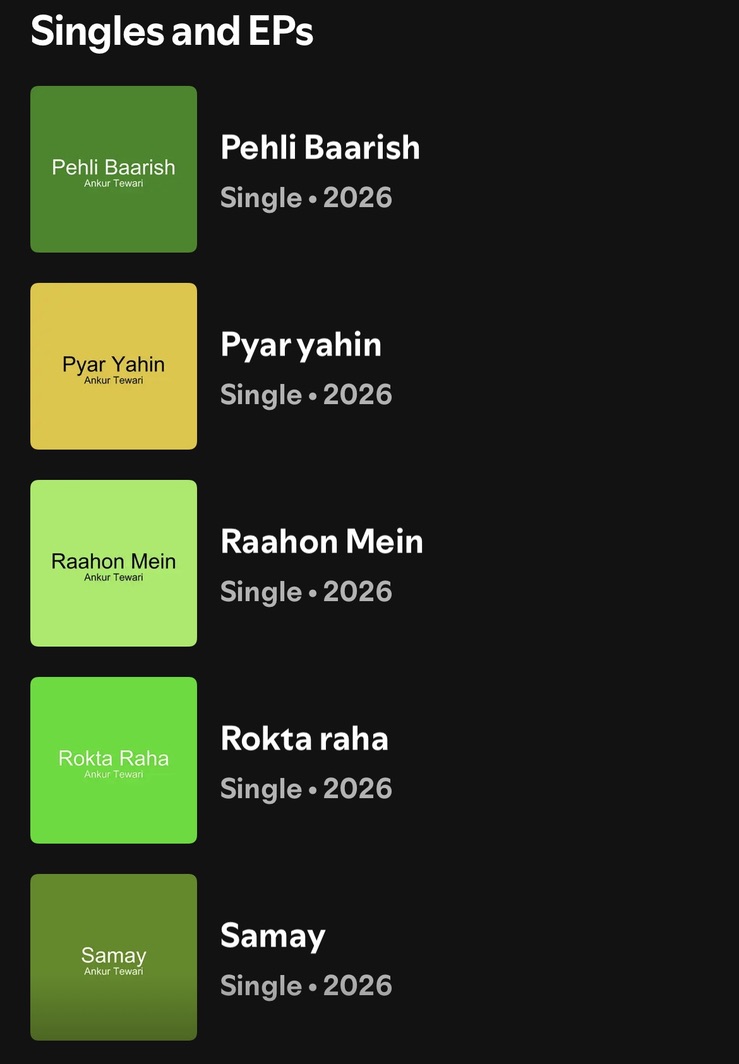
When Indian singer-songwriter Ankur Tewari went to his Apple Music account this past weekend, he was shocked to find that his ‘latest release’ wasn’t his new single ‘Chand Takiye’ but a track he didn’t recognise that has been put out under his name.
Even more startling was that it wasn’t only the one. About a dozen other songs, which had he nothing to do with, appeared on his profile on both Spotify and Apple Music. When he went to check the credits for the tunes on Spotify, he found that while he’s listed as the main artist, “Henry Hopsin” has been attributed as the composer and lyricist, Hopsin as the producer, and Ali Music as the source.
Tewari has never heard of anyone by that name. After he put up a story on his social media, a friend told him that Henry Hopsin has shown up under the credits of what seemed like AI-generated tunes attributed to other artists as well. Indeed, Music Ally found other tracks that list Indian acts such as Amit Trivedi, Reble and RUUH as the main artist, for which Hopsin and Ali Music have been credited.

His team and he reached out to the DSPs to take the songs down, not all of which were removed by the middle of the week. Apart from Spotify and Apple Music, they’re also available on Amazon Music and JioSaavn. “I definitely think this is a symptom of the future of streaming,” says Tewari.
“At the moment, it looks like the beginning of the end, because very soon, AI will [be used to] upload much more music, tagging whichever artist [the uploader] wants to tag. It might not be easy to bring down all these songs. It’s probably time that as musicians, we head back to the basics and start looking at physical sales and distribution, whether it’s vinyls, cassettes or CDs, and concentrate on our live [shows]. The future looks weird.”
He says he hasn’t been able figure out who’s behind the uploads of the set of tracks released under his name. Music Ally tried to trace the origin of one of the songs, ‘Pagal Se Hum’, by submitting it to an AI detection platform. It suggested that the single was generated using Suno – which is by no means definitive proof, of course. We reached to Suno’s PR representatives for confirmation but did not receive a response until the time of publication.
However, incidents such as these point to the alarming scope for streaming fraud and the helplessness of artists whose identities are used to engage in it. Like Tewari, they can only wait for DSPs to take down such tracks—which are likely to stay up there until artists and their teams get to know of their existence in the first place.
‘ The preceding article may include information circulated by third parties ’
‘ Some details of this article were extracted from the following source musically.com ’