Following the Oklahoma Supreme Court’s dismissal of a petition for a public vote, the city of Norman is moving forward with tax increment financing, or TIF, districts to help fund the Rock Creek Entertainment District.
Two TIF districts are expected to raise up to $600 million in 25 years, according to the city’s district project plan.
What is a TIF district?
A TIF district reallocates a portion of tax dollars generated within the district to support development in a certain geographic area, according to the Oklahoma Department of Commerce.
To create a TIF district, the local government borrows the sum of money required to develop the district, according to the U.S. Department of Transportation. This is done through loans and bonds.
The local government decides what portions of the district’s taxes to collect and how long the district’s taxes will be reallocated to development.
According to the U.S. Department of Transportation, the TIF district typically splits property tax into two streams: the base value, representing the original property value, and the tax increment, the earnings from the new development that are then used to pay back the bond. The length of time depends on the district’s development cost.
In some cases, such as the Rock Creek Entertainment District, the government will establish multiple TIF districts. The reallocated money is then pulled from different taxes for each district.
Tax increment financing model.
Once the districts have been in place for the predetermined amount of time, or have met requirements specified at the time of district establishment, all tax revenue is apportioned as usual.
According to the Oklahoma Department of Commerce, TIF districts may only be established in reinvestment areas, historic preservation and enterprise areas. Descriptions of these areas can be found online.
TIF districts in Norman
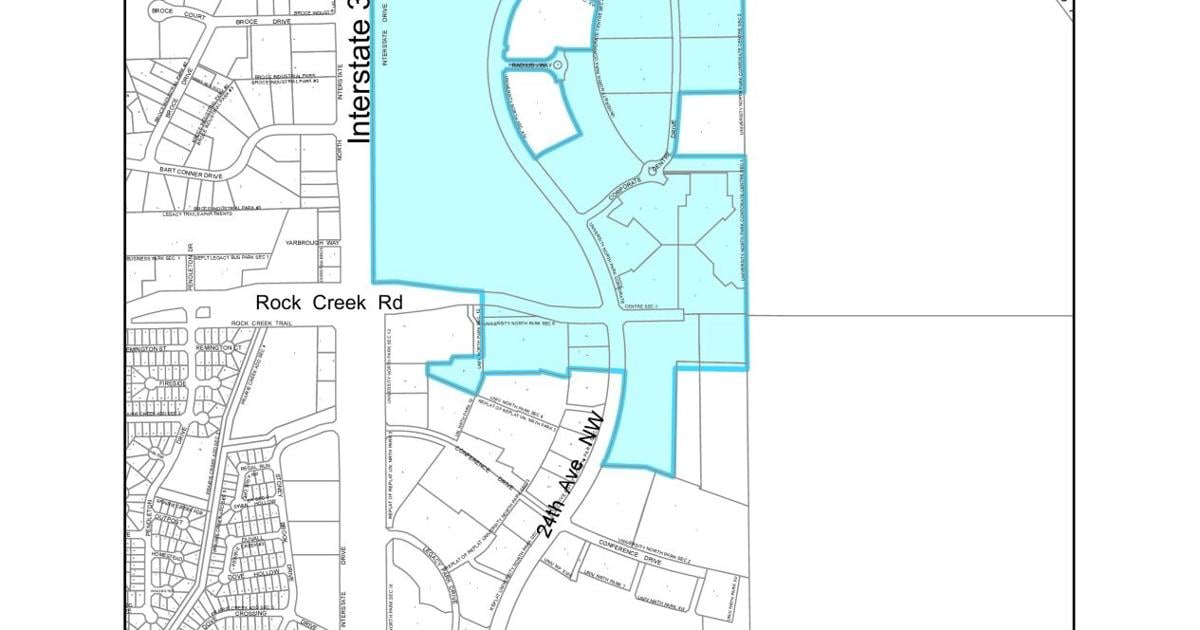
The Rock Creek Entertainment District, which will be located in University North Park, will be partially funded by TIF districts. These districts will be located within the boundaries of the project. Private donors will provide the remainder of the funding.

The area will be split into two districts, with one district functioning as a sales tax district. The TIF will pull 3% of the district’s gross sales tax from Norman’s non-dedicated tax revenue, which is a pool of tax revenue for discretionary use, and capital improvements sales tax for city development.
The other district will function as an ad valorem, or “according to value” tax district, where the amount taxed is proportional to the value of what is being taxed. In Oklahoma, ad valorem taxes fall under the property tax system. All ad valorem tax in excess of the district’s base assessed property values will be allocated toward the cost of the district, according to the project’s plans.

Rock Creek Entertainment District TIF district boundaries.
According to the city of Norman, the first district was set to be activated May 1, 2025, and is expected to generate $151 million in tax revenue. The second district is set to be activated on Dec. 31 and is expected to generate $389 million.
The two districts will be active until one of three outcomes is met: the $230 million needed to finance private development and public infrastructure has been paid with interest, the districts raise a total of $600 million or 25 years elapse.
According to the city’s project plan, residents can expect supportive impacts on various taxing jurisdictions.
For example, Norman Public Schools is expected to have greater enrollment numbers as a result of new residents moving to the residential areas of the entertainment district, which could increase tax revenue to the school district.
Other impacts include a projected increase in demand for services from Cleveland County Health Department, Moore Norman Technology Center, Cleveland County and the Pioneer Library System.
Additionally, termination of the TIF districts once parameters are met is expected to result in an annual increase of non-sinking fund revenue, funds not set aside for planned purchases, to these public services.
The greatest impact will be on the city as it anticipates net gain in new retail, higher tax revenue output and the responsibility for maintaining the district’s new infrastructure and development.
This story was edited by Macey Thaxton and Audrey McClour. Kennedy Johnson and Tori Pham copy edited this story.
‘ The preceding article may include information circulated by third parties ’
‘ Some details of this article were extracted from the following source www.oudaily.com ’