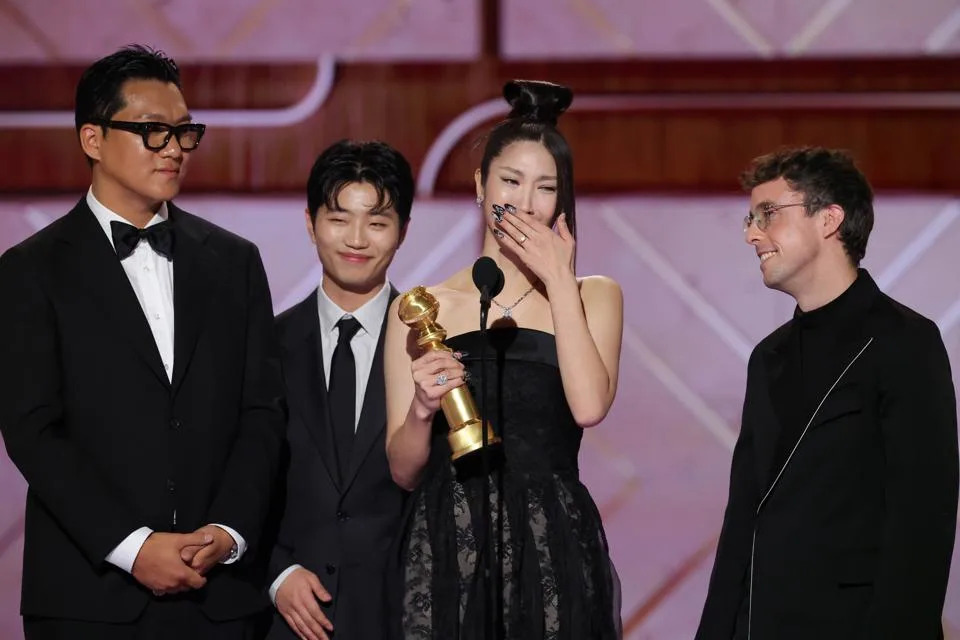
When EJAE, Audrey Nuna, and Rei Ami took the Dolby Theatre stage Sunday night to perform “Golden” from Netflix’s KPop Demon Hunters, the audience — from Leonardo DiCaprio to Michael B. Jordan — was fully participating. In a first for the Academy Awards, every attendee had been given K-pop lightsticks, the glowing support rods central to K-pop fan culture. As traditional Korean percussionists and hanbok-clad dancers opened the performance, Steven Spielberg, DiCaprio, and longtime KPop fan Emma Stone waved golden lights in time to the music.
By the end of the ceremony, KPop Demon Hunters had secured two golden statuettes: Best Animated Feature and Best Original Song for “Golden,” which became the first K-pop song ever to win an Academy Award.
“Golden” Makes Oscar History As First K-Pop Song To Win
The win caps a record-breaking run. Since its June 2025 release, the film has become Netflix’s most-watched animated title of all time, pulling in over 500 million cumulative views. “Golden” spent eight consecutive weeks at No. 1 on the Billboard Hot 100—the longest-running No. 1 girl group song of the 21st century and only the third song to spend eight or more weeks atop the chart and win an Oscar, joining “You Light Up My Life” and Eminem’s “Lose Yourself.” The nine-song soundtrack placed four simultaneous tracks in the Billboard Hot 100 Top 10, racking up over 3 billion global streams.
But for EJAE, the Korean-American singer-songwriter who both co-wrote “Golden” and voices the film’s protagonist Rumi, the Oscar represents something more personal: validation.
“Growing up, people made fun of me for liking K-pop,” EJAE said through tears during her acceptance speech. “But now everyone’s singing our song and all the Korean lyrics. I’m so proud. And I realized, the song, this award is not about success; it’s about resilience.”
From SM Entertainment Trainee To Oscar Winner: EJAE’s Journey
That resilience was hard-won. From age 11, EJAE trained at SM Entertainment, one of South Korea’s most powerful K-pop agencies, alongside members of Girls’ Generation, SHINee, and f(x). She attended vocal and dance practices after school until midnight, honing her craft in the notoriously demanding K-pop trainee system.
For 12 years, she waited for her debut. It never came. SM Entertainment let her contract expire in 2015 without selecting her for any group. Industry insiders cited “concept fit” and “visual harmony” issues. EJAE’s husky, lower register was deemed a flaw in a system that prized high, crystalline vocals.
She moved to New York, studied music at NYU’s Tisch School of the Arts, and discovered songwriting. In 2017, she returned to SM for a songwriting camp and wrote the melody for Red Velvet’s “Psycho” in 30 minutes. The certified gold hit opened doors to work with aespa, TWICE, LE SSERAFIM, and NMIXX.
When directors Maggie Kang and Chris Appelhans heard EJAE’s demos for KPop Demon Hunters in 2020, they didn’t just want her songs—they wanted her voice. That unconventional tone SM had rejected became Rumi’s signature sound, anchoring “Golden” with raw emotional power.
KPop Demon Hunters Oscars Performance Brings Lightsticks To Hollywood
The Oscars performance reflected that cultural crossover. Dressed in all white, the trio stood center stage as dancers twirled golden flags, backed by Korean instrumentalists and traditional choreography. The staging drew on the folklore at the heart of the film, which follows fictional K-pop group HUNTR/X as they secretly fight demons with music. In the story, “Golden” creates the Honmoon—a protective barrier that shields humanity from supernatural threats.
The collaboration with co-writer Mark Sonnenblick and five other K-pop songwriters — Joong Gyu Kwak, Yu-Han Lee, Hee Dong Nam, Jeong Hoon Seo, and Teddy Park — made “Golden” the first song with more than four writers to win Best Original Song.
After EJAE’s speech, co-writer Yu-Han Lee stepped forward to add his thanks—only to be drowned out by the orchestra as the show cut to commercial. Fans criticized the interruption as disrespectful, though a question from Decider let the songwriters finish their remarks backstage.
Netflix’s KPop Demon Hunters Wins Best Animated Feature
When KPop Demon Hunters took home Best Animated Feature earlier in the night, co-director Maggie Kang delivered an emotional speech: “For those of you who look like me, I’m so sorry that it took us so long to see us in a movie like this. This is for Korea and for Koreans everywhere.”
The film beat Disney’s Zootopia 2, Pixar’s Elio, and other animation heavyweights. Netflix and Sony Animation have since closed deals with Kang and Appelhans for a sequel.
KPop Demon Hunters’ Oscar wins represent a broader shift in how global audiences celebrate K-pop and Korean culture. The film made the genre accessible to general audiences through animation and storytelling, introducing Korean lyrics, choreography references, and cultural touchstones to viewers who might never have clicked on a K-pop music video.
‘ The preceding article may include information circulated by third parties ’
‘ Some details of this article were extracted from the following source www.yahoo.com ’