Traiteurs. Vigilantes. A doomed love affair — or is it? This is the drama that infuses “Belizaire the Cajun,” a critically acclaimed film about 19th-century Louisiana life by writer and director Glen Pitre.
The 1986 movie was screened at international festivals like Sundance and Cannes, and received a positive review from Robert Ebert himself, who wrote, “What I liked about the movie was its unforced view of Cajun life, the rhythms of the speech as they move from Cajun French into English and back again, and the comic timing of some of the scenes, especially two where the local sheriff tries to temper justice with fairness.”
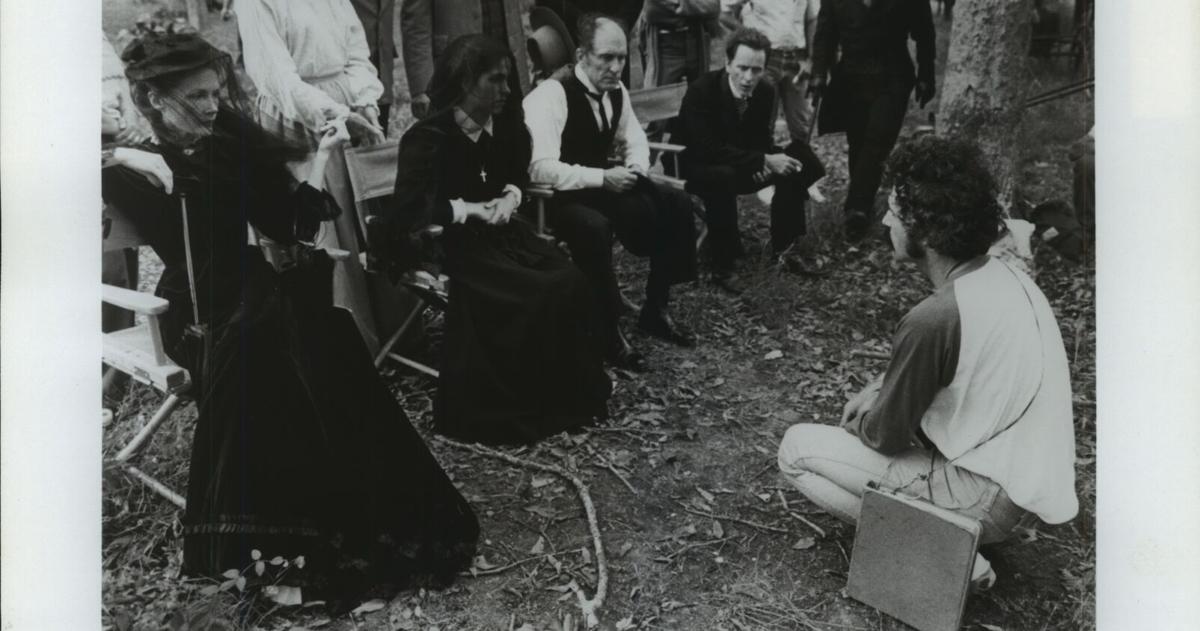
Director Glen Pitre, 29, on the set of “Acadian Waltz” which was released as “Belizaire the Cajun.” Pitre’s film is being produced in association with Sundance Institute. Shooting took six weeks from April 22 to June 21, 1985. Co-producer Robert Duvall had a cameo role in the film which starred Armand Assante as “Belizaire,” the cajun healer. (State Times File Photo)
Pitre grew up in Cut Off in the 1960s and ’70s, and in many ways, he wrote what he knew of life in south Louisiana — the relationships, the jokes, the hard work and gentle speed of life in bayou country.
He said his grandparents never spoke English, and he spent more time on boats than on land. The plot of “Belizaire the Cajun” unfolds in that world, but 100 years before in the Louisiana frontier of 1859, with French speaking Cajun people in conflict with Anglo vigilantes who have framed Belizaire’s cousin for murder.
The film is a look at the 19th-century melting pot of Louisiana and the traditions of the Cajun people.

“Belizaire the Cajun” – Armand Assante is Belizaire, the Cajun, a lover, a fighter, a man of music and a man of healing.
Belizaire Breaux is a traiteur — a country healer who uses prayer, herbs and folk remedies to help the sick. He plays the accordion, plays tricks and flirts shamelessly, with the panache of a Cajun Robin Hood.
Breaux doesn’t have a lot in common with his English-speaking neighbors, one of whom is married to Alida Thibodeaux, the woman he loves.
“All stories are based on conflict of some sort or another,” said Pitre, who now lives in New Orleans and continues to work on film and Louisiana cultural projects. “Everything isn’t black and white. You had the evil American, but his brother-in-law’s heart was basically in the right place. You have the Belizaire character, and his cousin, who should have known better. There’s the local sheriff, who was played by my father, cutting legal and ethical corners left and right.
“Whether they’re on the side of good or on the side of evil, they’re all recognizable as people we see, people we know and occasionally ourselves.”

“Belizaire: The Cajun” A vigilante Bob Edmundson tires Leger, a Cajun, (Michael Schoeffling) to a tree so he can be horsewhipped.
The collision of worlds is a common story in Louisiana history, where French, Spanish and American authorities have all left their mark through the centuries. The Cajun story has been forged through upheaval, from the Canadian expulsion to settlement in a new land. The character of Belizaire makes a lot of sense in this context, where you can’t always control the things happening around you, but you can control your response.
“He survives by his wits and being just one step — occasionally half a step, or even just a quarter — ahead of others,” Pitre said of Belizaire. “It’s an archetype that was in half the stories I grew up with that has nothing to do with the events of the film.”
Pitre noted that the events in the film were loosely based on a real person who lived in Vermilion Parish and was arrested for the murder of a vigilante.
“He was a healer. He was an accordion player. He was arrested and later released, and then he moved in with a widow, so that was the kernel of the story,” he said.

“Belizaire the Cajun” – Belizaire, a Cajun healer (Armand Assante) listening to Alida’s (Gail Youngs) unborn child.
Today, “Belizaire the Cajun” is difficult to find on streaming services. DVDs are available for purchase on Amazon, and clips from the film can be found on video sharing sites. The film sometimes airs through local cable listings such as Louisiana Public Broadcasting, and Pitre periodically attends local screenings and question and answer sessions.
The root of the story, though, includes experiences that many Louisianans relate to.
Pitre says the biggest compliment he has received was from another director who noted that Pitre’s films don’t include characters who are idle. Instead, they reflect real life, with people having conversations, washing dishes, feeding chickens or fixing a car.
“So many people consider it a part of their story,” he said. “To create a world, to have audience members believe that world, you want to show how people lived.”
‘ The preceding article may include information circulated by third parties ’
‘ Some details of this article were extracted from the following source www.theadvocate.com ’