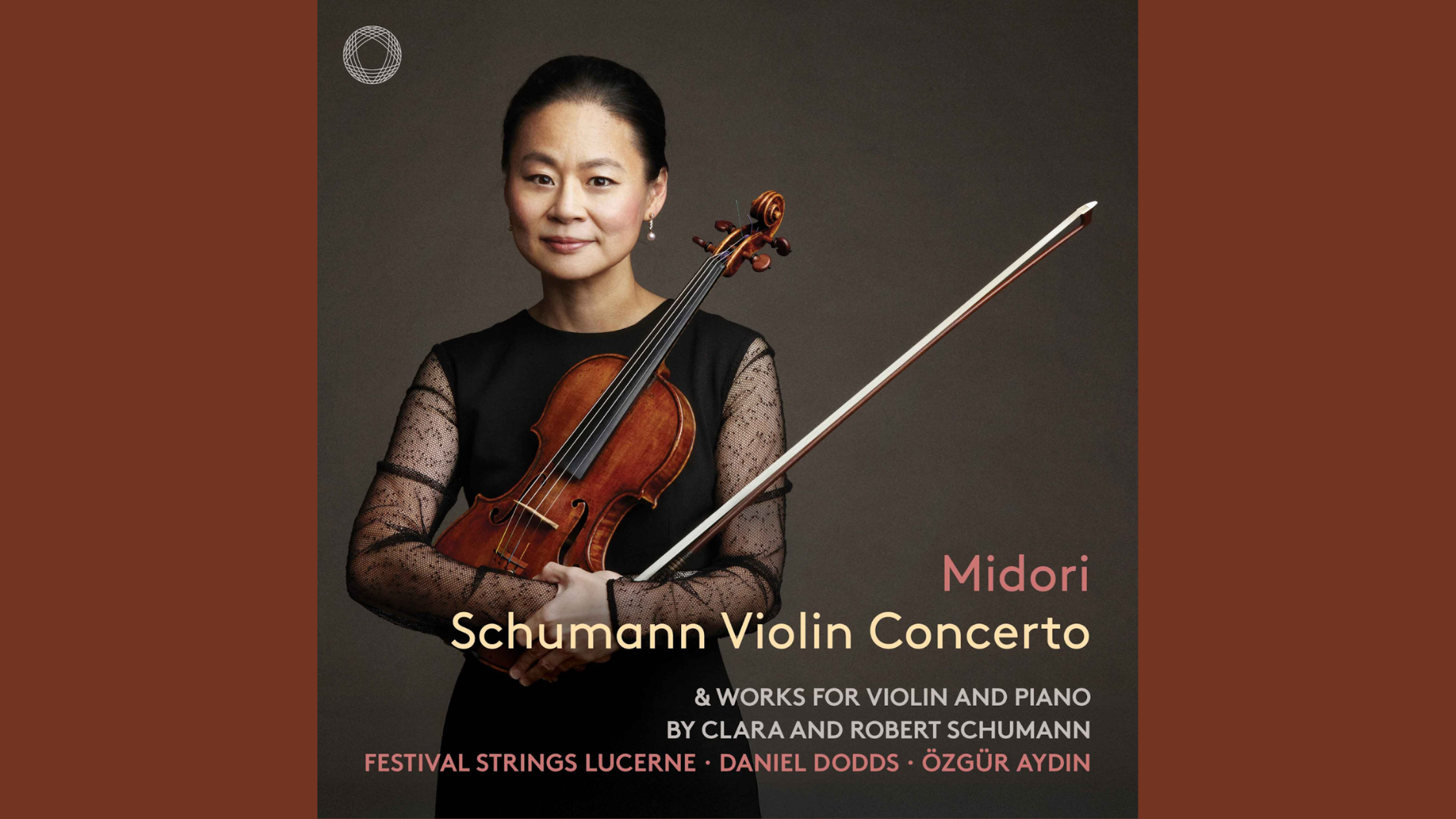
When she was just 11 years old, Japanese-born American violinist Midori made a stunning debut concert with the New York Philharmonic. Since then, she’s released dozens of recordings, covering the violin repertoire from Bach and Beethoven to Tchaikovsky, Brahms, and beyond. But as she recently observed, one romantic concerto was conspicuously absent from her repertoire: Robert Schumann’s. Her newest album remedies this, and adds chamber works by both members of music’s first power couple: Robert and Clara Schumann.
There’s a reason why Midori might have overlooked Robert Schumann’s Violin Concerto in D Minor: he wrote it in the autumn of 1853, when his mental and physical health were rapidly declining, and the piece often comes across as challenging and diffident, without the flashy pyrotechnics that romantic concertos were known for. After Robert was institutionalized the following year, Clara Schumann and the work’s dedicatee, violinist Joseph Joachim, decided to keep the concerto to themselves, fearing that it would be judged harshly by critics. Joachim even went so far as to declare that it shouldn’t be published until 1956 – a hundred years after the composer’s death.
That idea prevailed until the 1930s, when interest reawakened in the “lost” concerto thanks to, of all things, a séance that allegedly made contact with Robert Schumann’s spirit. It was finally premiered in 1937, and has been recorded occasionally since then, with violinists taking care to resolve the many lingering errors in the manuscript. On this new recording, Midori gives Schumann’s concerto a thoughtful reading, joined by the Lucerne Festival Strings under the direction of conductor Daniel Dodds. The performance shines in its more introspective parts, like the intimate second movement:
Understanding Wisconsin, Together.
WPR’s “Wisconsin Today” newsletter keeps you connected to the state you love without feeling overwhelmed. No paywall. No agenda. No corporate filter.
Rounding out this new album are chamber works by the Schumanns, where Midori is joined by pianist Özgür Aydin. This includes Clara Schumann’s Three Romances for Violin and Piano, Op. 22, which also dates from 1853, when the piano virtuosa was preparing to embark on a concert tour with Joachim. These are the ideal complement to Robert’s concerto, and Midori and Aydin bring out the pathos in each movement:
The other works on the album were not originally written to feature the violin: Robert Schumann’s Three Romances, Op. 94, were originally intended for oboe and piano, but with no oboist available, they were premiered on the violin in 1850, and are frequently heard on both instruments. His “Five Pieces in Folk Style,” Op. 102, were meant for the cello, but here again, Schumann prepared an alternative version for violin and piano. It adds a welcome note of levity to the program:
These works are all excellently performed by an artist with the necessary experience and perspective to find their hidden details. Midori’s Schumann album is out now on the Pentatone label.
‘ The preceding article may include information circulated by third parties ’
‘ Some details of this article were extracted from the following source www.wpr.org ’