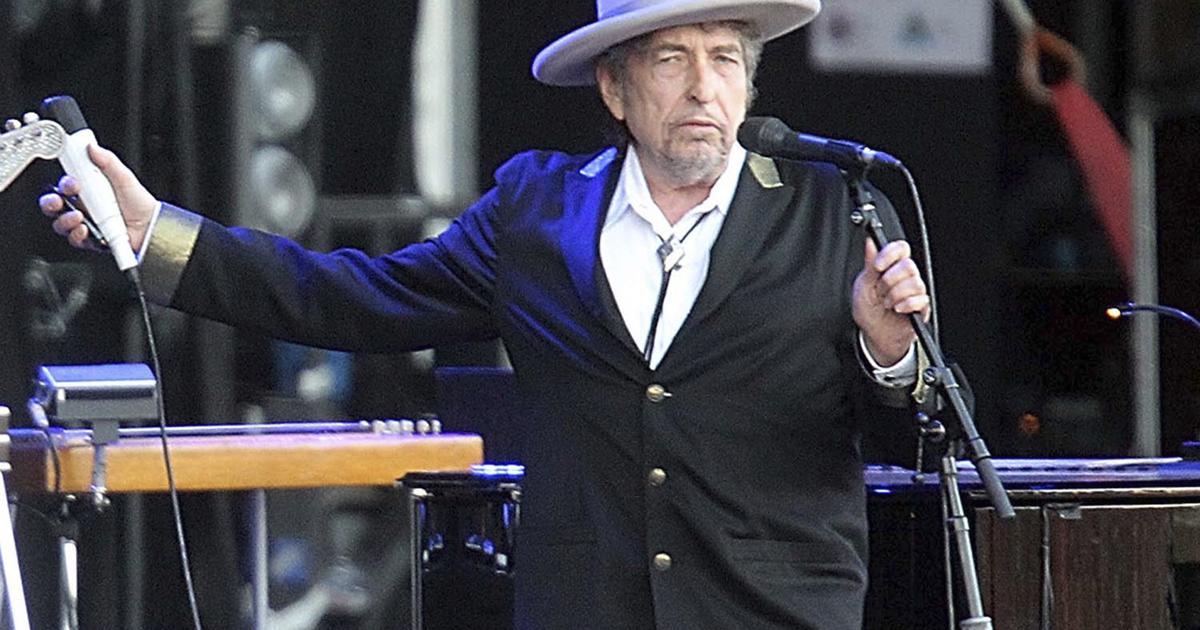
Bob Dylan stays newsworthy.
In the past few weeks and months, he’s been the subject of dozens of stories, items and reviews.
The Times (of London), New York Times, Chicago Tribune and many other newspapers, NPR, the magazines American Songwriter, Rolling Stone, Guitar Player and Far Out and websites Salon, Artnet News and Jambands are among the media outlets covering Dylan from a variety of angles.
Iconic singer-songwriter Bob Dylan will perform in April in Baton Rouge.
This recent coverage includes reviews of two new books about the enigmatic singer-songwriter who turns 85 on May 24: Robert Polito’s “After the Flood: Inside Bob Dylan’s Memory Palace” and Jim Windolf’s “Where the Music Had to Go: How Bob Dylan and the Beatles Changed Each Other — and the World.”
Polito’s “After the Flood” makes the case that the past 30 years of Dylan’s career have been as significant to his catalog as the 1960s and ’70s. Those earlier decades saw him writing and recording “Blowin’ in the Wind,” “Masters of War,” “The Times They Are A-Changing,” “Mr. Tambourine Man,” “Knockin’ on Heaven’s Door” and more future classics.
Polito’s book highlights such later Dylan albums as 1997’s “Time Out of Mind,” 2001’s “Love and Theft” and his masterful 2020 opus, “Rough and Rowdy Ways.” The book also cites the considerable touring Dylan has done since 1988, aka the “Never Ending Tour.”

This April 27, 1965, photo shows singer-songwriter Bob Dylan in London.
Dylan’s wandering bootheels bring him to Baton Rouge for a Monday concert at the River Center Theatre for Performing Arts and Tuesday to the historic Shreveport Municipal Memorial Auditorium. The Baton Rouge show is nearly sold out.
The other new Dylan book, Windolf’s “Where the Music Had to Go,” chronicles Dylan’s relationship with his 1960s peers, the Beatles. Friendly rivals, they influenced and inspired each other. Initially dismissive, Paul McCartney found himself enraptured by Dylan’s first two albums during the Beatles’ extended engagement in Paris in January 1964, just weeks before Beatlemania struck the United States.
“For the rest of our three weeks in Paris we didn’t stop playing them,” John Lennon said of those Dylan records.
In his 2021 book, “The Lyrics,” McCartney reveals the impact Dylan made on the Lennon-McCartney songwriting team: “In the earliest days we were writing like Buddy Holly. Then we were writing like Motown. Then we were writing like Bob Dylan.”

ASSOCIATED PRESS FILE PHOTO — Bob Dylan performing at the Olympia Theater in Paris in 1966.
Dylan later grew especially close to George Harrison, who recorded the Dylan song “If Not for You” for his 1970 solo album debut. Nearly 20 years later, ex-Beatle Harrison joined Dylan in the supergroup Traveling Wilburys. And 22 years after Lennon’s death in 1980, Dylan released a tribute to him, “Roll on John.”
Dylan’s 2026 performances in Louisiana are part of his yearslong “Rough and Rowdy Ways” worldwide tour. Many of the shows on its latest leg are in smaller venues in places like Saginaw, Michigan; La Crosse, Wisconsin; Muncie, Indiana; and Waukegan, Illinois.
In a review of Dylan’s March 30 performance in Waukegan, Chicago Tribune writer Christopher Borrelli describes the evening’s inscrutable main attraction as “a Flying Wallenda, pulling arrangements out of shape, not looking down to see just how precarious all of this sounds, as his excellent four-piece band turns toward him, carefully watching his footing. It’s also just a weirdly cozy image for a famously caustic legend.”
The Waukegan show’s set list included Dylan’s take on songs by some of his rock ’n’ roll heroes (Bo Diddley’s “I Can Tell” and Eddie Cochran’s “Nervous Breakdown”); his recasting of his own classics; and “Rough and Rowdy Ways” songs.

Bob Dylan performs in Los Angeles in 2012. Dylan’s new album, ‘Shadow Kingdom,’ is a must-listen for his fans.
Initially seen as a folk singer, Dylan was canonized by the early ’60s folk music scene. Those early years are depicted in the eight-time Oscar-nominated 2024 Dylan biopic, “A Complete Unknown.” The film follows him from his 1961 arrival in New York City to the electric performance at the 1965 Newport Folk Festival that enraged folk music purists.
In 2016, Dylan became the first musician to win the Nobel Prize for Literature. He chose not to accept his prize in person. The U.S. ambassador to Sweden, Azita Raji, read his acceptance speech at the gala Nobel Banquet in Stockholm City Hall. An excerpt is below:
“When I started writing songs as a teenager, and even as I started to achieve some renown for my abilities, my aspirations for these songs only went so far. I thought they could be heard in coffee houses or bars, maybe later in places like Carnegie Hall, the London Palladium. If I was really dreaming big, maybe I could imagine getting to make a record and then hearing my songs on the radio. That was really the big prize in my mind. … Well, I’ve been doing what I set out to do for a long time, now. I’ve made dozens of records and played thousands of concerts all around the world. But it’s my songs that are at the vital center of almost everything I do. They seemed to have found a place in the lives of many people throughout many different cultures. I’m grateful for that.”
‘ The preceding article may include information circulated by third parties ’
‘ Some details of this article were extracted from the following source www.nola.com ’