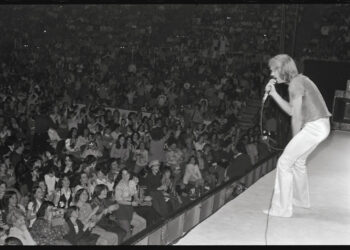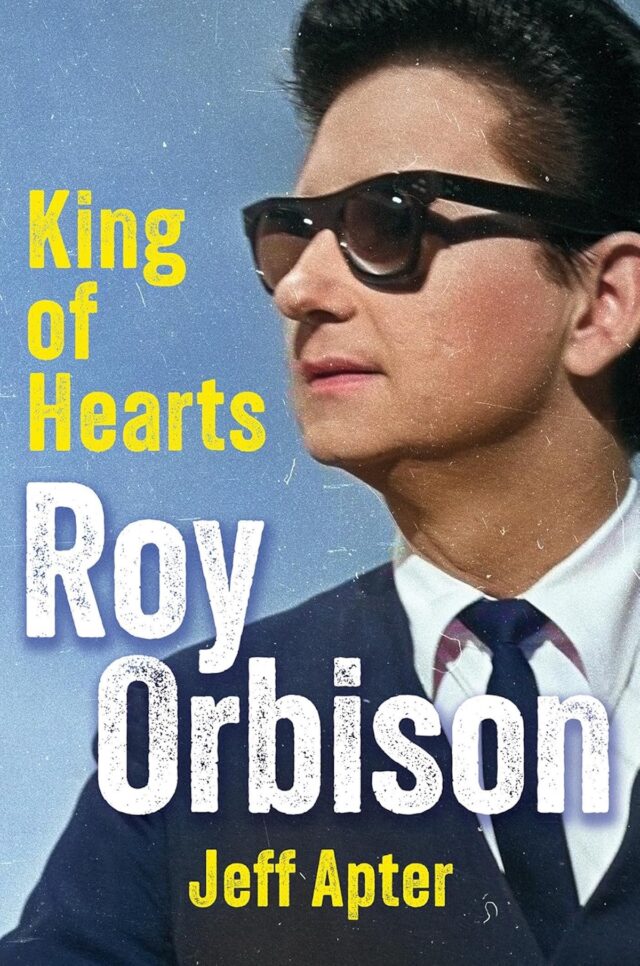
Hey, there’s a new Roy Orbison bio coming out. That reminds me: I interviewed his widow Barbara back in 2010, when Roy got a star on the Hollywood Walk Of Fame. I’ll have to find that chat sometime. Come to think of it, I have spoken to a few rock widows over the years: Along with her, there was Buddy Holly‘s wife Elena (also for a Hollywood Walk Of Fame event), George Harrison’s wife Olivia (for Santana’s cover of While My Guitar Genty Weeps, believe it or not) and… well, I’m sure there were others. I’ll try to think of them while you peruse next week’s musical tomes:
 Roy Orbison: King Of Hearts
By Jeff Apter
THE EDITED PRESS RELEASE: “He didn’t look, move, or sound like his contemporaries, but Roy Orbison, king of the emotionally charged, slow-burning, drama-ballad, struck a worldwide chord. Now, from acclaimed music biographer Jeff Apter, comes the definitive biography of one of music history’s most beloved, versatile, singer-songwriter legends. Clad in black with dark shades, Orbison had a mystique, style, and voice that were unmistakable and singularly different from his famous peers of the 1950s and ’60s, like Johnny Cash, Elvis or Jerry Lee Lewis. Roy hit notes that, in the words of Bruce Springsteen, sounded “like the world’s going to end.” Born in Vernon, Texas, Roy was the son of a guitar-playing oil worker. Already a music fan by age six, Roy went on to form a high school band. Honky-tonk gigs followed. Then a contract at Elvis Presley’s label, Sun Records, where Roy found mentors and friends among the likes of Carl Perkins. Following a shift to Monument Records, he shared a bill with a group called The Beatles, who were huge fans of his. After experimenting with different styles, Roy edged closer to a sound all his own. He found it with smash singles including Only The Lonely, Crying and Oh, Pretty Woman, songs heavy with pathos and remarkable vocals. It was gold. But what lay ahead was a professional downswing, and personal tragedy with the death of his wife and two sons. 20 lean years followed. Yet Orbison was far from over. Amid the rockabilly revival of the 1980s and the formation of the British-American supergroup Traveling Wilburys — with, among others, Jeff Lynne, who would eventually produce Roy’s posthumous albums — Roy’s comeback was legendary. Asked how he’d like to be remembered, Roy said, “One day when they are mentioning people who had an impact, if they just mention me among the rest of the guys and gals, it would be great.” He got his wish. Roy Orbison: King of Hearts seals it.”

Prince: Black, White, Color: Collected Photographs
By Steve Parke
THE EDITED PRESS RELEASE: “Prince. Visionary, multi-instrumentalist and extraordinary showman. One of the most influential and inspiring pop superstars of the 20th century. Prince: Black, White, Color reveals the artist as he’s never been seen before thanks to a unique set of photographs, many published here for the first time, all captured by Prince’s own trusted art director — award-winning photographer Steve Parke. These photos allow readers an extremely rare glimpse of Prince at Paisley Park, at his sun-drenched house in Marbella, and at work in the studio, posing for portraits as well as moments of quiet tenderness with his first wife Mayte Garcia and their beloved dog Mia. With over 570 images, this two-volume special edition showcases a stunning collection of intimate photos, all personally selected by Parke from his own archives.”

Run-DMC And Raising Hell: 40 Years
By JayQuan
THE EDITED PRESS RELEASE: “In 1985, Queens rap group Run-DMC teamed with heavy metal producer Rick Rubin to record their breakthrough album and one of the most influential songs in rap and rock. The album, Raising Hell, went double platinum and sold over 3 million copies. The song, a collaboration with rock group Aerosmith covering that band’s 1975 hit Walk This Way, is credited with pushing hip-hop into the mainstream and launching the rap-rock genre. JayQuan draws heavily from his interviews with key figures, including surviving group members Joseph “Run“ Simmons and Darryl “DMC” McDaniels, as well as studio and label personnel. Illustrated with performance and off-stage photography, as well as select memorabilia, this beautiful slipcased hardcover is the ultimate word on a work that had a towering impact on both rap and rock and is an essential addition to the collection of any fan.”

Spit: A Life In Battles
By Jonnie Park AKA Dumbfoundead
THE EDITED PRESS RELEASE: “Spit is the raw and electrifying memoir of Jonnie Park — better known by his rap moniker, Dumbfoundead — whose rise from an unruly childhood in L.A.’s iconic Koreatown to international rap stardom is as unlikely as it is exhilarating. Born in Argentina to Korean parents and smuggled by a coyote across the U.S.-Mexico border at age three, Park grew up amid cultural dislocation, his father’s violent alcoholism, and the turbulent protests and riots of the early 1990s. Searching for belonging, he found salvation in the highly competitive underground world of battle rap, where he was among the only successful Asian American combatants. He honed his freestyle superpowers at Project Blowed, the legendary South Central open-mic venue, amid a motley crew of characters who took him in as one of their own. Told through the lens of his life’s greatest battles — his father’s rage, racist stereotypes, the pressures of fame, and his own addictions — Park tells his story with his trademark humor, lyrical style, and unflinching honesty. Like Eminem’s 8 Mile, Spit charts the author’s course from high-school dropout to cultural pioneer, one verse at a time. From open-mics in South Central to freestyle cyphers in Seoul to music festivals across the globe, Park’s memoir is a testament to creativity, grit, and the power of speaking your truth — even when the world isn’t ready to hear it.”

Acme BOY: The Birth Of Punk & Anti-Fashion 1975-1985
By Phil Strongman
THE EDITED PRESS RELEASE: “It’s been 50 years since The Sex Pistols played their first gig and the ‘street couture’ shop Acme Attractions opened. Which makes it perfect timing for Phil Strongman’s Acme BOY — the stunning inside story of Acme, punk, anti-fashion and the London youth culture explosions of the 1970s and ’80s. By turns amusing, intriguing and shocking, Acme BOY features the author’s own story, his involvement with the Pistols, The Clash, Malcolm McLaren and Vivienne Westwood — and exclusive words from Acme Attractions founder John Krivine and Boy co-founder Steph Raynor. Their shops were crammed with classic jukeboxes and staffed by the likes of future film-maker / DJ Don Letts, Rough Trade boss Jeannette Lee and stylist Eric Rose. Their customers included John Lydon, Sid Vicious, Bob Marley, Andy Warhol, Rudolf Nureyev, Peter O’Toole, Rod Stewart, Daryl Hall, Boy George, Joe Strummer, Chrissie Hynde, Billy idol, Patti Smith, Deborah Harry, Philip Sallon, Steve Strange and Adam Ant. The untold story of the brand’s tangled roots are both revealing and fascinating. Back in 1975, King’s Road proto-punk was initially dubbed The Big Sleaze by fashion mags before it rapidly became notorious as punk, the shattering scene that shocked the U.K. Post-punk, mod, new romanticism, two-tone, goth, rockabilly, and more followed in swift succession. Strongman saw these movements develop and was involved in many. He is the only person to have designed for Acme Attractions and Boy — before managing bands, taking photos and supplying clothes to multiple outlets. His designs have been worn by Anita Pallenberg, Roger Daltrey, Billy Connelly and Pamela Stephenson as well as hundreds of musicians. With its gripping text and an array of rare and unseen photos, images and illustrations, Acme BOY is one of the most important, and personal, contemporary books to explore the fashion of the ’70s punk era.”

Tony Schwartz: Snapshots In Sound
By Tony Schwartz
THE EDITED PRESS RELEASE: “A born-and-bred New Yorker, Tony Schwartz (1923–2008) was enamored with his city. Though a popular campaign designer for Madison Avenue clients such as Johnson & Johnson and American Airlines, and later creating the sound for hundreds of political advertisements (including the infamous Daisy spot for Lyndon B. Johnson’s 1964 campaign), his first and truest love was the sounds of the streets around him. Using a reel-to-reel tape recorder, the agoraphobic Schwartz ventured only a few blocks from his Hell’s Kitchen apartment yet captured an encyclopedia of sounds. Many of these tapes were broadcast on his perennial WNYC radio show Around New York from 1945 to 1976. Though the term may seem an oxymoron, Schwartz truly was an audio visionary. Sampling from his voluminous catalog of recordings and coupling them with the poetic descriptions he gave to them, Snapshots In Sound assembles an A–Z of Schwartz’s vivid practice. Filled with candid images of his documentation in action, cover art from his many records and his own writings, this charming volume also includes an appreciation of Schwartz’s work from the legendary Village Voice columnist Nat Hentoff.”

Rolling Stone & The Rise Of Hip Capitalism
By Charles L. Ponce de Leon
THE EDITED PRESS RELEASE: “In its early years, Rolling Stone stood out on the magazine rack: an iconoclastic bimonthly aimed at young Americans, dedicated to music, culture, and politics. Magazine cofounder Jann Wenner’s vision of a magazine that blended politics with sophisticated coverage of rock music and related social and cultural trends was groundbreaking and a surprising commercial success, turning the brash young publisher into the era’s quintessential “hip capitalist.” This is a history of Rolling Stone’s heyday, from its founding in 1967 to its twentieth anniversary, examining its coverage of notable social, cultural, and political developments and the contributions of its distinguished and often brilliant writers — from Greil Marcus and Hunter S. Thompson to William Greider and P. J. O’Rourke. It also reveals how, in response to shifts in its audience, the magazine industry, and the broader culture, Rolling Stone gradually changed, becoming more successful but also less innovative and influential. In the magazine’s prime, however, Wenner and company showed how a thoughtful, irreverent magazine could attract advertisers as well as readers and spread sixties-inspired values into the mainstream.”

Won’t Back Down: Heartland Rock & The Fight For America
By Erin Osmon
THE EDITED PRESS RELEASE: “Hear American Girl or Born In The U.S.A. and, like it or not, chances are you begin to hum along. Heartland rock — the soundtrack of grocery stores, pool halls, bowling alleys, flea markets, chain restaurants, drug stores, and political rallies — is beloved by some and derided by others, but is inescapable. As rollicking as the music it describes, acclaimed music critic Erin Osmon’s Won’t Back Down tells the story of the origins, chart-topping development, and tangled legacy of heartland rock, the music that ruled the airwaves of the 1980s and remains instantly recognizable to millions. Spinning an entertaining and eye-opening account, Osmon delves into the complicated afterlife of heartland rock’s classic albums and songs, including Springsteen’s Born To Run, Bob Seger’s Against The Wind, John Mellencamp’s Small Town and Tom Petty’s I Won’t Back Down. She demonstrates the centrality of often-overlooked women like Melissa Etheridge, Bonnie Raitt and Lucinda Williams — explaining how some of the most popular music of the time was made beyond its white-male stereotypes. She traces the genre’s connections to country and Americana, and reveals how legendary figures like Prince were inspired by and expanded heartland rock. And she shows how its success revitalized the careers of figures like Bob Dylan and Neil Young. Through it all, she explores the ’80s cultural developments that fostered the genre — such as the rise of MTV and the switch to CDs — and argues that the music played a vital role in opposition to ’80s conservatism and in support of LGBTQ rights, labor issues, and the environmental movement. A fair-minded critic with an ear for a great behind-the-scenes story, Osmon makes clear that at its best, heartland rock connected with millions of overlooked people longing to be heard.”

Easy: A Hard Look At Soft Rock
By Timothy Gray
THE EDITED PRESS RELEASE: “Soft rock, they call it; low-key stuff with wide appeal.” So stated a 1971 Chicago Tribune article on The Carpenters. Over time, soft rock became the butt of jokes, yet during its heyday, it fit America’s changing mood, blending rebellion with conservatism. Easy explains how soft rock and associated genres emerged in the late 1960s and achieved broad recognition in the 1970s. Tracking hundreds of songs, Timothy Gray supplies Billboard’s chart rankings to show how soft music easily crossed over from one fan base to another. Featuring acts as familiar as Fleetwood Mac and Carly Simon, and as underappreciated as The Three Degrees and J. D. Souther, Easy provides an entertaining aircheck of American culture during a transformational era.”

Minimalist Music
By George Grella Jr.
THE EDITED PRESS RELEASE: “Minimalist Music looks critically into the music’s past, shows how the genre thrives across styles, and points the way toward minimalism’s ongoing future. Minimalism as a genre is best defined not by any style or flavor but by its means. Certain rhythms and chords in other music may identify things like jazz or bossa nova or reggae; take those same elements and put them through the processes of minimalism and you have minimalism with the hues of other musics. A still young genre with ancient roots, minimalism is much less any kind of style than a practice, a manner of making music. Reviving those means and applying them to contemporary sounds and experiences, the pioneers of minimalism created a new and avant-garde music that immediately communicated its power to listeners of all kinds. The global appeal of minimalism and the way the methods adapt to myriad styles open up a view into how music actually works as an art and an experience, how through time it connects in a fundamental way to how we as humans listen.”

The Sound Of Thinking: A Listener’s Companion To Conceptual Music
By Craig Dworkin
THE EDITED PRESS RELEASE: “An artist draws two octaves of pitches randomly from a hat, just enough to set each syllable of the dictionary definition of imprimer (to score, to print). Trawling the internet for cute videos of cats “playing” piano, an artist splices together a complete, note-perfect performance of Arnold Schoenberg’s Opus 11. Half a century after the release of Miles Davis’s album Kind Of Blue, a jazz quintet spends months of focused practice to reproduce the original exactly. These performances share a common denominator: Absolute fidelity to the outcome of a system. From Marcel Duchamp to Yoko Ono, Steve Reich to Sun Ra, The Sound Of Thinking brings together a diverse array of musical or sonic works that are algorithmic, automatic, permutational, procedural, or otherwise structured in contrast to the creative expressivity typically associated with artistic production. In 26 short essays, each keyed to a term that begins with a different letter of the alphabet, Dworkin discusses work composed or performed according to a predetermined rule, transforming artistic creation into a system running its course. The pieces detailed here, drawn from more than a century of musical experimentation, offer a fresh perspective on the history of innovative music by decoupling music from expression and by shunting creativity from the level of organizing sounds to the level of devising a system that can do the organizing. Not only does this book spotlight the critical role of music in twentieth-century conceptual art, but it also identifies previously overlooked links among diverse artists and movements.”

Manchester Must Dance: A Life Of Music, Madness And Moving On Up
By Mike Pickering
THE EDITED PRESS RELEASE: “Beginning on the night in November 1963 when his mum took him to see The Beatles live at Manchester’s ABC Cinema, Mike Pickering takes the reader through 60 years of clubs, clothes, gigs, record labels, football matches and politics. Pickering has lived through decades of rapid change in popular music. As an influential DJ he introduced house music into the legendary Haçienda. He signed Happy Mondays and James to Factory Records before working with Kasabian, Gossip and Calvin Harris at Sony. His Mercury Prize-winning, multi-million-selling group M People transformed the music industry’s attitude to dance music. As he tells his remarkable story he introduces an array of friends and collaborators, many of whom would become important — and sometimes notorious — figures in music history. Manchester Must Dance is a revelatory insider’s account that moves from the cramped back streets of 1950s north Manchester on a journey deep into music, the city and the wider world. It features forewords from some of those Pickering inspired: Martin Fry, Johnny Marr, Noel Gallagher and more.”
‘ The preceding article may include information circulated by third parties ’
‘ Some details of this article were extracted from the following source tinnitist.com ’