Staging another world premiere with big names attached is one more feather in Chicago Shakespeare Theater’s cap — or would be, if Scooter Pietsch’s “Fault,” directed by Jason Alexander and starring Enrico Colantoni, weren’t such a letdown.
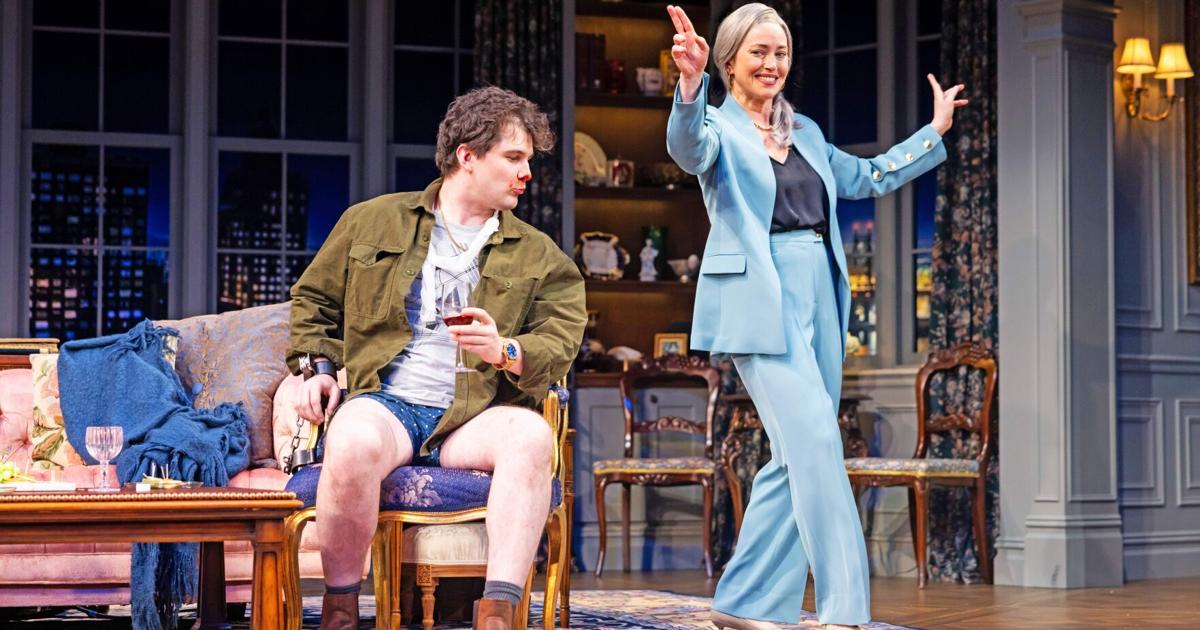
But, alas, this major marital battle that unfolds mostly at high volume and more or less in 90 minutes of real time is based on a preposterous premise, involves truly unpleasant people, has a climax that seems all wrong and features broad direction and some egregious overacting. The best thing about it is Paul Tate dePoo III’s scenic design of a lavishly appointed New York City living room with skyline views.
Truth be told, the sensibility strikes me as more Hollywood than Manhattan. It’s as if the playwright, who has written a lot for TV, created a sitcom that mashes up elements from “The War of the Roses” and “Who’s Afraid of Virginia Woolf?” peppered with ping-pong verbal duels like those of the title duo in “Rosencrantz and Guildenstern Are Dead” or Gogo and Didi in “Waiting for Godot,” all without any regard for industry regulations or propriety.
The evening begins with the lights (by Greg Hoffmann) coming up on Lucy Green (Rebecca Spence) having rough sex behind a couch with the much younger Shaun (Nick Marini) when her husband Jerry Green (Colantoni) comes home early and finds them in flagrante delicto. He has a bottle of good Champagne and intends to celebrate the hugest ever merger he’s managed to pull off (the figure $200 billion is bandied about), making them filthy rich after years of almosts.
Instead of just throwing Shaun out or beating him up, Jerry, an Anglophile, threatens him with his swordstick — a sword hidden in a walking stick or cane — and ends up handcuffing him to his favorite French Provincial chair. Then he, with the apologetic Lucy’s acquiescence, convinces Shaun to judge — for huge sums of promised money — who is at fault for the deterioration of Jerry and Lucy’s marriage and business partnership over the last decade.
What follows is a series of performances by Jerry and Lucy, each trying to enlist Shaun’s sympathy, even as we have the growing sense that they’ve played these games of lies and betrayals before. At times, we begin to believe that they really care for each other, but even that may be play-acting.
For his part, Shaun is drawn in, repeatedly asking for more information about what happened next in their accounts of the past and injecting his own opinions on what Jerry and Lucy should have done to right their relationship. His belief that honesty is the best policy even bites him on the backside, allowing the couple to destroy his faith in the affair.
While Jerry and Lucy’s falling out, both personal and professional, arguably peaked in London, the way they react to a crisis with Shaun epitomizes just what horrible people they are. Consumed by greed, status and false ideas of success, they don’t care about anything that matters. The best that can be said is that they stick together, even as they blame each other and everyone else.
Alexander knows how to mine the material for humor, but other than that, the direction doesn’t add much to the script. While Marini and especially Spence find whatever truth they can in their characters, Colantoni’s Jerry is way over the top. In fact, he was so far over on opening night that if he had brandished the swordstick like a phallus one more time, I might have screamed.
‘ The preceding article may include information circulated by third parties ’
‘ Some details of this article were extracted from the following source www.hpherald.com ’