Music does not always need to argue for its place in the world. Sometimes it enters with such force, such beauty, and such undeniable authority that the room simply yields. This is when music takes action, when art does not beg to be valued, but appears fully formed and, almost without warning, weakens the knees. It unfolds into the heart before the intellect has time to organize itself. It assumes its rightful role, not as ornament, not as entertainment, not as a polite luxury for the well-dressed, but as an essential and necessary force in society.
That was the energy inside David Geffen Hall on Tuesday night, where the New York Philharmonic hosted its annual Spring Gala and Concert at Lincoln Center, honoring arts philanthropist Barbara Tober and the memory of Donald Tober. The evening did not feel like another beautiful institutional benefit, although it was certainly beautiful. It felt, perhaps more accurately, like a threshold. A rose-colored, rhythm-charged, almost feverishly alive glimpse into what may be coming next for one of the city’s most important cultural institutions.
The evening began with guests arriving through the Karen and Richard LeFrak Lobby across a green grass carpet in garden party formal attire, then moving toward cocktails in the Leon and Norma Hess Grand Promenade beneath hanging garden floral installations. After the concert, the same space bloomed into dinner, with peonies, ranunculus, anemones, tulips, orchids, and roses arranged in linked glass vases anchored by tree trunk slices and touched with faux butterflies. Designed by DeJuan Stroud and Robert Bloom, with catering by CxRA, the atmosphere carried a lush spring intelligence. It was romantic without losing its footing, festive without becoming frivolous, and charged with that particular New York glamour that appears when patrons, artists, and believers in culture gather for something larger than themselves.

At the center of this electric shift stood Gustavo Dudamel, the Philharmonic’s Oscar L. Tang and H.M. Agnes Hsu-Tang Music & Artistic Director Designate, conducting with a physicality and fervor that felt almost operatic in its own right. Dudamel does not merely lead the orchestra. He inhabits the score. His body seems to move from within the music rather than above it, arms slicing, gathering, releasing, and sculpting urgency into the air. His curls whipped with the frenzy of the sound, his gestures carried both command and abandon, and the passion moving through him became immediately visible in the orchestra itself.
That may be the most striking distinction. Under Dudamel, joy does not appear theoretical. It spreads. One could see it in the musicians’ faces, in the lifted energy of the sections, and in the sudden sense that everyone on stage was not only performing, but participating in something alive and contagious. The orchestra seemed brighter, freer, more open to heat. The room felt it. The audience leaned in as if pulled by magnetism. By the time Stravinsky’s The Firebird Suite arrived, the hall was no longer simply listening. It was, quite possibly, bracing itself for ignition.
The program itself moved with cinematic force. Musorgsky’s Prelude and Dance of the Persian Slaves from Khovanshchina opened the evening with atmosphere and tension, creating an almost perfumed sense of drama before Scriabin’s Piano Concerto introduced the exquisite command of Evgeny Kissin. Returning to the Orchestra for the first time in more than a decade, Kissin brought a kind of sovereign stillness to the stage. His presence seemed to reorganize the room before his hands even touched the keys.


Scriabin requires more than virtuosity. He demands mysticism, sensuality, danger, and an ability to make the piano feel like a charged interior landscape. Kissin understood this completely. His playing was crystalline without being cold, disciplined without becoming distant, and emotionally saturated without slipping into excess. Notes seemed to rise from some deeper register of consciousness, carrying the strange fever of Scriabin’s world with an almost private intensity. Following the standing ovation, his encores—Scriabin’s Mazurka, Op. 25, No. 3, and Tchaikovsky’s Nathalie-Valse, Op. 51, No. 4—felt like gifts offered with restraint, grace, and quiet magnificence.
Stravinsky’s The Firebird Suite gave the evening its most vivid declaration. Under Dudamel, the work did not simply shimmer with myth. It surged. The score’s volatility, wonder, glittering unease, and eventual radiance seemed to move through the hall like a living creature. This was not music placed neatly before an audience. This was transformation in real time, the kind that reminds one, rather urgently, why the arts must remain central to public life. The Philharmonic has promised a new era, and by golly, we are going to get one.
The closing Pas de deux from Tchaikovsky’s The Nutcracker offered a final gesture of tenderness, allowing the evening to exhale after the fire. It reminded the room that grandeur does not always arrive through force. Sometimes it appears through lyricism, through softness held with discipline, through beauty that does not shout and still devastates.


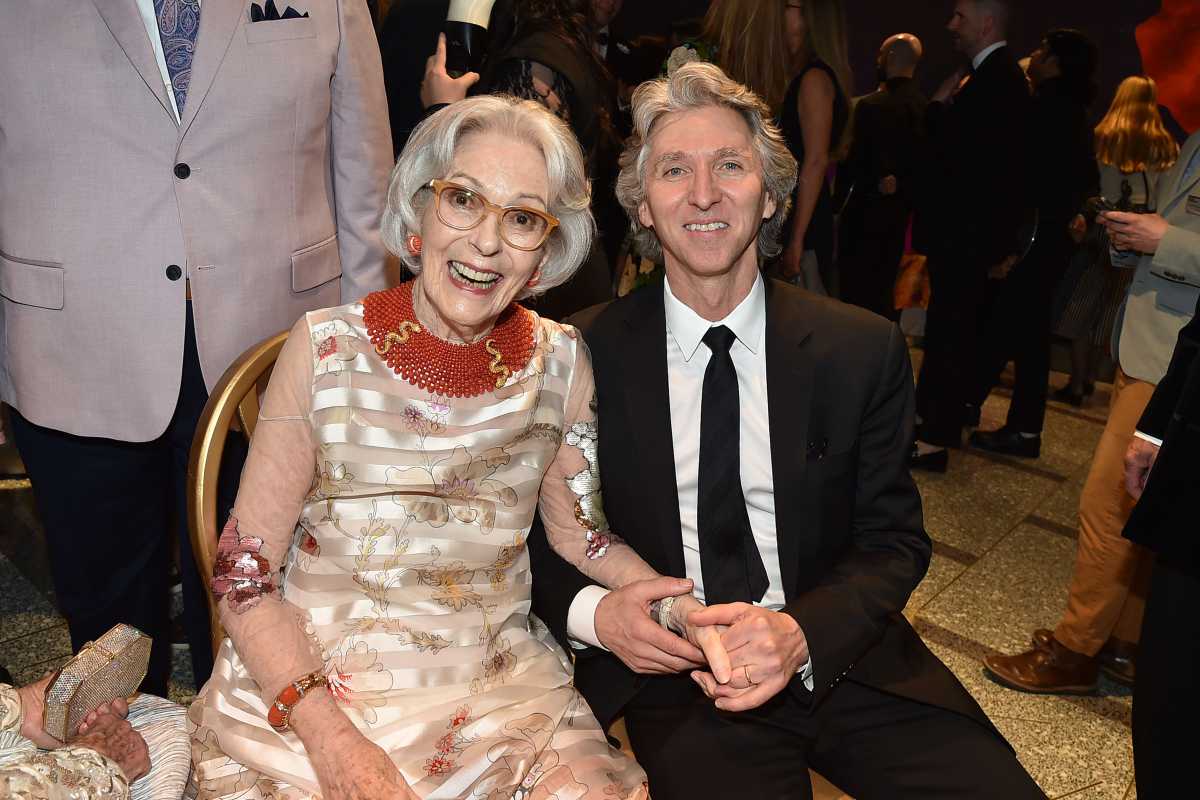
The gala itself raised $3 million, making it the highest-grossing Spring Gala in the Philharmonic’s history, with a sold-out concert and nearly 600 guests attending the dinner. Remarks from Matías Tarnopolsky, Peter W. May, Oscar L. Tang, and the deeply heartfelt Barbara Tober grounded the evening in stewardship, memory, and responsibility. Guests included Elizabeth Segerstrom, H.M. Agnes Hsu-Tang, Joshua Bell, Tania León, Grimanesa Amorós, Eartheater, Chloe Flower, Denyce Graves, Larisa Martinez, Hera Hyesang Park, Ellen Reid, Larissa Saveliev, Christine Shevchenko, John Varvatos, Christopher Wheeldon, Gale A. Brewer, Brad Hoylman-Sigal, and many others gathered around the belief that music is not peripheral to civic life, but vital to it.
What lingered most, however, was not the floral abundance, the grandeur of the dinner, or even the record-breaking success of the gala. It was the feeling of a room awakened by sound. Dudamel brings something urgently human to the podium: appetite, sweat, tenderness, rigor, and a nearly reckless love for the music itself. That devotion traveled through the orchestra and entered the audience with the force of weather.
The New York Philharmonic did not simply stage a gala. It revealed a pulse. It gave the city a glimpse of an artistic future that feels passionate, expansive, and beautifully impossible to ignore.
Catch on the New Era at the Philharmonic www.nyphil.org
‘ The preceding article may include information circulated by third parties ’
‘ Some details of this article were extracted from the following source www.amny.com ’