True to the Music City theme, the Tennessee Titans plan to make live music a prominent fixture on game days at the new venue
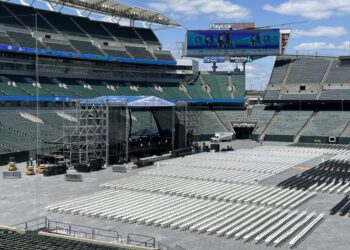
Reflecting the continuing convergence of sports and entertainment, the incipient Nissan Stadium, new home of the NFL’s Tennessee Titans when it opens in 2027, is being built with a dedicated, permanent concert-production infrastructure, including the league’s first permanent in-bowl stage. To establish the new venue’s role as a live-music venue and destination on top-end music touring itineraries, the design features a large retractable stage in the east end and a smaller, fixed “Nashville Stage” at its west end.
Although many NFL stadiums — particularly domed versions like Las Vegas’s Allegiant Stadium, Inglewood, CA’s SoFi Stadium, and Atlanta’s Mercedes-Benz Stadium — are designed to accommodate concerts and other types of performances year-round, none currently incorporate permanent, purpose-built stages of this sort. The stage at the Titans’ new facility will be the only one of its type in any of the league’s 30 stadiums.
“When they were designing it, they didn’t want music to be an afterthought, [as with] most stadiums; they wanted to be a premier music venue,” says Curtis Heath, president, Guitar Center Business Solutions and Audio Visual Design Group (AVDG), its AV-systems–integration division, which collaborated with the Titans on design of the main stage. “From the Titans’ perspective, they’re building more than just a football stadium; they’re building a venue that can support NFL games, concerts, corporate events, community events, premier experiences throughout the year.”
The venue will also house a 260-component K2 PA system from L-Acoustics, the largest to date globally for the France-based manufacturer, which opened a major U.S. office and distribution center in Nashville this year. That system will be installed by the Nashville office of Clair Global.
Guitar Center Business Solutions and AVDG are owned by Guitar Center, which is the Titans’ official music-gear retailer, a partnership announced in February as the team deepens its connection to Nashville’s music identity. As audio-visual integrator for key areas of the Titans’ new stadium, AVDG will lead the venue’s end-to-end AV delivery from system design and engineering through installation, commissioning, and long-term optimization, such as designing the sound system in the green room.
Built for the Big Show
The stage will allow use of the stadium’s field area for productions, which, at the very high end of touring, increasingly use multiple stages. So-called B-stages are either completely separate from a main stage or are connected via a large thrust.
For instance, Taylor Swift has used a B-stage on every tour since her debut Fearless Tour, positioning it on the far end of the venue; that configuration was also used for her subsequent Speak Now World Tour and The Red Tour. The approach was pioneered by the Rolling Stones, which has included B-stages in basically every tour since the late 1970s, and touring artists have to travel with their entire production ensemble. Integrating more stage area into various parts of the stadium in Nashville will offer tour-production designers more opportunities for design innovation and spectacle, which have become critical for ticket sales in what has become a very top-heavy production and high-ticket-price environment.
Making the Music Connection
The new $2.1 billion, 1.8 million-sq.-ft. facility was designed by MANICA Architecture with TVS as architect of record. It’s being constructed by the Tennessee Builders Alliance, whose members collectively have 55 years of NFL-stadium–construction experience, including 17 of the 30 most recently completed projects. The new venue features a circular, translucent roof, a 60,000 seating capacity, and 360-degree exterior terraces. The new audio system will be paired with more than 77,000 sq. ft. of Daktronics LED displays, including a 2,275-ft.-wide “Ring of Fire” screen around the upper bowl.
The main stage, which is on the second seating tier and will be visible to every seat in the house, will have its own green room. In keeping with Nashville’s Music City theme, it’s planned to evoke one of the city’s most famous singer-songwriter venues and be able to hold as many as 200 people, creating a venue within a venue.
“You’ll literally be able to come out of that [club-like] green room and onto the stadium stage itself,” Heath notes. “Inside the stadium, they’re making it very much music-themed, music-decorated. That’s kind of the whole identity of the stadium. It’s the first music-themed stadium ever built.”
Said Tennessee Titans SVP Adam Nuse in a statement, “Music is at the heart of who we are as a city, and Guitar Center’s expertise and innovation will help us take our game-day experience to the next level, creating a home-field advantage that is uniquely Nashville. Guitar Center knows music is a unifying force, whether that’s at a concert, on a game day, or in the community, and we are proud to welcome them as partners of both the Tennessee Titans and new Nissan Stadium.”
The NHL Stakes a Musical Claim
Although the Titans’ stage will the first permanent one for the NFL, Nashville’s NHL Predators have always had a performance platform built into their home at Bridgestone Arena. Constructed over the Zamboni tunnel, that stage is modular and can be removed in part or whole as needed.
The Bridgestone stage is tied into the arena’s main d&b audiotechnik sound system, with a DiGiCo Quantum 338 front-of-house console and an SD stage rack on an Optocore network. A DiGiCo SD-12 console is available for use as a guest mix position. The Bridgestone Arena has also been used regularly as a rehearsal space for major music tours.
“The Ford Bandstage has been around since the start and is a key part of the Nashville Predators game day,” notes Predators Director, Technical Operations, Jacob Lutz, who is overseeing the tech part of a just-begun five-year, $650 million planned expansion at the arena as the hockey team watches its gridiron cousins ramp up across the river. “We activate it with a live band at every intermission. It also serves as a key location for activations throughout the game as well. Over the years, it has played host to several up-and-coming names as well as A-list celebrities, including Keith Urban, Vince Gill, and Scott Stapp of Creed.”
Super Bowl Bound
The new Nissan Stadium will soon be playing on its own bigger stage. At the annual spring meeting yesterday, NFL owners unanimously approved Nashville as the site for Super Bowl LXIV in February 2030.
Citing the 2019 NFL Draft in Nashville, NFL Commissioner Roger Goodell said in a statement, “Super Bowl LXIV at the new stadium is the next step in this remarkable football journey.”
Said Titans President/CEO Deana Ivey in a press release, “Hosting the Super Bowl is a defining moment for Nashville and Tennessee and reflects years of work to build Music City into a globally recognized destination for music, entertainment, and live events.”
Team and city officials had stated even before construction began that securing events like the Super Bowl was a primary goal.
Hosting Super Bowl LXIV, Nissan Stadium will follow Los Angeles in 2027, Atlanta in 2028, and Las Vegas in 2029.
A Model for the Future
While music entertainment has become an integral part of most NFL games, the stages for those shows have historically either been shoehorned into existing architectural geometries or been temporary structures hastily assembled and taken down for halftime events.
“Being integrated into the actual build, it’s the first of its kind, a unique opportunity,” says Heath. “And Nashville’s the perfect place to do that, because it is Music City and entertainment is the core backbone of Nashville. Now it also ties directly to the Titans. I think that, as other stadiums are built, this one’s setting a new precedent.”
‘ The preceding article may include information circulated by third parties ’
‘ Some details of this article were extracted from the following source www.sportsvideo.org ’