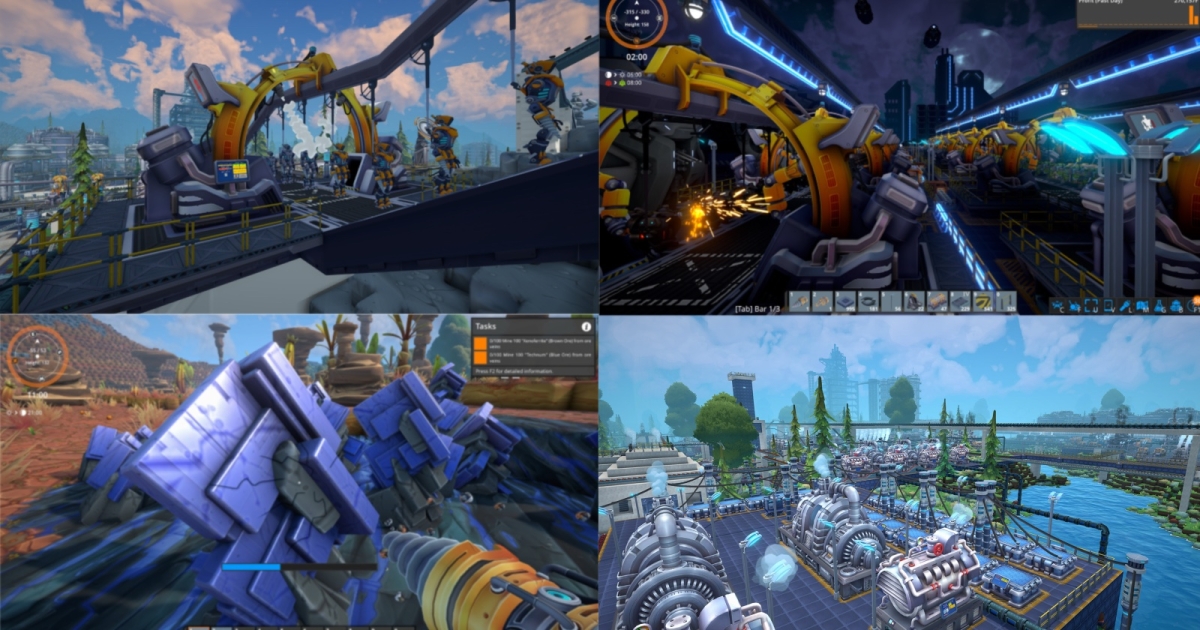
The game’s first-person perspective sets it apart from more traditional top-down factory builders. How did that influence both gameplay design and your technical pipeline?
Mark Laprairie: First-person changes the way players understand a factory. In a top-down game, a production line can be read almost like a diagram. In Foundry, you are standing inside the thing you built, which gives the game a much stronger sense of scale and presence, but also creates a lot of usability challenges.
One of our solutions was to make the building naturally grid-based and axis-aligned through the voxel world. Freeform first-person building can become difficult to reason about very quickly, especially in a factory game where precision matters. The grid gives players a predictable structure to build from, which helps reduce that mental friction.
The perspective also gives us moments that are hard to replicate from above: walking through your factory, debugging machines through in-world interfaces, building vertically through terrain, or riding your first train across a world you reshaped. Technically, that means the game has to support both close-up detail and huge factories visible at scale, which affects everything from asset creation to rendering, streaming, and simulation performance.
The upcoming update introduces trains, which are a major milestone for automation games. What were the biggest design and technical challenges in implementing a scalable rail system?
Mark Laprairie: Trains are a big deal in a factory game because they change the player’s relationship with distance. Belts are great when you’re building locally, but eventually you want to reach farther: remote resource patches, outposts, larger production chains, and routes that make the world feel connected. Trains are our answer to that stage of the game.
The challenge was making them approachable without making them shallow. A player should be able to build a basic line, connect two stations, and understand what is happening pretty quickly. But the same system also needs enough depth for players who want shared tracks, larger networks, and more optimized logistics.
On the technical side, trains touch a lot of systems at once. They have to deal with voxel terrain, long-distance simulation, pathing, save/load, multiplayer, and whatever ambitious rail networks players decide to build. That last part is always the wildcard in a factory game: players will build bigger and stranger things than you planned for, so the system has to be simple on the surface but solid underneath.
‘ The preceding article may include information circulated by third parties ’
‘ Some details of this article were extracted from the following source 80.lv ’