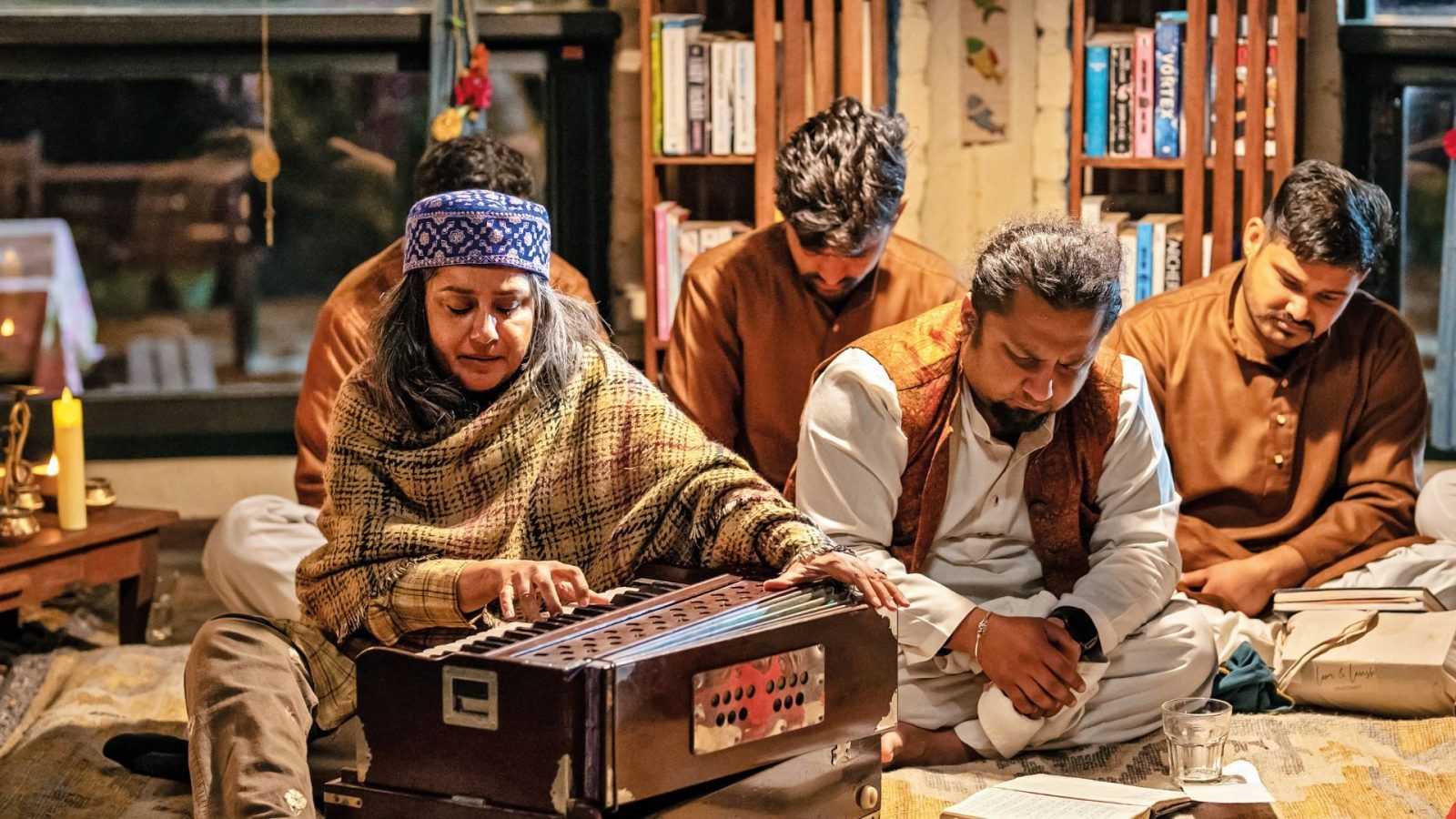
There was a time when music tourism meant wristbands, festival fields, and a flight booked around a set list. While that may still hold for some, the purpose of travel for music is shifting. People are now journeying not for headline acts or festival crowds, but for experiences like a qawwali by a river in Kumaon, a crystal-bowl immersion in Sedona, or a headphone-led movement class in Dubai.
Sure, you could dismiss this as another wellness micro-trend — but the travel economy suggests otherwise. The Global Wellness Institute’s Global Wellness Economy Monitor 2024 valued wellness tourism at $830.2 billion in 2023, with over 1 billion wellness tourism trips worldwide, and identified sound healing, white noise, noise cancellation, and wellness music as part of a rapidly expanding “senses, spaces, and sleep” economy.
The same expansion is visible in India. According to Global Wellness Institute country data released in 2026, India’s wellness economy reached $180 billion in 2024, driven in part by gains in wellness tourism and traditional and complementary medicine.
In this mix, sound is no longer a pleasing extra folded into a spa menu. It is becoming the point.

Not A Concert, Not A Retreat
This shift sits between categories. It is not traditional music tourism — built around energy, scale, and collective release. Nor is it wellness travel in the stricter sense, with diagnostics, discipline, and a day-by-day itinerary.
Samay Ajmera, psychotherapist, music therapist, and Western Regional Liaison at the Indian Association of Medical Music Therapy, explains that traditional music tourism is “more about stimulation, performance, and shared energy,” while quieter sound-led experiences are “more inward-facing, with minimal stimulation, supporting a calmer, more regulated state.”
Hilton’s 2026 Trends Report found that 56 per cent of respondents cited “rest and recharge” as their top motivation for leisure travel this year. What travellers seem to be after is not only escape, but relief from the level of stimulation they have come to accept as normal.
One of the most compelling expressions of this quieter music travel is unfolding in Kumaon.
At Soulitude by the Riverside, Amarrass Music Tours hosts small baithak-style gatherings. Founder Ashutosh Sharma says the idea was to bring music lovers directly to the musicians, ensuring an authentic experience.
The setting matters here. Sharma spent almost eight months scouting properties before choosing Soulitude — a place that cannot be driven into. Guests must get out of the car and walk across the river to arrive. The seven-room property caps gatherings at 15 to 20 people, and they sell out quickly.
Rupesh Jain, who travelled from Delhi, says the experience gave him something a conventional music event could not: the chance to sit face to face with the qawwals, surrounded by hills, a gurgling stream, and open countryside.
The Geography of Music Tourism
Elsewhere, sound is being built into a stay in more literal ways.
In Kerala, tulåh Clinical Wellness is preparing to open the Sonorium — a purpose-built immersive sound environment that founder Faizal Kottikollon describes as both a healing chamber and a living instrument. “Most sound experiences are still something you listen to,” he says. “But the body doesn’t respond to sound only through hearing — it responds through vibration.”
At Dharana at Shillim, Chief Wellness Officer Dr Shaji Pampalyam describes “a quiet but unmistakable shift” in the way guests approach sound-based practices. They arrive, he says, with an accumulated state — poor sleep, burnout, cognitive fatigue, the sense of being permanently switched on. What matters most, he notes, is the after-effect rather than the session itself.
Part of what makes this kind of travel so compelling is how naturally it lends itself to place.
At Ellenborough Park in the Cotswolds, sound baths are held in a candlelit chapel inside the hotel’s 15th-century manor. Director of Sales and Marketing Nadine Linington says the setting was an obvious fit: “The chapel offers a sense of history, intimacy, and quiet that perfectly complements the immersive nature of a sound bath.” The surrounding countryside and absence of urban noise deepen the experience further.
In Sedona, Arizona, Relais & Châteaux property Mii amo draws on a different kind of natural theatre. Crystal singing bowls, gongs, running water, birds, and deep acoustics are folded into a desert landscape already associated with silence and emotional reset. General Manager Christian Davies says demand for singing bowls and sound-led experiences is “noticeably on the rise.”
Ace Hotels offer a more urban version of this listening culture. At Ace Brooklyn, lobby programming with sound system collective and record label Dub-Stuy brings localised musical identity to the space, while other Ace properties feature in-room vinyl collections in Sydney, Toronto, and Athens. “It’s about creating a space where both the music and the guests’ enjoyment are equally centred,” says Tokotah Ashcraft, Director of Community & Global Partnerships.
Urban Sound Healing Travel Is Having Its Moment
At SIRO One Za’abeel in Dubai, the Signature Sanctum Sequence is a headphone-led movement class in which music and the trainer’s cues are delivered directly into each participant’s ears. The result is more immersive and less performative than a conventional fitness class.
Fitness Director Alexander Savva says guests are increasingly travelling for “immersive sound experiences and curated auditory journeys over traditional spectacles.”
For Avya Mishra, a 28-year-old communications specialist from Mumbai, the appeal was initially curiosity. “It wasn’t just about the fitness or the sound individually,” she says. “It was about how it would all come together.” By the end of the session, she felt “surprisingly light.”
Music Tourism’s Deepest Appeal Has Nothing To Do With Music
For Shruti Maheshwari Baid, a Delhi and Mumbai-based functional medicine practitioner who has sought out sound-led sessions in Bali, the Maldives, Dubai, and Mumbai, the attraction was calmness and mental rest. In the Maldives, she remembers the ocean blending with the instruments in a way that altered the session completely. “The mind quietens,” she says. “Everything else tends to follow after.”
This, perhaps, is what links the chapel in the Cotswolds, the river in Kumaon, the retreat in Kerala, and the studio in Dubai. What these experiences point to is a subtle but important shift in luxury itself. Increasingly, what feels exclusive is not access to more stimulation — but protection from it: a setting, and a few uninterrupted moments, in which the mind is simply allowed to be.
Note:
The information in this article is accurate as of the date of publication.
‘ The preceding article may include information circulated by third parties ’
‘ Some details of this article were extracted from the following source www.travelandleisureasia.com ’









![George Clooney's Armani Moments on the Red Carpet [PHOTOS]](https://celebrity.land/en/wp-content/uploads/2026/01/George-Clooneys-Armani-Moments-on-the-Red-Carpet-PHOTOS-120x86.jpg)