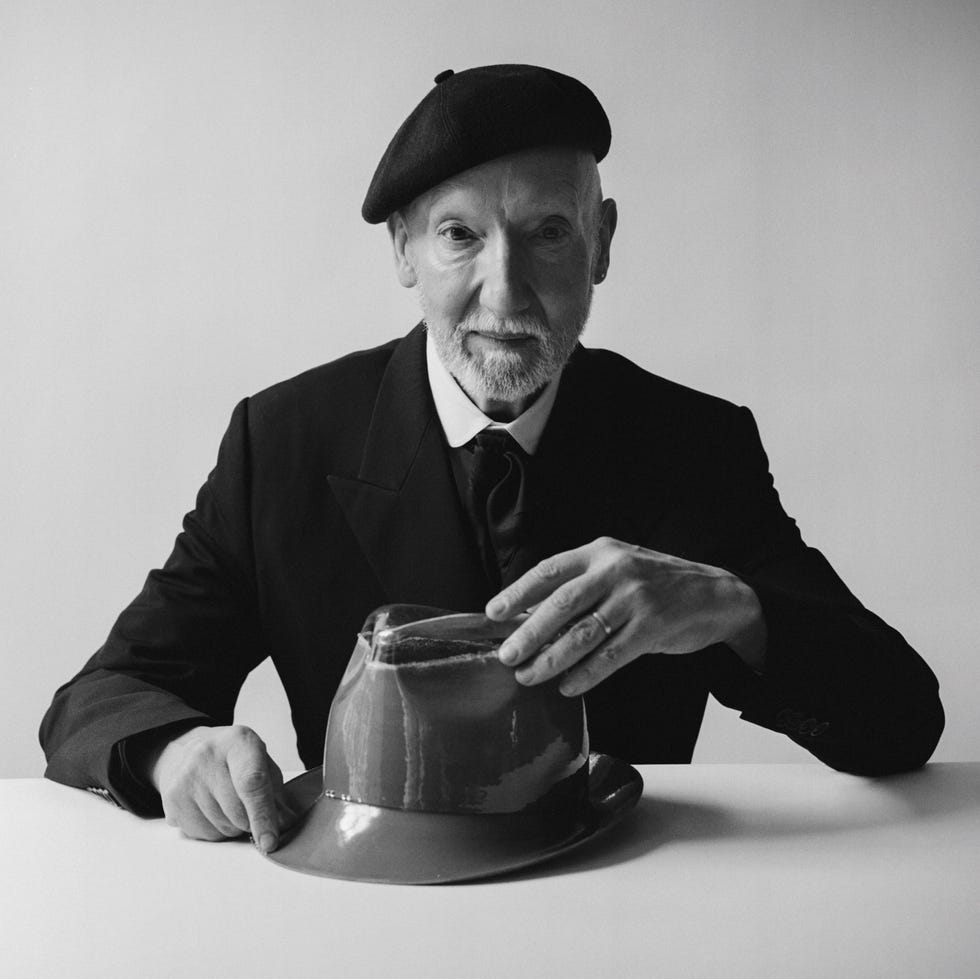
The first hats Stephen Jones made were destined for the dance floor. “They could only be so big,” the designer—who today is wearing a simple navy beret—recalls, framing his face with his hands. “They could be vertical, but they couldn’t be too wide, because how the hell do you dance in a big hat?”
As a “Blitz Kid,” enmeshed in London’s New Romantics scene, Jones was a flower growing between the cracks of Britain’s early-1980s austerity sidewalk. The retro, romantic theatricality of his designs, which he created for his club-habitué friends, could only have emerged out of tough times. “Things in the ’60s and ’70s had all been subconsciously about moving forward,” he remembers. “And we thought, ‘Well, maybe moving forward is moving back.’” His towering-but-narrow creations soon caught the eye, and adorned the head, of his then-neighbor Boy George.
Today, there are no limits, spatial or otherwise, on Jones’s creativity. He has collaborated with designers including John Galliano, Jean Paul Gaultier, Thierry Mugler, Raf Simons, and Rei Kawakubo, and a Rock & Roll Hall of Fame’s worth of musicians—Beyoncé, Lady Gaga, and Rihanna among them.
He is often inspired by dreamlike visions that transform into hats: When working with Galliano at Dior, for example, he turned ballet slippers, a painter’s palette, and a Grecian harp into memorable toppers. “Anything can be a hat!” he tells me.

A Jones sketch for John Galliano spring/summer 2009.
Millinery may be a niche art, but Jones still has the power to move the needle. The bicorne hats he debuted at Dior for spring 2026 became a defining editorial piece, bringing back an unlikely 18th-century silhouette. At Givenchy this season, he created satin head wraps that evoked the heroines of Vermeer paintings. When creative director Sarah Burton told him she’d love to work together, “I said, ‘Yeah, as long as it involves lots of chitchat, a cup of tea, and friendship—and, if we get a chance, to do some hats as well, but it needs to be in that order.’” Burton’s son’s oversize T-shirt, twisted into a head wrap, ended up inspiring the pieces. Jones often works in this improvisatory mode: One of the most famous hats he made—a gold lamé turban Kate Moss wore to the 2009 Met Gala—came about as the model played around with the idea of tying a towel on her head fresh out of the shower. “I put pins in it, and that became her hat. And then she put a $5 million sapphire or something in the front of it.”

Dior spring/summer 2026.
Working with someone who’s a little more type A helps even out Jones’s visual ad-libbing. For example, Thom Browne often augments his precisely tailored clothing with wild Jones-designed hats that could be anything from a gray flannel elephant head, complete with trunk, to a boater with braids sticking straight up from it. “Because it’s [paired with] tailoring, it brings it back down to earth,” Jones says. “So, aesthetically, it’s a perfect balance.”

Givenchy fall/winter 2026.
Today, with fashion moving in a more maximalist direction, Jones is in his element. Everyone is looking for flights of fancy, and he calls the escapist fantasy of the runway “this little sugar pill to make people feel better.”
With a résumé like his, you might think Jones would be jaded. But he’s perpetually looking forward. “The next hat,” he says, “is always a challenge.”
A version of this story appears in the Summer 2026 issue of ELLE.
‘ The preceding article may include information circulated by third parties ’
‘ Some details of this article were extracted from the following source www.elle.com ’