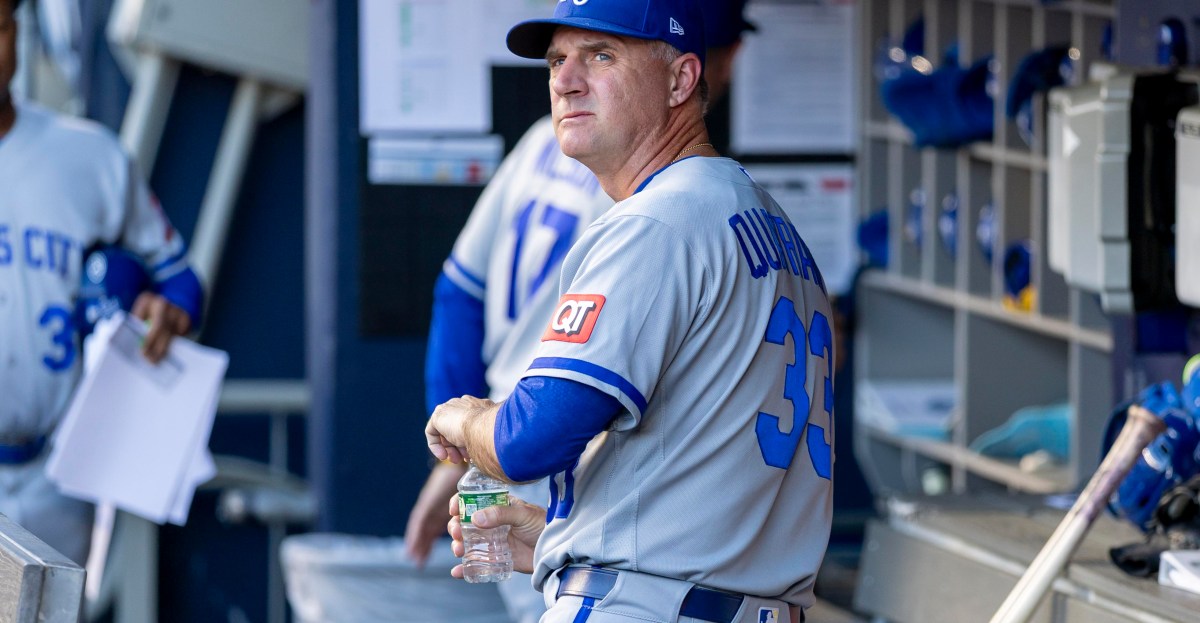
The Royals have lost 16 of 20 games, and are now just a half game from having the worst record in baseball in early June. The season has been a huge disappointment for a team that largely returned a roster coming off back-to-back winning seasons and was expecting to contend for a post-season spot.
When teams fail to live up to expectations in such dramatic fashion, fans and media begin to call for people to be fired. Royals manager Matt Quatraro was hired in 2023, and the next season he was praised for one of the biggest improvements in recent baseball history, winning 30 more games and reaching the playoffs. The team took a step back in 2025, but still finished with a winning record.
But now, as the team stumbles to a 23-37 start, the calls for a change in the dugout grow louder. Quatraro signed a three-year contract extension in January, which would seem to make a change unlikely. J.J. Picollo has expressed confidence in his skipper, telling reporters last week that the data doesn’t suggest a change would matter.
“You can go back and look at all the historical research on changing coaching staffs. There’s not a lot of strong data on changing coaching staffs mid-season leading to what you need to do. It appeases the fanbase because you’ve made a change, but we have to be logical in our thinking.”
Does firing a manager make a difference in team performance? Studies suggest a manager only has a net impact of a few wins or losses per year. Some moves backfire and blow the game, but other moves help win games and counteract those moves. Ultimately, a win/loss record is dependent largely on the level of talent.
But baseball is a results-oriented business, and a manager’s job is to win games. Aside from in-game tactical decisions, there is the question on how effective a manager is at getting the most out of his roster, or even getting it to overachieve. Leadership does matter, and if players are underperforming their expected talent level, questions will be pointed at the manager for what he is doing or not doing to get a better performance out of his players. Sometimes, a leadership style gets stale, a clubhouse vibe turns sour, and a clubhouse shake-up is needed.
Dan Syzmborski at Fangraphs took a look at this earlier this year after the Red Sox and Phillies each dismissed their respective skippers back in April. The Phillies have taken off since Don Mattingly took over for Rob Thomson, and are now over .500. The Red Sox have played near .500 baseball under Chad Tracy, a slight improvement over how they played under Alex Cora, but not enough to get them out of the cellar.
Syzmborski examined 40 managerial firings since the start of the 2004 season and found:
On a fundamental level, the teams did play better ball after firing their manager. The teams had a .414 winning percentage when their managers were fired, and the replacements accumulated a .467 winning percentage the rest of the way. Thirty two of the 40 teams saw their record improve.
So teams do generally improve in the win/loss column. But how much of this is the manager’s doing, and how much of this is underperforming teams simply regressing toward the mean? The Phillies and Red Sox were projected to be talented teams that could contend for postseason spots. Did they improve because the new manager made a difference? Or was it the team reverting to their true talent level? Or perhaps even a “dead cat bounce” where no team can play that poorly for that long?
Syzmborski compared how the team projected to do based on “rest of the season projections” at the time of the managerial change, and compared them to how the manager actually fared. The result was that “across 3,061 games managed, the new managers won 1.5 fewer games than expected…..a statistically insignificant difference.” The Red Sox were on pace to lose 102 games when Cora was fired – the team may be playing better under Tracy mostly because the roster talent level isn’t that bad. Don Mattingly has fared well for the Phillies, but it also helps that he took over when the Giants, Marlins, and Rockies were on the schedule.
That doesn’t necessarily mean a managerial firing is the wrong move. Teams do not operate in a vacuum of projections and probability. When a club is careening toward a disappointing season, ownership and the front office are often compelled to show that someone is being held accountable. A managerial change can signal that the organization recognizes the failure and is unwilling to accept it, even if the move itself is unlikely to produce a dramatic turnaround. The problem is that accountability and improvement are not always the same thing. Royals history offers several examples of that distinction.
Here are some of the recent mid-season managerial firings in Royals history.
1991 John Wathan fired, Bob Schaefer named interim manager, Hal McRae hired
The Royals went on a free agent splurge in 1990, signing Mark and Storm Davis (no relation), only to see those moves backfire. The team lost 86 games, at the time tying for the third-worst season in club history, and the low-key approach of manager John Wathan drew scrutiny. The next year, the team got off to a 15-22 (.405) start when new GM Herk Robinson fired Wathan in May, replacing him with Expos hitting coach and former Royals star Hal McRae. McRae wanted a much more aggressive style on the bases, – their stolen bases per game went from 0.54 under Wathan to 0.79 under McRae. He may have light a fire under the team, as they went 66-58 (.532) under him and finished with a winning record.
1997 Bob Boone fired, Tony Muser hired
The Royals wanted a youth movement after the work stoppage in 1995, and they brought in the academically-minded Bob Boone to oversee the effort. His first season was near .500, but the team lost 86 games his second year, and once again had a losing record of 36-46 (.439) going into the 1997 All-Star break. The Royals canned Boone and replaced him with Cubs hitting coach Tony Muser, but the team fared much worse, going just 31-48 (.392) down the stretch.
2002 Tony Muser fired, John Mizerock named interim manager, Tony Peña hired
Muser had a dour attitude, seemed to dig at one of his best hitters (Mike Sweeney), and was criticized for overusing his few good pitchers. He had four full losing seasons – at the time, some of the worst in club history – and yet the team seemed to stick with him. They finally fired him in 2002, after an 8-15 (.347) start, replacing him with bullpen coach John Mizerock on an interim basis. They lost their first six games with Mizerock in the dugout, but after they swept Cleveland, some fans wanted Mizerock to get the job on a full-time basis. Instead, they hired Astros bench coach Tony Peña, at the time a hot managerial prospect who had success in the minors and had been a widely respected player. The team did not play much better, going 49-77 (.389), and suffering two eight-game losing streaks and a 7-19 September.
2005 Tony Peña resigns, Bob Schaefer named interim manager, Buddy Bell hired
After a surprising run in 2003, Peña’s Royals fell back to earth with a thud in 2004. In 2005, he resigned in May with the team 8-25 (.242), the worst record in baseball. At the time, it seemed as if the stress of having the worst team in baseball had caused the resignation, but later reports indicated Peña may have been distracted by his involvement in a contentious divorce case in which he was alleged to have had an affair with the wife. After going 5-12 with interim manager Bob Schafer (.294), the team hired former Tigers and Rockies manager Buddy Bell who was Cleveland’s bench coach. The Royals went just 43-69 (.384) with Bell, a preview of the losing to come under his helm.
2010 Trey Hillman fired, Ned Yost hired
The Royals made an unconventional hire in Trey Hillman, who had become a candidate based on his experience managing in Japan. He won 75 games his first season, and the team got off to a good start in 2009 (18-11!) only to see the bottom drop out in a 97-loss season. The Royals brought in former Brewers manager Ned Yost as a special adviser in the front office, and the writing seemed to be on the wall for Hillman. His team got off to a 12-23 (.343) start, and a week after Dayton Moore said the team was not planning any moves, Hillman was let go. The Royals played much better under Yost until a September swoon, but they still finished with a 55-72 (.433) record on his watch.
‘ The preceding article may include information circulated by third parties ’
‘ Some details of this article were extracted from the following source www.royalsreview.com ’