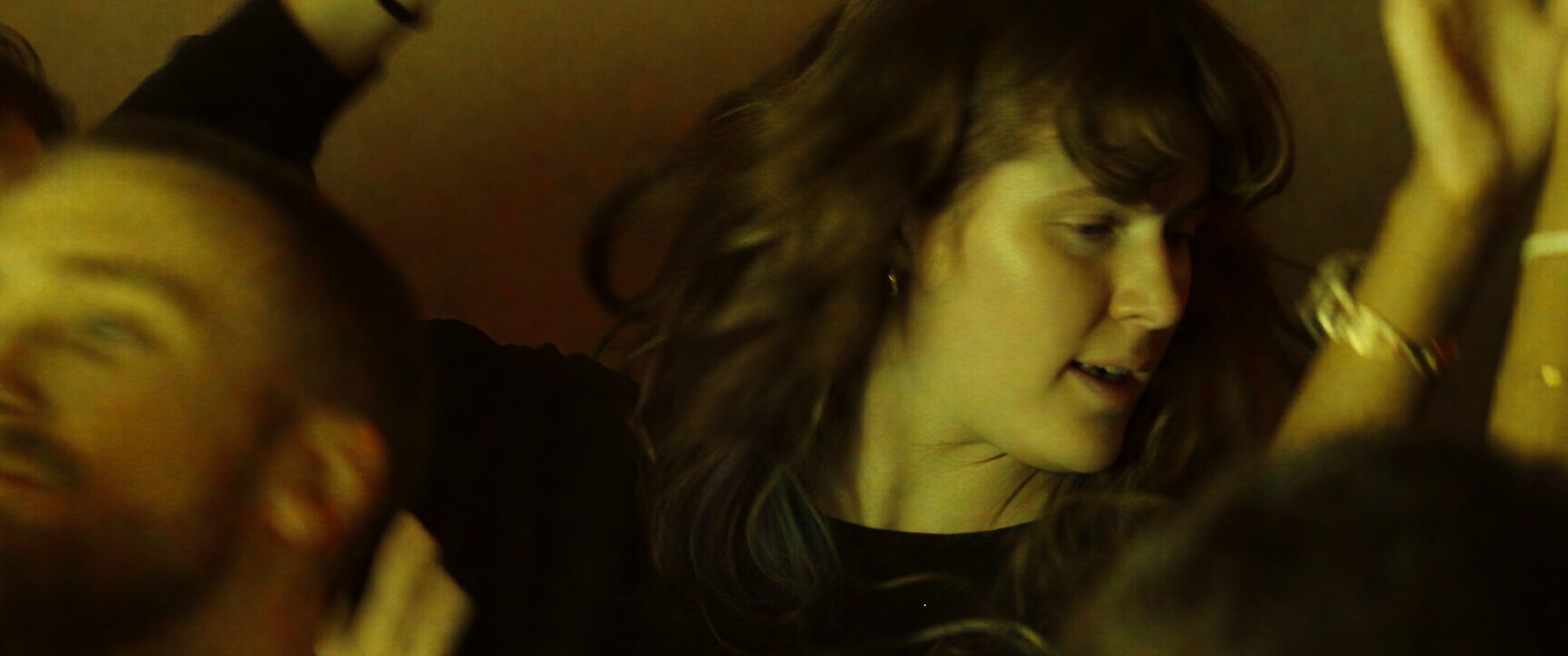
It was a Tuesday at Nightclub 101 in the East Village, and the floor was moving. Not shuffling — but moving with vigor. On stage, Jake Sondy wasn’t singing or playing an instrument. He was coding.
“Live coding music is no more or less valid than being a guitar virtuoso or playing instruments. The things that are in your head start coming right out of your fingertips,” says Sondy.
Sondy, 23, grew up in the Coachella Valley and spent his formative years touring with bands. Then he found live coding — a performance discipline in which artists compose music and visual projections in real time by writing algorithms — and traded his guitar for a laptop. His music slips between trance, pop, and ambient, often within the span of a single set, the genre shifting as the code does.
“Chainsaws are tools. Algorithms are thoughts,” says Char Stiles, a live coder and co-founder of Hex House, an artist community space in East Williamsburg that has become a hub for New York’s live coding scene. Stiles had been the one to initiate Sondy into the scene, and played the Tuesday show as his opener.
What distinguishes live coding from every other form of electronic music is not the sound — it’s the perspective. Its knowledge and technology are democratized through open sourcing, and the tools are developed and maintained by community members themselves: artists, programmers, and educators who believe the means of musical production should belong to anyone willing to learn.
Their ethos was codified on February 14, 2004, when a group of artists and hackers gathered at a bar in Hamburg and founded TOPLAP — the Transnational Organization for the Purity of Live Algorithm Programming (the acronym has evolved over time).
“Their philosophy really helps to keep the commercialization out,” says Stiles. “When they have the option of a flourishing, supportive community, then they’re less likely to feel like they need to sell out.”
The manifesto they drafted had one central demand: “Show us your screens.” Transparency was not a feature, but the point. Strudel, one of the movement’s most widely used platforms, runs entirely in a web browser, requires no installation, and costs nothing.
By 2011, two of TOPLAP’s founders had coined the term “Algorave,” and the movement had begun spreading to cities across the world, New York among them.
Live coding has long wrestled with a core tension: a scene rooted in the ideal of radical accessibility, it’s practiced mostly by people who already know how to code, and has never been fully understood by the mainstream. Sondy’s answer was to meet the internet where it lives.
He began posting live-coded remixes of hit pop songs like “It Girl” and “Illegal,” and the response was immediate. When SZA left a comment on one of his videos requesting a remix of her music, it signaled something the movement had been reaching toward for two decades: that live-coded music could capture the zeitgeist.
But beyond an astute musical sensibility, live coding demands of its practitioners the capacity for feeling exposed. Live coding, by the terms of the TOPLAP Manifesto, offers no safety net: no pre-recorded audio, no backup. At his last New York show, his system crashed mid-set. He rebooted in front of the crowd.
“People seeing that it really is live is part of the show,” says Sondy. It is, by design, the opposite of the idling DJ behind the decks — the code on the screen is not window dressing. It is both the score and the instrument.
The set ended, and the floor was abuzz. Stiles does not believe that the interest was focused on programming.
“You go, and you watch a person perform — it’s not about the computers or the programs or the tools. It’s a way of thinking.”
‘ The preceding article may include information circulated by third parties ’
‘ Some details of this article were extracted from the following source www.amny.com ’