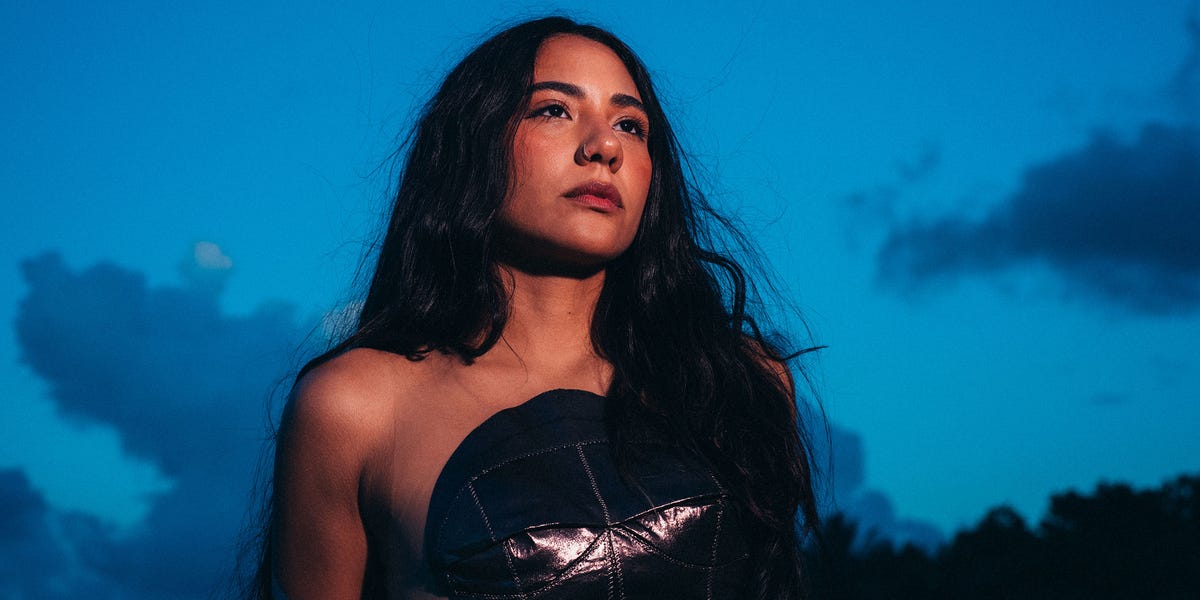
RaiNao’s latest album Marcriá (Puerto Rican slang for being spoiled), has been brewing for a long time. “It started when I was 8 years old,” the singer, whose real name is Naomi Ramirez Rivera, tells me over a recent video call. That year, her mother enrolled her in a specialized elementary school for the blind. “I was one of the few sighted kids, and my mom said she put me there to help. That’s where my whole sensory journey began—learning how to live in the other ways that I saw my classmates living.” Two decades later, she was finally ready to explore what those experiences meant to her. “I started naming these sensory moments and from there we made the songs—basically I tried to transport myself back to specific moments where there was a memory of a taste, a color, an emotion, tied to it—and from there I started creating these arrangements.”
It’s an appropriate origin story for a record whose sounds are immediately transformative and obliquely reflective of what it’s like to spend time in Puerto Rico, RaiNao’s homeland: there are mellow electronic beats with heavenly choruses that sound like spending time underwater while the waves crash above you, tambores and panderos that suddenly overflow into the subtle rhythms of salsa, groovy basslines that seductively emerge through the beats of plena, and even touches of jazz courtesy of RaiNao’s own saxophone playing. It is a sensual exploration of island life simultaneously grounded in nostalgia and the lucha of daily life. Marcriá is a record to put on in the car when you drive back from a long day on the beach, with salty hair and sticky skin, tuning out as you look out the window at the trees and the sky and the clouds that dominate the landscape and let your thoughts wander to wherever it is they see fit.
And yet, musically, nothing is accidental. RaiNao is an exacting composer. “With these arrangements I was very specific about how I wanted my voice to sound, what instruments I wanted to hear,” she explains, though that doesn’t mean she wasn’t open to experiments. “It was surprising how much of it came from the producers’ minds, just letting ourselves get carried away by the sensory treatments and seeing what sounds we heard, what instruments called out to us.” She works deliberately, there are no surplus of songs, and with her future collaborators in mind. Marcriá boasts an impressive roster of features, from legends of the Puerto Rican and Caribbean music scene like the reggae band Cultura Profética, the salsa singer Andy Montañez, and the Cuban singer Omara Portuondo (who took part in the seminal Buena Vista Social Club album). “I’ve been listening to Andy and Omara from the very beginning, so it’s a dream to have them here, to immortalize their voices that are so important in the Caribbean,” she says. While RaiNao can still technically qualify as an emerging artist, she also considers it important to cede space to other up-and-coming and independent musicians like Solo Fernández, Matt Louis, and Frido Vargas, who all get their turn in the spotlight.
RaiNao first burst on the scene in 2022 with the release of her EP ahora A.K.A. Nao, which caught the attention of Bad Bunny, who invited her to perform on his slew of shows in Puerto Rico following the release of Un Verano Sin Ti; and later asked her to collaborate on the song “PERFuMITO NUEVO,” from last year’s record-breaking Debi Tirar Mas Fotos. Music was always part of her life—her father is also a musician—but she never thought she would have a career in music. “I first discovered my voice at church, but it was not something I wanted to explore, I had a bit of stage fright,” she recalls. She attended Puerto Rico’s famous Escuela Libre de Música where she studied the saxophone (“I loved Lisa Simpson”) and music theory, but still did not think to make it her focus once she got to college.“I tried biology for a bit—that didn’t work out—and then I studied film and theater at the Universidad de Puerto Rico. I always wanted to be an actress since I was a little girl and I really thought I would try to make a living out of it; but then as always music just slapped me in the face.” Although there is an element of the cinematic in her music, she considers RaiNao to be an expression of herself rather than a character she has created. “RaiNao helps me cancel my shyness a bit—I think theater also helped me a lot in this aspect—but I think it’s me, just a better version of it.”
‘ The preceding article may include information circulated by third parties ’
‘ Some details of this article were extracted from the following source www.harpersbazaar.com ’