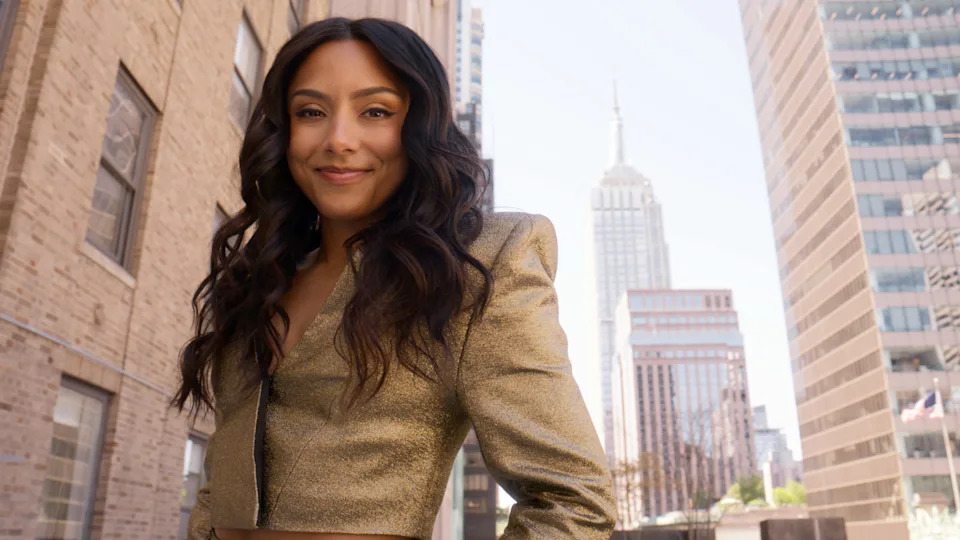
Cleo Abram took night classes to learn how to edit and produce videos while she was working on the business side of media company Vox.
Serendipitously, she soon found herself producing an episode of Vox’s Netflix series Explained before becoming the host of Glad You Asked, a series that was part of YouTube’s slate of fully-funded originals (back when they did that).
More from Deadline
Most people would have hung on to such a job, but Abram decided it was time to bet on herself and, at the end of 2021, launched her own independent science show, Huge* If True, which covers topics including quantum computers, dinosaurs and F1. Abram now has over 8 million subscribers on her YouTube channel and her show has been submitted for the Emmys in the Outstanding Short Form Nonfiction or Reality Series category.
She is one of a number of creators that the Google-owned platform has been putting front and center as it thumps its chest, becoming the biggest streaming service in the world.
Days before YouTube’s annual Brandcast presentation to advertisers in New York, Deadline sat down with YouTube CEO Neal Mohan and some key creators — Abram; Michelle Khare, creator and host of Challenge Accepted; Julian Shapiro-Barnum, who hosts series including Celebrity Substitute and upcoming late-night show Outside Tonight; and SubwayTakes host Kareem Rahma, who just launched travel series Keep the Meter Running — to reveal how and why they took this bet.
WATCH: DEADLINE’S INTERVIEW WITH YOUTUBE’S CEO NEAL MOHAN AND KEY CREATORS CLEO ABRAM, MICHELLE KHARE, JULIAN SHAPIRO-BARNUM AND KAREEM RAHMA:
“Every YouTuber fundamentally bets on themselves,” Abram told Deadline. “The big difference between YouTube and every other streaming service is that every other service thinks the best way to make the best stuff is to have a small group of really talented people say, ‘Here’s what’s going to get greenlit, here’s how much money gets spent on it, and here’s what people are going to want to watch’. YouTube said, ‘No, we’re going to let everybody all around the world make what is in their mind… and this will result in the best, highest quality creative work.’ The fact that that bet has worked and the fact that YouTube is now the largest streaming service says something absolutely awesome about human creativity.”
Khare has racked up tens of millions of views by emulating Houdini’s deadliest trick, performing Mission: Impossible stunts and running seven marathons on all seven continents in one week and has noticed an “evolution” of the medium in recent years.
We fundamentally do two things: one is we help amazing creators like this build an audience, no matter where they are in the world, and that takes an enormous amount of investment in the technology and the capabilities to do that. Then, the second thing we do is we help them build businesses.
Neal Mohan, YouTube CEO
“We started in a place of actually being able to hone the craft as we went, as opposed to what I saw in the traditional space, which was a lot of time spent watching other people do the craft before suddenly having to step in and do it yourself. I love being able to have the experience of knowing what it’s like to operate the camera, to run sound, to edit myself, so now that when we’re commanding teams of 10, 20, even 50 people on set, we can empathetically lead those teams and have deeper understanding of the material we’re putting out,” she said.

YouTube is now submitting a number of its biggest shows to the Emmys, a push that began with a conversation that took place at 2 a.m. in a pizza joint in New York City.
Challenge Accepted has been submitted in the Outstanding Hosted Nonfiction Series or Special category, where Khare could go head-to-head with the likes of Stanley Tucci and David Letterman.
Khare, who has over 5 million subscribers, said, “I also have to hand it to Neal that three years ago when he came into office as CEO, I had an impromptu meeting with him, and he asked me, ‘What would your dream be as a YouTube creator?’ I just threw out this idea that I think it’d be incredible for a native content creator to win a Primetime Emmy and here we are three years later.”
When I started on YouTube, I didn’t do that to make money, I did it for the love of the game. I did it because I had this story I was dying to tell.
Julian Shapiro-Barnum
Shapiro-Barnum, whose show is being submitted in Emmy category of Outstanding Short Form Nonfiction or Reality Series, believes the initial buy-in for creators is relatively small. After studying theater acting at Boston University, the pandemic hit and he began posting videos of him interviewing kids on YouTube, which turned into Recess Therapy. He subsequently teamed with Benj Pasek and Justin Paul, the EGOT-winning team behind the songs from The Greatest Showman, to launch Celebrity Substitute, which has featured the likes of Billie Eilish, Andrew Garfield and A$AP Rocky.

“When I started on YouTube, I didn’t do that to make money, I did it for the love of the game. I did it because I had this story I was dying to tell,” he said. “Then as your career goes on, the bets that you have to take are bigger and bigger and bigger, but your platform and storytelling grows.”
If these creators are taking all of the risk in producing shows that look increasingly like cable originals and have budgets to match, what is YouTube doing other than basking in the reflected glory?
YouTube’s model sees creators receive 55% of net revenue from advertising for long-form videos as well as similar, if marginally lower, revenue splits across YouTube Shorts.
Mohan said its contribution is the technology to make these creators stars. The CEO told Deadline that his mission is to build the “world’s best stage.”

“Our bet is different than what the typical sort of Hollywood studio does, but I think it’s profound in that we invest up front in the technology,” he said. “We fundamentally do two things: one is we help amazing creators like this build an audience, no matter where they are in the world, and that takes an enormous amount of investment in the technology and the capabilities to do that. Then, the second thing we do is we help them build businesses, connecting them with advertisers or brands that support the vision, building out subscription businesses, building out other ways for them to turn what they love and what they’re talented at into full-fledged careers.”
Mohan is keen to tout the fact that YouTube has paid out $100 billion over the last four years to creators. It just remunerates its talent differently.

In May, YouTube highlighted the new ways it was working with advertisers. It essentially launched a slate of shows at its upfront presentation that sees it play matchmaker between the creators and advertisers, rather than creators having to do all of the legwork themselves.
The presentation looked a lot like one the broadcast networks and subscription streamers would give, with new shows including Rahma’s Keep the Meter Running, Shapiro-Barnum’s Outside Tonight as well as the third season of his Celebrity Substitute, Quen Blackwell’s Feeding Starving Celebrities 2.0, Jesser’s Summer of Soccer, Trevor Noah’s World Tour and Pot Stirrer from Call Her Daddy’s Alex Cooper.
Rivals have increasingly been picking off creators to work with, from Netflix striking deals with the likes of Ms. Rachel, former NASA engineer Mark Rober, The Sidemen and Alan’s Universe creator Alan Chikin Chow to Amazon spending hundreds of millions on MrBeast’s Beast Games.

Netflix executives have also griped publicly about YouTube; co-CEO Ted Sarandos called the platform a “little bit of a farm league.” These asides have increased as YouTube has grown its share of streaming. Per Nielsen’s latest The Gauge report from March, YouTube has 13.2% of the streaming market, up from 12.5% in January, while Netflix’s share fell from 8.8% at the start of the year to 8.2%.
But Mohan doesn’t hit back; he’s sanguine about the competition, wherever it comes from.
“YouTube does find itself really at the center of culture and I think other platforms have taken notice of that. Every time I speak to creators, they tell me over and over that YouTube is their home. I have to earn that. My team has to earn that every single day, whether it’s new sets of tools or capabilities or support with brands and advertisers, or whatever the mechanism is,” he said. “Creators really view YouTube as their home; they don’t leave it, not because they don’t have plenty of choices, it’s because that’s where their most authentic audience is, that’s where the actual fandom is, the interactivity that exists. It’s not just about sitting on the couch and watching and sort of leaning back.”

YouTube content creators
Abram, Khare, Shapiro-Barnum and Rahma all agree that YouTube feels like home.
“Think about the deal on YouTube,” said Abram. “You can reach the widest possible audience in the most places around the world, for free, in any language. You can own all of your own work forever and not need to ask anyone for a moment to be able to make the next thing. I have dreams of what Huge* can be that look like many different projects and iterations, and I think there’s an infinite future here. That doesn’t mean necessarily that you wouldn’t see creators also do other things, but the idea that you can continue to build and you can continue to own, and you can continue to make your creative dreams come true, is the reason that we’re all here in the first place.”
Rahma broke out with SubwayTakes, an interview show that has featured the likes of Charlize Theron, which started on TikTok. His next show, Keep the Meter Running, was originally in development at celebrity.land, before Rahma walked away from the deal and went to YouTube, which is submitting his show in the Emmy category of Outstanding Short Form Comedy, Drama or Variety Series.

“When I started, I was like, ‘Oh, the dream of TV’. [YouTube] was like this is a stepping stone, but now it’s become the place where I want to be and the place where I want to produce and the place where I want to make stuff, so, yeah, it does feel like my home.”
That’s not to say that these creators wouldn’t like to make some home improvements.
During the video interview, Shapiro-Barnum pitched the idea of a way for audiences to discover new channels from creators that they already love.
Mohan doesn’t want YouTube to put its “thumbs on the scale” but seemed open to the idea.
“You want your success to beget more success in terms of new ideas, other creative bets that you’re making, and we want to really facilitate that,” he said. “There might be other things that we could do at the channel level that would allow you to at least make your fans aware in different ways.”

“Neal and his team are very focused on how we can renovate the house rather than telling us how to decorate our bedrooms,” Khare added.
In December, YouTube beat out traditional rivals for the rights to host the Academy Awards starting in 2029. This means that Disney’s ABC will stop being the home for the Oscars for the first time in 50 years.
The platform also has a wide-ranging deal with the NFL, including for Sunday Ticket, and thought to be close to finalizing a pact for another new package of games. This comes after a big push at Super Bowl LX.
How do these moves, which are very broadcast-coded, fit into its creator strategy?

YouTube looks at its investments in these spaces through a creator lens, according to Mohan.
“If there is not a mechanism there to have YouTubers be involved from a culture and fandom standpoint, then it’s not interesting. That’s one way that you can think about the common thread in terms of our relationship with ‘traditional media’ or the live sports leagues or other forms of linear television,” he said. “It oftentimes expands the audience, and it certainly brings a new type of creativity to something that might have been in that same format for decades before that.”
“I’ll just say now, I would like to host [the Oscars], Neal,” joked Shapiro-Barnum. “I’m just happy to be there,” added Rahma.
Best of Deadline
Sign up for Deadline’s Newsletter. For the latest news, follow us on Facebook, Twitter, and Instagram.
‘ The preceding article may include information circulated by third parties ’
‘ Some details of this article were extracted from the following source www.yahoo.com ’