At 29, Dr. Heidi Nowakowski had been walking for four days across Spain with her brother, Josh, 25, and her friend Rowan Knight from Scotland. As happens with siblings, the big sister fussed at her little brother for oversleeping.
They argued. He got ready. She was not.
He hit the road without her and her friend — and he wasn’t at their pre-planned meeting spot that night.
When Nowakowski and Knight arrived at the Cathedral of Santiago de Compostela the next day at noon, her brother was there waiting for them with water in hand.
Heidi Nowakowski, left, and Rowan Knight make heart signs in front of the Cathedral de Compostela after their arrival.
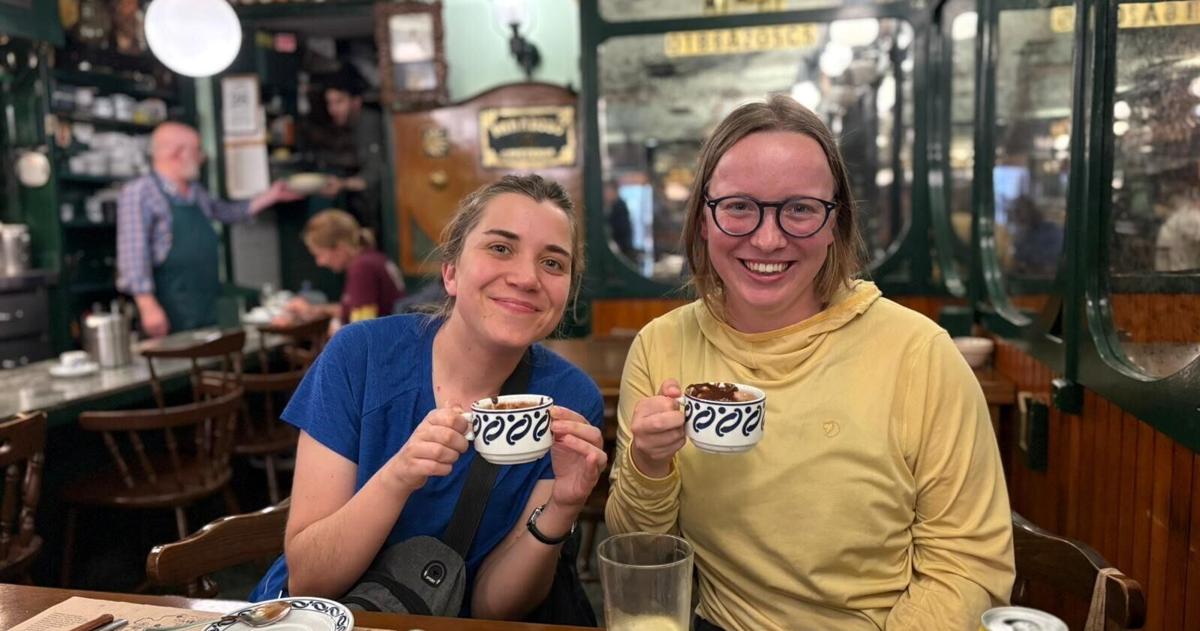
“Then we had lunch and churros and hot chocolate. It just made the arrival all the more sweet,” she said. “My brother and I are very close. So we fight a lot, but we always make up.”
The pilgrims were three of 530,919 who walked the Camino de Santiago, earning a Compostela Pilgrim Certificate in 2025. Twenty years ago that number was 93,923, evidence of the increase in popularity of the journey.
Many make the walk without receiving the Compostela certificate, which requires proof of the journey using a Camino Pilgrim Passport, with certain stipulations — either 100 kilometers walked or ridden on horseback or 200 kilometers cycled.
Along the way, pilgrims stop at cafes and churches to get their passport book stamped at least twice per day from Saria to Santiago.
For more than a thousand years

A stop along the Camino for pilgrims to stamp their passbooks.
Dating back to the ninth century, pilgrims have walked various routes of the Camino de Santiago, “The Way of Saint James,” to the Cathedral of Santiago de Compostela in northwestern Spain, where the remains of the apostle St. James the Great are believed to be buried.
Its recent popularity is not a first. During the medieval period, it was one of the three most important Christian pilgrimages, along with Jerusalem and Rome.
Martee Fry, at the Southeast Louisiana Chapter of American Pilgrims on the Camino, assisted Nowakowski with her planning.
“She helped me so much,” Nowakowski said. “She gave me some pointers on which trips would be the best for what I was looking for and with my time constraints. She also told me about the right guidebooks to use and little things to look out for.”
‘The Camino will tell you why’

Martee Fry pauses along the way on her Camino de Santiago.
Some walk the Camino for spiritual reasons. Some walk to honor a lost loved one. Some walk for fitness. Some walk for travel reasons. Some walk to mark a pivotal moment in their lives.
Fry, a 76-year-old pilgrim who has been on the Camino three times, says that the Camino reveals its purpose to each participant. She walked her first Camino at 66 years old. Fry lives in Poplarville, Mississippi, but for many years, she lived in New Orleans, working as an operating room nurse at Ochsner.
The movie “The Way” with Martin Sheen motivated her to go on the Camino about 10 years ago. After a trip to Italy with friends was canceled, she pivoted to walking the Camino in Spain — by herself.
“When you’re out in the countryside, you can see the raindrops or the dew glistening on spider webs,” she said. “You can see the beautiful flowers. You can actually hear the sheep lowing out in the fields. You can see the little old ladies out sweeping their steps.”
She said the people who met along the way asked each other one major question: “Why are you walking the Camino?”

Martee Fry snaps a photo of her shadow on the Camino de Santiago.
“The powerful thing about the Camino,” Fry said, “is you don’t have to have a purpose when you put your first step on the Camino, because the Camino is going to tell you why you are there.”
Nowakowski, the child of Catholic Polish immigrants, said the Camino was a spiritual journey for her.
Even though her compatriots were not motivated by religion, they hustled to make sure she made it to Sunday Mass at one of their stopovers.
“It was so sweet that they were trying to get there for me,” Nowakowski said. “I remember getting to that church, and it was a bunch of smelly pilgrims. We were all sitting together, and I cried because it was so beautiful. I didn’t understand the Spanish very well, but I just felt so like lucky to be there.”
‘Catholic or not’

Nancy Hicks, left, and her brother, Jim Peevey, with his daughter, Sarah Peevey, along the Camino de Santiago.
For Nancy Hicks, a Baton Rouge pilgrim who went on the Camino with her brother and her niece, every morning started with prayer.
“Whether Catholic or not, we wanted this to be a spiritual walk because you are walking the walk that St. James’s ashes were brought to the cathedral,” Hicks said. “We prayed that God would show us something during the day.”
Larry and Jiji Jonas, who went in May, wanted to achieve the challenge of doing the Camino Portuguese, the second most popular route that begins in Portugal. As master naturalists, Larry, 83, said they also wanted to experience Spain’s flora and fauna. Jiji, 81, said she was able to identify wildflowers and bird sounds along the walk.

Larry and Jiji Jonas pause in front of the first marker on their journey in Tui, Spain.
A social experience
Fry said many pilgrims take the trip with the expectation of having a quiet and meditative experience, but it’s surprisingly social.
“As you walked, a lot of people were doing your same walk and same distance, so after you slept for the night and got back on the trail, you’d run into the same people,” Hicks said. “You build up friendships along the way, and they would tell what they had seen and talk about their lives.”
Robert Hawkins and Nell Huard, two octogenarian Baton Rouge friends who walk together, have done the Camino twice. Both had memorable interactions along the way.
Huard met a young man who asked her where she was from, and when she told him Baton Rouge, he asked if she knew Jay Johnson, the LSU Tigers baseball coach. Turns out he was one of Johnson’s former players.

Josh and Heidi Nowakowski pose with Rowan Knight, center, in front of the zero kilometer marker in Santiago after they had arrived.
For Hawkins, it was a connection from his past that impacted him the most. He befriended a Vietnamese Canadian pilgrim who was from the same town that Hawkins was stationed in while serving in the Vietnam War. They got along great and learned their timelines just missed each other.
Nowakowski, who is from Gonzales, picked up a bunch of free pins from Gonzalez City Hall and LSU that she handed out to people she met. Travelers from all over the world now have Jambalaya Festival and LSU pins as mementos from their Caminos.
Whan that Aprille with his shoures soote
Just as Geoffrey Chaucer says in “The Canterbury Tales,” the best time for European pilgrimages is the spring — particularly April and May.
Nowakowski first heard about the Camino when she was in 10th grade at St. Michael the Archangel High School in Baton Rouge. Her religion teacher, Ryan Hallford, shared his Camino experience and told his students something she carried for nearly two decades.

Rowan Knight, left, and Heidi Nowakowski proudly display their Compostela Pilgrim Certificates.
“He said that it was the first time he realized that to experience beauty, you need to experience pain. He had a leg injury along the way, but he said while he was walking, it was so painful, yet he was surrounded by such beauty,” Nowakowski said.
She went on to attend LSU and medical school. When her residency ended and she finally had a break, she decided it was time for the Camino. She was ready to encounter the pain and the beauty.
After walking 23 kilometers on the first day, her knees and feet started aching in ways she hadn’t expected.
“I had never felt my joints like that,” she said. “I remember thinking, ‘I’m not sure how I’m gonna do this every day.'”

Martee Fry celebrates her arrival at Cathedral de Compostela with a selfie.
She did — after applications of athletic tape and Tiger Balm.
After the fight with her brother and the reunion at the cathedral, after the churros and hot chocolate, after everything her joints had to say about it, Nowakowski understood what her teacher meant all those years ago.
“I think we underestimate ourselves a lot,” she said.
‘ The preceding article may include information circulated by third parties ’
‘ Some details of this article were extracted from the following source www.nola.com ’