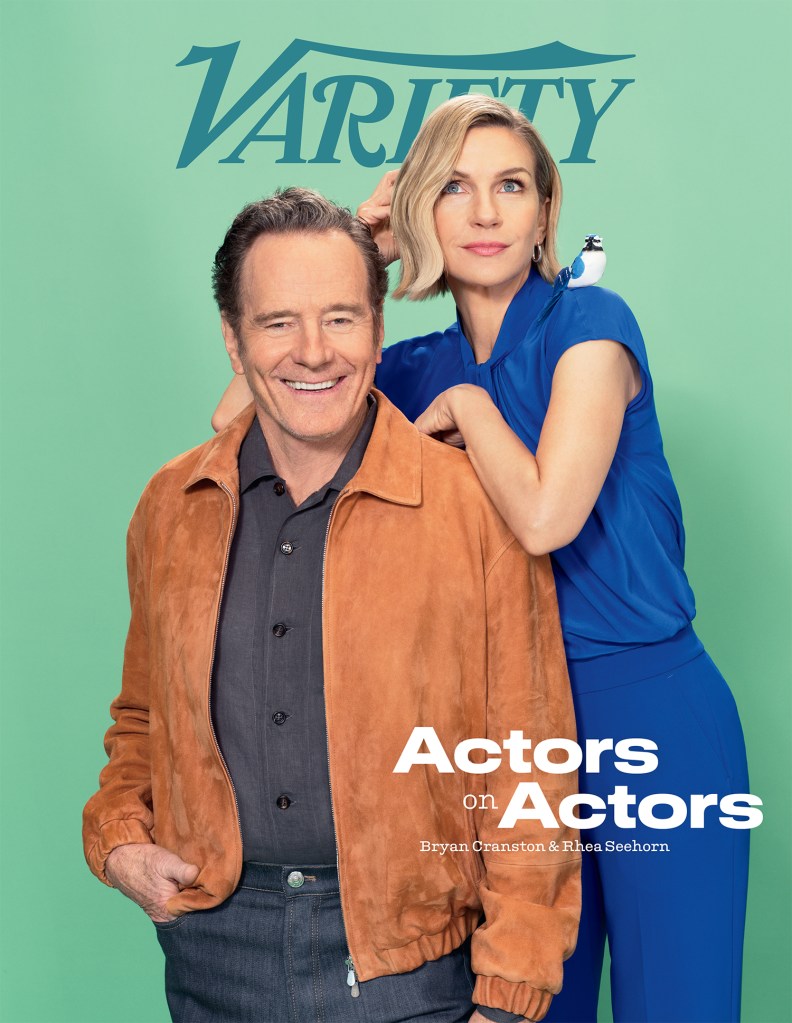
This interview is part of Variety and celebrity.land’s Actors on Actors series. Watch the full video interview now at celebrity.land.com/Watch (or on the celebrity.land app) and on Variety’s YouTube channel starting at 11:59 pm ET.
Bryan Cranston and Rhea Seehorn are key players in the crime-ridden, “Breaking Bad” universe created by Vince Gilligan. Cranston’s portrayal of Walter White, the science teacher turned meth kingpin, won the actor four Emmys as he became a villain for the ages. And after “Breaking Bad” (and Walter!) came to a bloody end in 2013, Seehorn’s Kim Wexler became a fan favorite in 2015’s “Better Call Saul,” the “Breaking Bad” prequel that revolved around Walter’s lawyer, Saul Goodman (Bob Odenkirk). By the end of that series, Kim had forsaken her lawless life in Albuquerque and moved to a Florida suburb, giving up her legal career to work in peace at a sprinkler company.

Mary Ellen Matthews for Variety
But Gilligan wasn’t finished with Seehorn: He enlisted her to lead “Pluribus,” his Apple TV sci-fi series. On the show, Seehorn plays Carol Sturka, a miserable romance novelist who’s one of only 13 people who haven’t become possessed during “the Joining” — a global event that’s taken over the minds of nearly all humans on earth, transforming them into seemingly happy, always optimistic people. (Carol hates that.)
As an antihero in “Breaking Bad,” Cranston was cast against type, since he was so well known as Hal, the hapless, lovable dad from the Fox sitcom “Malcolm in the Middle,” which ran from 2000 to 2006. This spring, Cranston stepped into Hal’s shoes once again for Hulu’s revival, “Malcolm in the Middle: Life’s Still Unfair.” The idea to bring back the show was Cranston’s, and he decided to “keep chipping away” at creator Linwood Boomer until he gave in. “We had a great time. It was a family, and we really cared for each other,” Cranston tells Seehorn, expressing a very un-Walter White-like sentiment.
Between “Pluribus” and the “Malcolm” reboot, these two Gilligan all-stars have much to discuss — including Cranston’s unhinged role on “The Studio” as a movie honcho, for which he won an Emmy last September for comedy guest actor.
Rhea Seehorn: We only get our scripts one at a time on Vince Gilligan’s shows, and you don’t generally even get told an outline of what the whole season will be. So you have no idea what the character’s going to do. And I will say it was a new way to work. Was it for you? Because I’m assuming it was the same on “Breaking Bad.”
Bryan Cranston: It was the same, but like Carol, you’re going through so many twists and turns that are hard to fathom, you can’t possibly plan ahead. I just thought, “This is kind of good for Walter White just to step into what’s next for him,” because it was such foreign territory — just like it is for you.
Seehorn: Yeah, for Carol and “Pluribus” — and then even for Kim Wexler in “Better Call Saul.” I mean, we try not to preplan or be result oriented anyway, but people would ask, “But don’t you want to know if you’re lying?” I actually found quite a bit of freedom in it.
Cranston: It’s amazing. I remember shooting an episode of “Breaking Bad” where Aaron Paul’s character, Jesse, comes at me with a gun because he thinks I poisoned the little boy in the show, and I’m going, “Why would I do that?” And I point the finger in the direction of Giancarlo Esposito’s character: “Gus Fring, he’s the one who would stand to gain by this!” And then: “You think I did it? Then kill me. Then shoot me right now, if you think I did it!” And then the next episode came a few days later and I’m reading it and I go, “Oh, I did do it.” Oops. My bad!
Seehorn: But you wouldn’t have changed how you did that scene, right?
Cranston: No, because he has to be believable. But maybe I really thought that it was Gus Fring that did it!
Seehorn: People mistakenly think that Vince Gilligan and Peter Gould — who was co-showrunning, and then showrunning by himself on “Better Call Saul” — are doing it to manipulate us. It’s not that.
Cranston: No, no, no.
Seehorn: They also like to plant a lot of seeds, and see which things are blooming. Vince told me — this has to be terrifying to most writers — “Oh yeah, we love to paint ourselves into a corner and then freak out trying to figure out how to get out.” It’s like, what?
Cranston: Every season of every show, he’s done that. Your show, your other show, “Breaking Bad,” it’s always, “I don’t see how he’s going to get out of this.”
What I found interesting watching “Pluribus” was that you take the tropes of every science fiction alien-invasion story you’ve ever heard — and it’s completely the opposite. They’re always ugly. They want to kill you. And he flipped it upside down. So it’s fascinating watching “Pluribus” and going, “I don’t know where this is going!” Like any fan, I watched it cold. And I go, “I don’t know that I would be kind and soft. I would be freaked out.”
Seehorn: Vince’s little logline that he came up with was, “What if the most miserable person on Earth had to save the world from happiness?” And we had a couple people say, “I don’t think she’s the most miserable.” Certainly, the brilliant Carlos Manuel Vesga’s portrayal of Manousos is pretty angry. I would also put out there that — and Vince has said this on panels — nobody asked that about Walter White. Nobody asked that about Jimmy McGill: “What’s up with them being so unlikable?” They were behaving in an honest way to the situation they were in.
Cranston: You think it’s a gender issue?
Seehorn: I don’t know. When people are like, “She’s so unlikable,” I’m like, her wife’s dead; they killed her. Career’s done, might not ever be back. You may very well die alone and never speak to anybody again on a couch eating a frozen meal, watching “Golden Girls.” There are no friends anymore, there’s no family and the world is saying, “We’re just waiting around until we can take your brain away.” And she’s not polite about it.
Cranston: On the other hand, that Bea Arthur is funny.
Seehorn: She is! But my way into it was just conversations with Vince, with him saying, “In this very fantastical circumstance, I want her to be utterly realistic, completely honest.”
Mary Ellen Matthews for Variety
Cranston: And “Am I next?” She’s got to fight, so I never took it as she’s an angry person. So you’re going into the second season.
Seehorn: Yes, we are. They’re in the writers’ room right now.
Cranston: And do you have any idea of where it’s going?
Seehorn: No, none. I don’t even know what she does with atom bomb in the driveway. I don’t think he would lie to the fans. She’s come back and asked Manousos if he would help, but that’s a tricky relationship. He just wants to kill everybody.
I just watched the four new “Malcolm in the Middle” episodes. It’s hilarious.
Cranston: Going from “Malcolm in the Middle” to “Breaking Bad,” there was only one year in between, and Vince was my champion to get that role. The execs at Sony and at AMC were like, “Ooh, wait, no, the goofy dad from ‘Malcolm’? Not to play Walter White!” He’s going, “Trust me, trust me, trust me.”
Seehorn: Your autobiography [“A Life in Parts”] was great. I tell everybody to read it.
Cranston: Oh, thank you.
Seehorn: At one point, you talk about your “Malcolm in the Middle” auditions, and that there was very little information about the character. You thought, “Well, the best storytelling here” — and I’m sure I’m butchering how you put it — “would be that he’s the things that the wife is not.” Like, not competent, not capable.
Cranston: Jane Kaczmarek’s character, Lois — she was strong, powerful, fearless, intimidated others, a sergeant at arms, disciplinarian, all these things. I just wrote the opposite of everything she was. And I realized, “Oh, I’m creating a list of characteristics of what became Hal.”
Seehorn: So I’m curious what it was like returning to “Malcolm in the Middle.” What was the gap between?
Cranston: Twenty years.
Seehorn: I still see these characters I came to know and love. But everybody did a little bit of evolving as well. Hal, not a lot.
Cranston: I think what was great about Hal and Lois is that they didn’t change — they just got older. But he’s still madly in love with her.
Mary Ellen Matthews for Variety
Seehorn: Do you want to do more of them?
Cranston: I don’t know. I don’t like to do anything as a stepping stone to something else.
Seehorn: I’m very excited for Season 2 of “The Studio.”
Cranston: Oh my God. It’s crazy.
Seehorn: Wait, where were you guys shooting? In Cannes?
Cranston: Venice, Italy. We shot two episodes in Venice re-creating the Venice Film Festival.
Seehorn: So famous people playing famous people in it again, right?
Cranston: Yes. Lady Madonna. [Sings] “Children at your feet.”
Seehorn: What was she like?
Cranston: Madonna’s great. I gotta say, her work ethic is really impressive. The paparazzi are everywhere trying to get a picture of her. But I was really impressed with how much she prepared. Because we didn’t know — “What’s she like now?” And it’s been a while since she acted.
Seehorn: Oh, I guess that’s true.
Cranston: But she was terrific. And she’s very funny.
Seehorn: I was going to say, does she have a sense of humor?
Cranston: She’s very funny! And we had Michael Keaton and Donald Glover and Julia Garner. It was really a lot of fun. And that show is just bonkers.
Seehorn: OK, are you on drugs again?
Cranston: Oh, yes.
Seehorn: [laughing] Are you?
Cranston: Ohhhhhhh, yessssss. Oh, Rhea. There is a scene in the episode dealing with the Oscars. That’s all I’ll say. People will not believe what happens.
Seehorn: And it’s your fault?
Cranston: I either propelled my career to a different level or completely destroyed it. Completely obliterated it, like, “What was he thinking?” But it will be talked about.
Seehorn: It’ll be up there with body-hair shaving, which you opened “Malcolm in the Middle” with?
Cranston: My dear, that’s very tame.
Seehorn: And I love Kathryn Hahn. I know her a little bit.
Cranston: She’s a hoot.
Seehorn: And of course the brilliant Catherine O’Hara, which was sad to see.
Cranston: Oh, we miss her so much. I played Catherine O’Hara’s husband in three different productions. And then she was my nemesis in “The Studio.” I miss her so much. She was such a joy to be with. Catherine O’Hara was a person who, you not only marveled at her comedic chops, but when it’s “cut,” you say, “I want to sit next to Catherine.” It was just heartbreaking to lose her.
Seehorn: Well, I hope I get to be your scene partner one day.
Cranston: We haven’t worked together.
Seehorn: The storylines sort of crossed paths in “Better Call Saul.” And you were there when I meet Jesse. Do you remember that?
Cranston: Oh, yes!
Seehorn: And you gave Aaron Paul a note. You told him to punch the rain.
Cranston: I thought it was cool! It was a cool little moment. You know, when Walter White died, I thought, “Wow, that’s it. That was great. Good run!” But then I did him — I came back, like, three times. You might be asked to do Kim Wexler again!
Seehorn: Yeah, or I’ll come do, apparently, some grotesque scenes with you on “The Studio.”
Cranston: You have the courage. I know you’re the type of actor to say, “Fuck it. Let’s go.”
Seehorn: I think I could. If I get to do it with you, I’ll do it.
Cranston: Let’s do it.
Prop styling and art direction: Shawn Patrick Anderson/Acme Studios; Assistant prop styling: Joseph Bell
‘ The preceding article may include information circulated by third parties ’
‘ Some details of this article were extracted from the following source variety.com ’