This article contains affiliate links; if you click such a link and make a purchase, we may earn a commission.
“Hearst Magazines and AOL may earn commission or revenue on some items through these links.”
Brianna Capozzi’s latest monograph is titled Womanizer. It is a word that conjures a vision of a man who entices women with promises of love and security, only to disappear and find some other women to trap in their web of deception.
And yet, the word also perfectly captures the allure that Capozzi has with the women she photographs; the way she is able to engender a complete trust that unleashes an uninhibited side that is sensual, playful, fun, and above all, shows off their inner strength.
“I landed on the title while I was watching a documentary on Helmut Newton,” she explains over a video call. “I don’t know if Susan Sontag actually called him a ‘womanizer’, but to some extent she had that feeling about him and I love his work; so I was thinking about it in a very critical way about what it means to love his work, and what does it mean that he’s one of my influences, and what makes it different for me to be doing this.”
The German photographer is known for his iconic, sensually-charged images of women—sometimes dominant, and sometimes submissive, but always visually striking. It’s that age-old debate of the differences between the male gaze and the female gaze—is it enough for a photograph to be taken by a woman to completely erase the traces of the male gaze through which almost the whole world is observed, or does it involve something more, something ineffable beyond that? Capozzi’s work definitively points to the latter. She recalls going through her archive while saying “womanizer” over and over in her head to figure out whether the images were “giving womanizer” or not. “They have a lot of energy and exuberance, and they’re very confident and expressive and maybe even a bit wacky,” she says.
Analisa Teachworth, New York City, 2024Courtesy: Brianna Capozzi
(Courtesy: Brianna Capozzi)
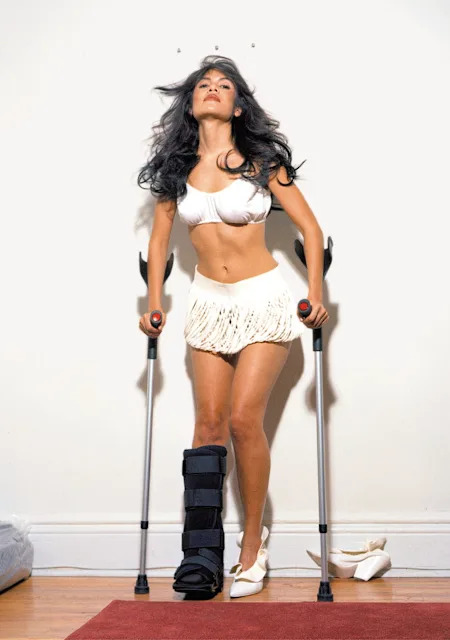
In the book, impromptu photographs with her best friends seamlessly mix together with celebrity portraits commissioned by glossy fashion magazines. Her portraits of Jennifer Lopez, which originally ran in Interviewmagazine, speak to her unique brilliance. Capozzi captures a specific kind of inner power and sexuality, which is an outward symbol of the relentless energy and desire that have driven her to get to the top and stay there for the past three decades.
“It’s not actually always so easy,” Capozzi counters. “They don’t always trust me off-the-bat—it really has to be earned.” Capozzi often works with the stylist Haley Wollens, a combination that can also help them gain the trust of reticent subjects. Here are two women at the top of their respective fields consistently making groundbreaking work—what’s not to trust?
Chloë Sevigny, Edgewater, NJ, 2014Courtesy: Brianna Capozzi
(Courtesy: Brianna Capozzi)
Surprisingly, Capozzi did not originally set out to become a photographer. She attended Parsons, where she enrolled in a program called Integrated Design, which encouraged her to think across disciplines. “I was making one of a kind clothing and after I started shooting [those] clothes, I decided that I was much more interested in the story and the character and less interested in making anything sellable,” she remembers. She took an intro to photography class and later realized that a lifetime spent “on the floor at Barnes & Noble looking through every magazine” had fine-tuned her eye.
“In some ways, I had influences that I knew I loved—in the early days, I was really influenced by David Lynch—and so from a conceptual point, the shoots were there,” Capozzi explains. “For the rest, I didn’t know a lot, so I wasn’t overthinking it. I had this camera, and I was making lights out of hardware store lamps, so they kind of looked the way they looked, and I just figured it out on my own with the tools that I had.”
Her images may convey a spontaneity, but Capozzi explains many of them are “planned to a T,” including Chloë Sevigny‘s famous photo with the lobster. She also took the book as an opportunity to photograph women she’d always wanted to but hadn’t yet had the chance, like Laverne Cox, or women like Addison Rae, whom she had photographed before for a Marc Jacobs campaign, but could now capture in a different light. “I felt like once I had really honed in on the energy of the book, it would be really fun to make specific photos for it,” she explains, adding that the process would also bring her a different kind of freedom as an artist. “The idea is that I don’t have to take so many pictures—I just need two amazing photos, and that’s it.”
Laverne Cox, New York City, 2025Courtesy: Brianna Capozzi
(Courtesy: Brianna Capozzi)
One of the best parts about Womanizer is that Capozzi identifies every single subject in her images, whether friend, model, celebrity, or the year the image was taken. At the end of the book, she even shares a few stories of how some of the photographs came together. “I feel like from the book you can tell that I am a fun, wacky person, and there’s always something crazy happening, and we’re always dying laughing on set,” she says. “I hate writing, but I did love writing these stories.”
Courtesy of Rizzoli
(Courtesy of Rizzoli)
You Might Also Like
‘ The preceding article may include information circulated by third parties ’
‘ Some details of this article were extracted from the following source www.aol.com ’