© Yoko Ono. Photo by and © Clay Perry
“Light a match and watch till it goes out.”
That nine-word imperative comprises one of Yoko Ono’s earliest mature artworks, an “Instruction” typed out on plain paper. Titled Lighting Piece and dated “1955 autumn,” it helped ignite a practice that, for the remainder of the 20th century and well into the 21st, would revolve around the viewer stepping into the role of essential participant in the completion of a work of art.
Before Sol LeWitt abandoned the physical act of making paintings in favor of designing them and letting others handle the brushes, before Tino Sehgal created “Constructed Situations” that exist solely as encounters between spectators and facilitators, before Yayoi Kusama invited people to cover every surface of an all-white room in brightly colored stickers, there was Ono.
Though her art has been overshadowed for more than half a century by her status as a pop-culture icon, the 93-year-old multidisciplinary artist has been the subject of a growing reevaluation in recent years, culminating in a traveling retrospective, Yoko Ono: Music of the Mind, which recently opened at what is likely its last stop, the Broad in Los Angeles, and which explores her lifelong themes of collectivity and connectivity.
To the countless throngs who still hear “Yoko Ono” and think “John Lennon,” the exhibition stands to be a revelation. As Sarah Loyer, curator and exhibitions manager at the Broad, notes of the chronological display, “You don’t encounter John Lennon until about halfway through the show. She did a lot in the decade-plus before they met.”
So much, in fact, that visitors may leave asking not, “Did Yoko Ono break up the Beatles?” but rather, “Did John Lennon stunt Ono’s art practice?”

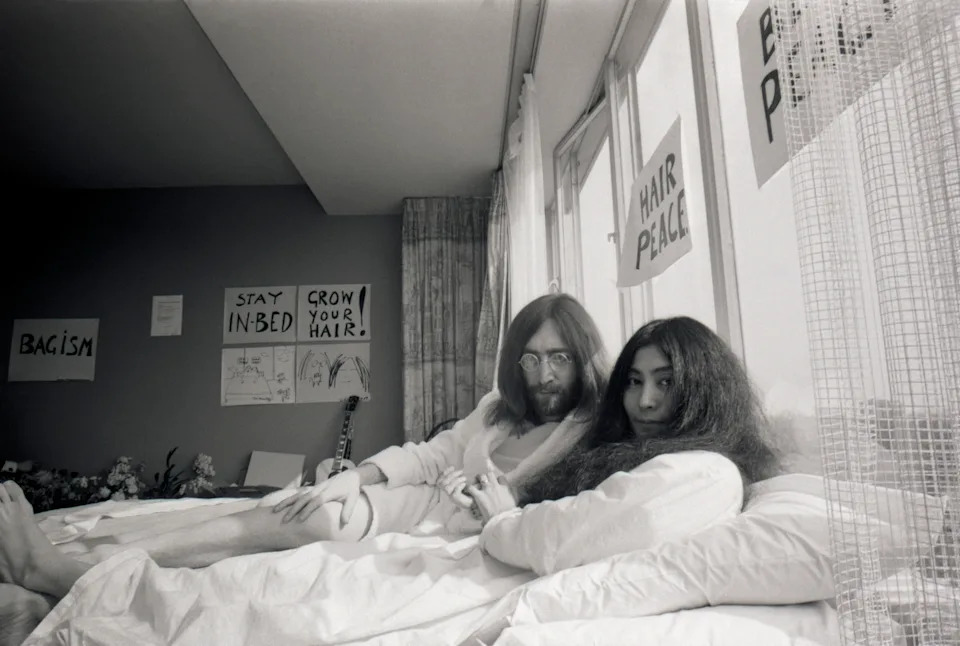
Bed-In at the Amsterdam Hilton Hotel, Netherlands, 1969.
Photograph by Henry Pessar. © Yoko Ono
By the time the couple met—at a 1966 exhibition of her “Instruction Paintings” at Indica Gallery in London—Ono had become a key figure in Fluxus, a movement that sought to blur the lines between disciplines such as music and visual art as well as between art and life. She was fully enmeshed in the avant-garde scenes in both New York and her native Tokyo.
Her “Instruction” works sowed the seeds of conceptual art, and her performance art, such as the famous Cut Piece, would influence generations of feminists. In that 1964 work, Ono sat still on a stage, a pair of scissors beside her, as audience members took turns shearing her clothing. Most snipped small bits from her skirt and sweater, but in one notorious rendition in New York, preserved on film, a man gleefully hacked off the torso portion of her slip, then sliced the straps of her bra, leaving her to draw her arms protectively around her breasts.

Cut Piece, 1964, performed in New Works of Yoko Ono, Carnegie Recital Hall, New York, filmed by David and Albert Maysles, film, 16mm, black and white, and sound (stereo), 8min, 27sec.
© Yoko Ono
“She’s really questioning and inviting a different relationship between the audience and the artist from the very beginning of her practice,” says Loyer. “The audience is not passively observing. They’re active participants, they’re implicated in the work, and the decisions that they make determine where the performance goes.”
The retrospective, which originated at the Tate Modern in London, takes its title from Ono’s To the Wesleyan People (1966), in which she wrote, “The only sound that exists to me is the sound of the mind. My works are only to induce music of the mind in people.”
Ono’s transgressive instincts are evident early on in the exhibition, with Painting to be Stepped On (1960), which, true to its name, is a piece of canvas spread on the floor like a doormat. “That’s a simple engagement—to step on the canvas—but even in that, there’s a radical gesture,” says Loyer. “Typically you’re not supposed to touch [an art object]. This feels a little bit deviant.”
The viewer is also invited to shake hands with a stranger through a hole in one canvas and hammer a nail into another one. A much darker work, produced decades after Lennon’s 1980 murder, features a glass panel punctured by a bullet hole; viewers can stand on either side, taking the point of view of shooter or victim.

Installation view of Painting to Shake Hands in Yoko Ono: Music of the Mind, Gropius Bau, Berlin, Germany, 2025.
Photograph by Luca Girardini. © Gropius Bau
Ono has also made her mark as a peace activist, and her humanitarianism runs throughout her oeuvre. All the game pieces in White Chess Set (1966), for instance, are the same color, leading players to confuse whose are whose—and negating the possibility of war.
Her later works, such as Wish Trees, in which viewers write their hopes on tags and tie them to branches, and My Mommy Is Beautiful, a room where people can affix thoughts about motherhood onto the four walls, might strike some as cloying, but Loyer says the works and museum-goers’ input are more nuanced than one might expect. She also notes Ono’s attendant humor: The ceiling above My Mommy is a grid of breasts and vaginas.

Yoko Ono, Wish Trees for London, 2024 installed in Yoko Ono: Music of the Mind at Tate Modern, London, 2024
© Yoko Ono. Photo © Oliver Cowling, courtesy of Tate
Loyer sees a thread from these works back to Ono’s formative childhood in Tokyo, when she was evacuated to the countryside during the brutal 1945 U.S. bombing campaign. “There’s this shared sense of humanity that’s really powerful,” she says. “It builds over the experience of the exhibition from more playful gestures to these more contemplative ones.”
She points to Helmets (Pieces of Sky), a 2001 installation of German military helmets dangling from the ceiling like buckets and holding puzzle pieces that form pictures of the heavens; viewers are instructed to take a piece. “Of course it’s a metaphor,” Loyer says. “It’s telling us we’re all a piece of this together, we all need to collectively repair the world.”
Originally Appeared on Architectural Digest
More Great Stories From AD
‘ The preceding article may include information circulated by third parties ’
‘ Some details of this article were extracted from the following source www.yahoo.com ’