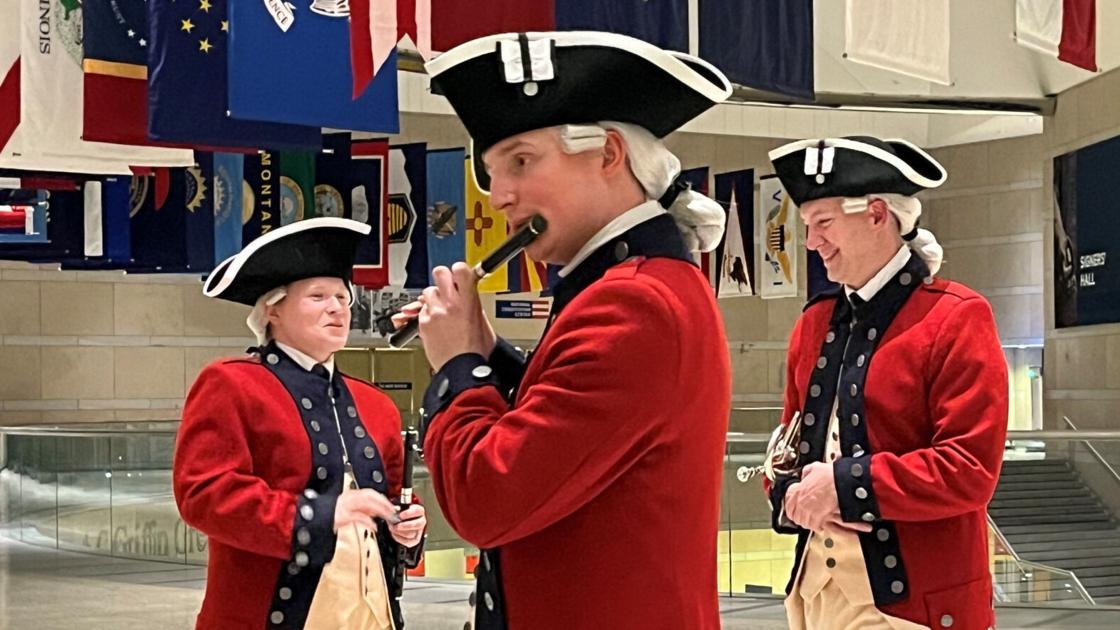
Egner
“The point is, Look at these colonial Americans trying to be cooler than they really know how to be,” Egner said. “That we’re actually a bunch of backwoods, unsophisticated people.”
One story has it that British fifers and drummers, on their way to Lexington in April 1775, taunted the colonists by playing “Yankee Doodle.” Then, during the British retreat to Boston, the colonists counterattacked, sniping at them from behind trees and rocks — and singing “Yankee Doodle” back at them, mockingly, as they scattered.
Americans soon reclaimed “Yankee Doodle” as their marching song.
It got new lyrics, too. Some versions dropped the pony and the macaroni, and substituted a seemlier story: “Father and I went down to camp, Along with Captain Gooding, And there we saw the men and boys, As thick as hasty pudding.”

Staying power
Why did this song weather the test of time?
The Revolutionary War produced lots of other songs. “Chester,” a patriotic anthem by William Billings, was a big hit. So was “The Liberty Tree,” a catchier melody with lyrics by Thomas Paine that the Disney studios tried (and failed) to repopularize in the 1957 film “Johnny Tremain.”
“Yankee Doodle” survived, indelibly linked with the war in people’s minds. People still play it, whistle it, parody it. They quote it in other songs — most memorably, in George M. Cohan’s “Yankee Doodle Dandy.” In 1978, it became the state song of Connecticut.
The most trite explanation is the most likely: It’s catchy.
“It’s an easy song, and everyone knew it,” Cionek said. “People value melody, whether it’s in a video game or a movie score or whatever. And ‘Yankee Doodle’ is definitely an earworm.”
‘ The preceding article may include information circulated by third parties ’
‘ Some details of this article were extracted from the following source tucson.com ’