By Louise Adler – a former director of Adelaide Writers’ Week
It should go without saying but in case there is any doubt, the atrocity on Bondi beach should appal all of us, whether we are Jewish or not. Those who lost their lives and their loved ones deserve our collective empathy and it is only right and proper that their suffering has been comprehensively acknowledged.
Unfortunately, the Royal Commission on Antisemitism and Social Cohesion, far from addressing the complex political and historical context of the Bondi tragedy, is only reinforcing an exclusionary discourse – a precondition for conflict.
The Commission is tasked with investigating the nature and prevalence of antisemitism. Over 16,000 submissions have been received in the first block of hearings devoted to the lived experience of antisemitism and most will have been scripted by the lobby’s full-time ‘project officers’. It is disappointing, but unsurprising, that the Commission has not probed these testimonies. Who wants to suggest a witness might be ideologically motivated or prone to exaggeration or self-dramatisation? If the Commission is to have any credibility beyond acting as a sop to tireless lobbyists, rigorous scrutiny should be applied to the testimonies.
If we are to accept that a Royal Commission is an appropriate site for the narration of ‘lived experience’, and that ‘lived experience’ has some evidentiary value, the questions of whose lived experience is deemed relevant and to what ideological ends demands critical consideration. Instead, the conceptual ambiguity of this category ‘lived experience’ means that claims that are often tendentious are rendered irrefutable.
The Commission has given equal weight to actual events and feelings. Feelings and anxieties are established as reality. Many witnesses testify, often unwittingly, to this self-fulfilling operation. Take, for example, the testimony of “Dina”, a witness reluctant to be identified by name but happy to appear on livestream and give press interviews: “right now, the Australian Jewish community is living a very different reality to what I think the rest of the Australian community is living”. What is the role of the Royal Commission in reconciling Dina’s reality with that of “the rest of the Australian community”?
A random selection of examples sheds light on the problem. Ms Pinsky says “the actual data does not support that Palestine is the worst humanitarian crisis today in the world” and that, far from targeting Palestinian children, the IDF is an army made up of Israelis who want “to support their country to defend against terror, which Israel is afflicted with and must defend against”. Elsewhere Ms Pinsky admits, “I’m not very good at history”.
Then there is the witness who is cruelly exposed to news reports of starvation in Gaza during her “30 second” lift ride in her office building, and who has to suffer the indignity of seeing the Palestinian flag and hearing artists say “free Palestine” at cultural events – all of which she describes as “very tiring”. The obscene contrast, though it barely needs stating, is the ‘tiring’ reality to which these flags and slogans gesture: the fatigue, for example, of a parent living in a tent for three years in Gaza, who spends their days trying to find the most basic provisions and lies vigilantly awake at night to stop the rats from biting their children.
Another witness speaking of the Bondi attack says: “the reality is that they came to kill us. We just weren’t there.” Not being there is a recurrent theme: a child who had to be taken to hospital could have been treated differently for being a Jew but wasn’t (“It was a different hospital, and she received the correct treatment and everything was fine”). A child on a school excursion who could have been exposed to antisemitic abuse wasn’t (“So my children didn’t experience anything, but…”). In many testimonies paranoia abounds.
A prospective patient in a NSW hospital, who describes an intensifying anxiety that she would be mistreated if her Jewish identity was revealed (“I spent probably the worst 24 hours of my life imagining all the ways I could be killed legitimately in a hospital”), insists that despite ultimately receiving “extremely professional” care, her trust in the healthcare system remains broken. One witness who went to the Opera House on October 9 2023 to show her solidarity with Israel describes having to leave shortly after arriving because of an “ominous sort of feeling”.
Another witness describes being on a bus when a news item detailing Israel’s depredations in Gaza was audible, a fact which she says “felt very deliberate”. These cases of unlived experience certainly testify to a heightened atmosphere, but what do these fantasies, phobias and anxieties tell us about actually existing antisemitism? While we must take seriously accounts of actual antisemitic attacks detailed by some witnesses – and acknowledge the increased prevalence of a casual antisemitism that has always pervaded Australian society – for the most part these hearings have been an opportunity to ventilate anxiety about antisemitism rather than instances of it.
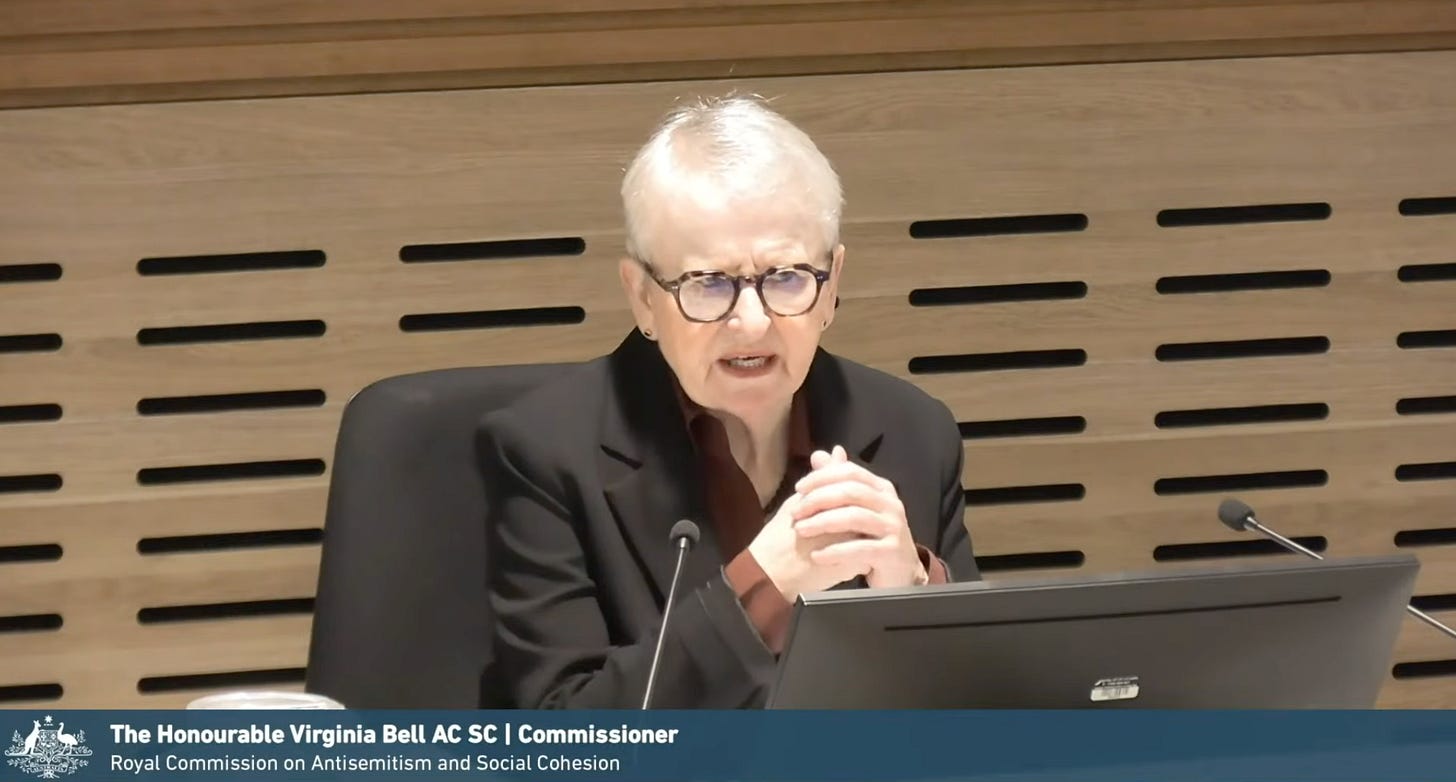
Disturbingly, misleading claims that go uncontested do not issue exclusively from the testimony of witnesses; they are also expressed in the posture and assumptions of their interlocutors. Take, for example, Justice Virginia Bell’s description of the October 7 attack as a “Hamas invasion” – a characterisation scandalous both because of its ahistorical and ideological implications and because of the casual manner of its assertion, i.e. as an aside and thus entirely self-evident. In two words, Bell recasts this story of dispossession and ethnic cleansing and in so doing attests to the denial of return – Israel’s enduring crime. Palestinians become invaders; Israel’s Jewish population become innocent victims of antisemitism, that most ancient of hatreds.
Common to almost all accounts is an experience of rupture between pre-October 7 Australia – a “safe” idyll, a “successful multicultural society where everyone felt very well integrated” and the post October 7 “reality” (one wonders what First Nations Australians or indeed Arab and Muslim Australians make of this apparently universal “great sense of safety and freedom”). Excluded, are those who threaten this amicable consensus, particularly the Palestinian organisations who have been consistently demonised as antisemitic but who have been deemed to have no “direct and substantial interest” in the matter.
Witnesses including Jewish university students, healthcare workers, musicians, describe their experiences of exclusion as a kind of unfathomable discrimination. But as these testimonies unfold what becomes clear is that these are not disinterested parties: they all assert what they call the right of Israel to exist and affirm their fealty as committed Zionists.
A teacher describes with missionary zeal his commitment to “ideally, in an ideal world, completely stamping out antisemitism and anti-Zionism”. Another, a student who describes being persecuted and excluded by housemates for being Jewish, turns out to also have been the co-president of the Australasian Union of Jewish Students (AUJS). A nurse who describes being “targeted” at work as being a Zionist – an accusation she finds discriminatory and offensive (“we are expected to be apolitical, impartial…I don’t ask other employees what their political or personal opinions are”) – elsewhere reveals she displays posters of Israeli hostages, captioned “bring them home” on her desk and wears the words “my heart remains captive in Gaza” on a necklace.
These are individuals engaged in a political project, the violent implications of which they need to neutralise. Unfortunately, being labelled a “genocide supporter” – an understandably harrowing experience recounted by so many witnesses – is the cost of supporting genocide.
Indeed, the attempt to disavow the political content of their ideological commitment is common to most accounts: witnesses testify to allegiance to the Zionist project, their deep and abiding connection to Israel whilst, at the same time, deeming it “unfair” and “antisemitic” when “targeted” as being identified with the Jewish ethnostate.
Take Vic Alhadeff, who told the Commission:
“The person on the other side of the table said to me quote, ‘But look what is happening to the Palestinians in Gaza’. My response was, ‘You have to be made of stone not to care about what is happening to the Palestinians in Gaza. However, why are you holding me responsible?’ And this issue goes to one of the issues which is informing a lot of the antisemitism which has been rocking this country, if I use that term, for the last two and a half years: holding Jewish Australians accountable for what is taking place on the other side of the world. Jewish Australians have no agency in what the Israel Defence Force does or indeed what the Israeli government does, and yet so many, so much of the manifestation of antisemitic incidents and attacks is interlaced with and references what is taking place on the other side of the world. We are not accountable and we are not responsible.”
A significant repudiation from Mr Alhadeff who once offered, in explaining his own trajectory, an early formative school experience following the outbreak of the Six Day War, when he “became the de facto spokesperson for Israel and for 12 million Jewish people”. “I draw a dotted-line”, he said, “from that memorable experience … to my subsequent careers as editor of The AJN and … CEO of the NSW Jewish Board of Deputies.” This once self-appointed spokesperson for Israel is now offended that he might be held responsible for the its action? The Jewish “homeland”, to which Alhadeff has professed such profound connection, is now considered to be remote and irrelevant to Australian Jews, “a place on the other side of the world”? Is the man who, whilst Chair of the NSW Community Relations Commission told members of the Australian Jewish community that Israel will “do whatever is needed to defend its citizens”, now suggesting he’s neither responsible nor accountable? Is the man who once said, “I hold to Elie Wiesel’s dictum that we must always take sides”, now pleading impartiality, insisting that what’s going on in Israel has nothing to do with him? Is the man who once said regarding Israeli retribution “all options are on the table” now, over 70,000 Palestinian lives later, pleading innocence?
Given the Jewish leadership insists it is axiomatic that criticism of Israel is antisemitic, it is unsurprising that diaspora Jews should be held responsible for Israel’s conduct. The insistence that antisemitism is exceptional, rather than a specific form of the racism that pervades our society more broadly, is not in the interests of the Jewish community and can only foster antisemitism. If the Royal Commission is serious about investigating the nature of antisemitism and its “key drivers”, it should begin with Australia’s Israel lobby – the leading proponents of the conflation of antisemitism with antizionism. If Bondi teaches us anything, it’s that Jews (but not only Jews) are greatly imperilled when this distinction is obscured.
Got a tip? Send an email to [email protected] or send an anonymous Signal to @deepcut.25.
‘ The preceding article may include information circulated by third parties ’
‘ Some details of this article were extracted from the following source www.deepcutnews.com ’