Nostalgia isn’t an Ojai virtue, however, and younger composers kept things current. Messiaen’s nature-consciousness found a counterpart in Gabriella Smith’s “Anthozoa,” for violin, cello, piano, and percussion, which evoked the microscopic bustle of coral reefs, with clicks and rustlings giving way to oceanic hymnal chords. Anna Thorvaldsdottir’s “Ró” (“tranquillity,” in Icelandic) unfurled a not dissimilar soundscape of organic tendrils growing from sustained drones. Meanwhile, the pianist Conor Hanick played two new pieces by John Adams, the most boyish of near-octogenarians; one of them, “song without words,” offered a transfixing instance of Adamsian endless melody, at once radiant and bittersweet.
Of the half-dozen Ojai festivals I’ve attended, this one was perhaps the most perfectly executed. The excellence of the programming and music-making testified not only to Salonen’s magnetism but also to the behind-the-scenes dexterity of the veteran arts administrator Ara Guzelimian, who has been associated with Ojai for decades and has led its operations since 2020. The ovation that erupted when Guzelimian walked out to introduce the festival’s closing concert was a fitting acknowledgment that golden-age concerts do not happen by themselves.
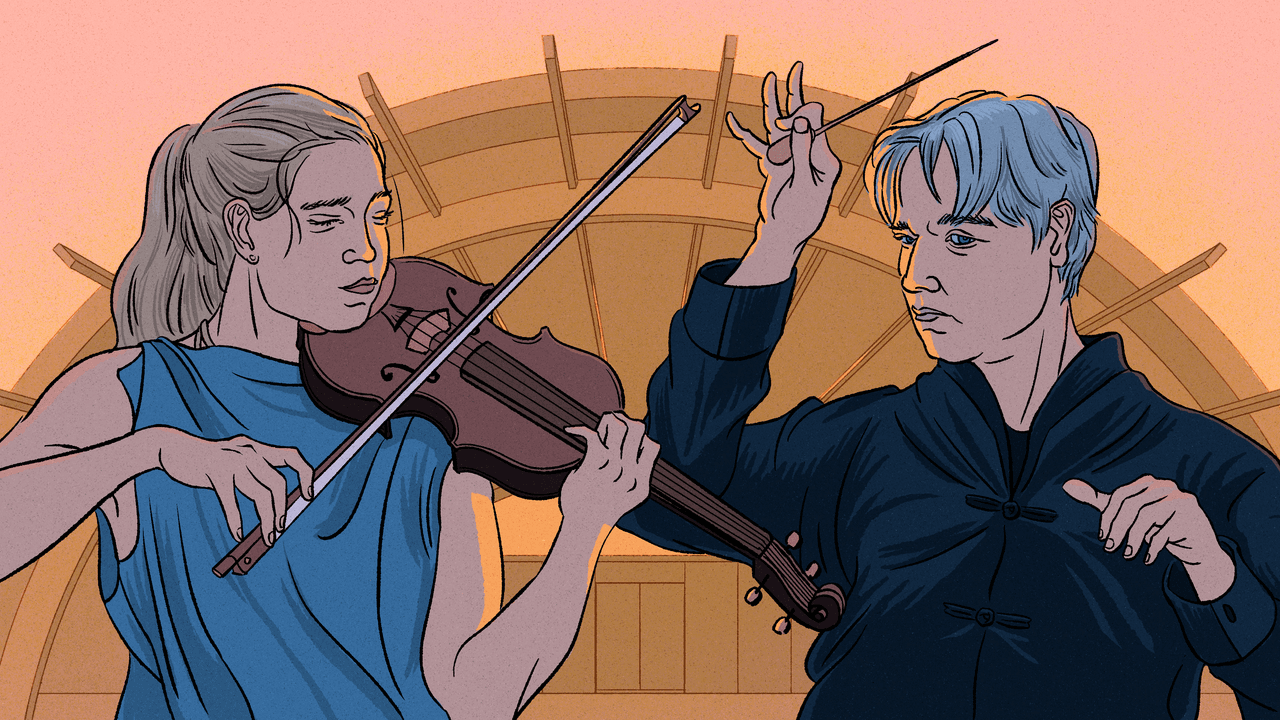
That final concert, featuring the student orchestra of the Colburn School, in L.A., at once exemplified Ojai’s ethos and jolted its laid-back atmosphere. Salonen led a buoyant, mercurial ninetieth-birthday tribute that he wrote for the late Frank O. Gehry, titled “Fog.” He also presented Stravinsky’s ironic-bucolic ballet “Pulcinella,” a bracing prelude to summer. In between came Ligeti’s towering, terrifying Violin Concerto, written between 1989 and 1993. Leila Josefowicz, for whom both Salonen and Adams have written concertos, essayed the solo part for the first time in her career, and she delivered it with such sublime fury that afterward the customarily reserved Salonen did something quite uncharacteristic: he slapped his forehead with his palm and gestured at Josefowicz in happy disbelief.
I had been waiting more than thirty years to hear this concerto done so intensely. In 1993, when I was a neophyte critic, I went to Boston to report on a Ligeti festival at the New England Conservatory. The composer was in attendance, holding forth in lectures and discussions, his arachnid mind spinning webs across music history. At one point, he gave a virtuosic disquisition on motifs of lament, citing Gesualdo, Monteverdi, Bach, Schubert, and Purcell (he sang an excruciating version of “Dido’s Lament”), not to mention flamenco, Roma music, and funeral songs he’d heard in Transylvania as a child. He also discussed the Violin Concerto, which he was still revising. He related the piece to his attempt to develop a new kind of tonality, one that would absorb tradition without becoming trapped by it. He said, “I am in a prison—one wall is the avant-garde, the other wall is the past, and I want to escape.” Only Ligeti could find himself in an Escher-like prison with just two walls.
The concerto is less than half an hour long, yet it contains a universe of possibilities. Folkish ditties dance through fractal textures; standard equal-tempered tuning is juxtaposed with the archaic practice of just intonation; rhythms ricochet against one another; influences of Central African forager music and Indonesian gamelan are audible; the ancient lament resounds. Because of its extreme complexity, the work is seldom programmed, and when it is the realization can fall short of the conception. In 2000, I heard it at Carnegie Hall, with Christian Tetzlaff, Pierre Boulez, and the London Symphony. The notes glittered in place, but the piece came across more as a cerebral design than as a living thing.
Salonen has dug deeper. He esteemed Ligeti from an early age and worked closely with the composer from the nineteen-eighties onward. When the Sony Classical label launched a recorded survey of Ligeti’s music, in the nineties, Salonen was chosen to oversee the project. Alas, Ligeti proved to be an extraordinarily difficult collaborator, his manic perfectionism colliding with practical reality and leading to unpleasant scenes. One day, Salonen received a fax from him that read, “I promise to be relatively nice tomorrow.” Nonetheless, Salonen never stopped admiring the music, and he bore in mind the psychic pressures that weighed on the man himself. Messiaenic serenity was not within Ligeti’s reach. When I spoke with Salonen at Ojai, he told me, “Here was a man who lost almost all of his family in the Holocaust, and then fled from Hungary to Austria in 1956, in the middle of the night, with dogs chasing him at the border. When that is your starting point, it creates a very bleak world view.” What fascinates Salonen now, however, is not the darkness of Ligeti’s art but its aliveness and freshness: “The vitality of a piece like the Violin Concerto reminds me of the ‘Symphonie Fantastique’—it will always surprise you.”
‘ The preceding article may include information circulated by third parties ’
‘ Some details of this article were extracted from the following source www.newyorker.com ’